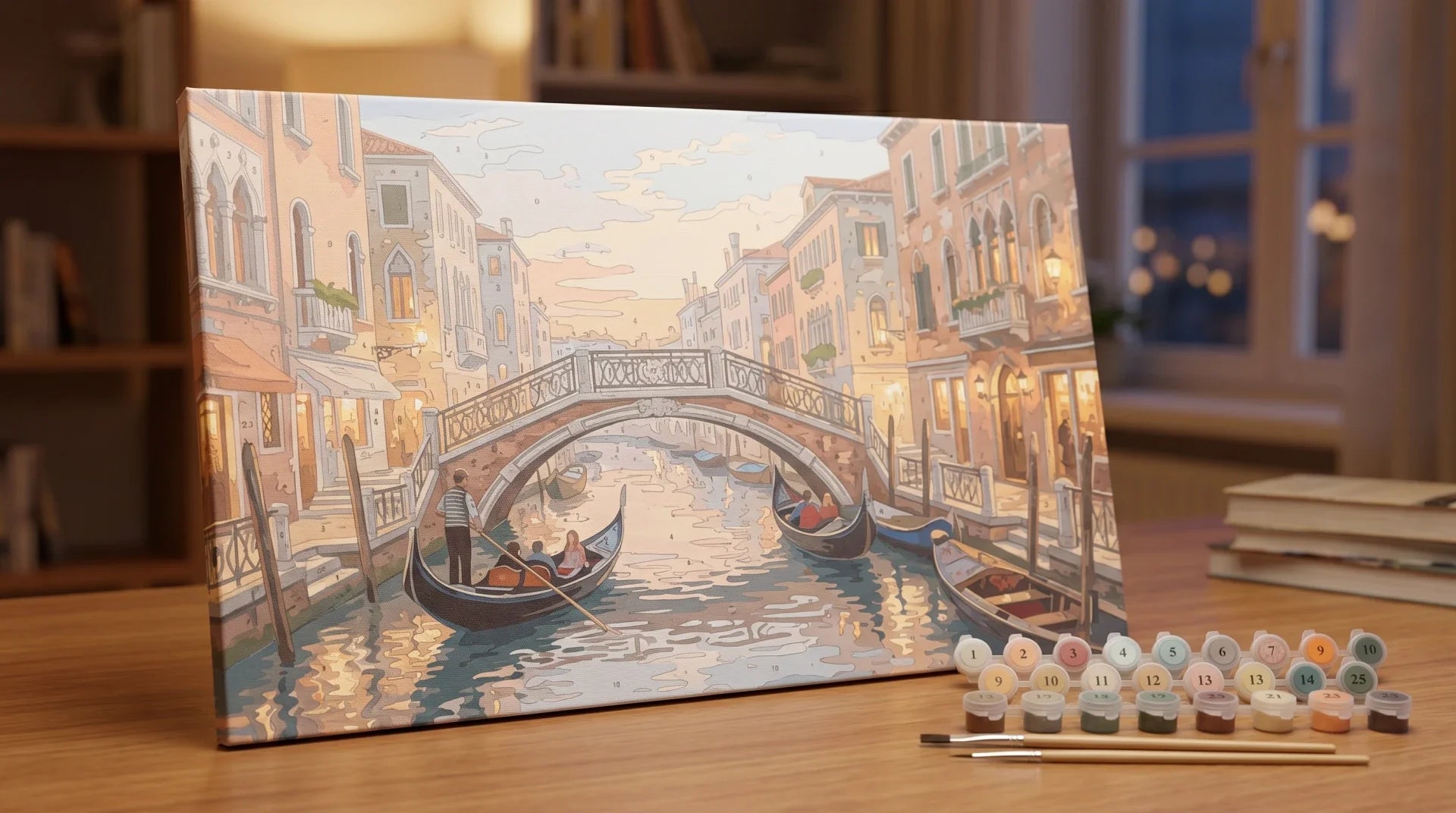
Article: Wedding Gift Ideas: The One Couples Actually Hang on a Wall
Wedding Gift Ideas: The One Couples Actually Hang on a Wall
By Simon I., co-founder, Paint Kit Studio. Published June 7, 2026.
Key takeaways
- Most wedding gift guides recommend registry items: crystal, towels, KitchenAid mixers, knife blocks. Those are useful gifts. They live in cabinets, get used Monday through Friday, and stop signalling that they came from you within about three months.
- The wedding gift the couple actually hangs on a wall is the one nobody on the registry knew to ask for. A custom paint-by-numbers kit of the venue, the bouquet, the church, the cabin, the city hall, or the view from the rehearsal-dinner restaurant.
- The recipients paint it together across the first month of their marriage. The kit takes 20-30 hours of evenings. The hours are when the couple builds the routine of doing something at the kitchen table together that is not dishes.
- The mistake most wedding-givers make is hand-wringing about whether the kit will be "too personal" or "off the registry". Couples who receive a custom kit of their wedding venue almost never describe it as too personal. They describe it as the gift they did not know to ask for.
- The custom kit is $34.95; the stock kits are $29.95. Both ship in about a week. The price is well below the registry-average wedding gift but the longevity is incomparably longer.
Bottom line: the wedding gift that survives the move out of the first apartment, the move into the first house, and the move into whatever comes after that, is the painting hanging on the kitchen wall. Not the mixer.
A customer named Linda ordered a custom kit in March of her daughter Annie's wedding venue. The wedding was held in May at a barn in Hudson Valley with a long meadow behind it and a wooden trellis where the ceremony happened. Linda took a photograph at the rehearsal dinner the night before the wedding, the trellis empty in afternoon light, the meadow gold behind it. The kit arrived at Linda's house ten days later. She wrapped it in plain brown craft paper with a small ribbon and gave it to Annie and her husband David at the post-wedding brunch.
Annie and David moved into their first apartment in Brooklyn that summer. They painted the trellis canvas across August and early September, mostly on Sunday afternoons, with the canvas propped on the small kitchen table they had also bought together. The painting hangs in their kitchen now, above the same table. Linda told me at Christmas that the painting is the one wedding gift Annie and David have mentioned to her unprompted, more than once. The KitchenAid she also gave them has not come up.
Linda's email is most of what I want to tell you about wedding gifts. The good ones survive the moves.
The registry problem nobody talks about
The standard wedding registry is a list of upgrades to the kitchen and the linen closet. The couple registers for it because the registry is a social convention, and they will use most of what arrives, and the items make their life slightly easier. None of this is bad.
What the registry misses is that the gifts arriving from it are interchangeable. Whoever gave the mixer could have given any mixer; whoever gave the towels could have given any towels. The couple's gratitude is real but diffuse. By the second anniversary, the couple cannot reliably remember which specific person gave them which specific registry item. The gifts blend into the household.
A custom paint-by-numbers kit of the venue cannot blend. The painting is a specific, irreproducible artifact of the actual day the wedding happened. The couple will never not know who gave it. They will never not know that the gift was about their wedding, not about a generic upgrade to their kitchen. And, more durably, the act of painting it together in the first month of marriage embeds a small ritual into the relationship that the mixer does not.
The four photographs that turn into the strongest wedding kits
From three years of custom-kit wedding orders, four photographic subjects account for most of what givers send us.
The venue. The barn, the cabin, the courthouse, the church, the meadow, the cliff, the vineyard, the hotel. Any wide shot of where the ceremony or reception happened, taken with reasonable light, becomes a landscape-style canvas that the couple paints across the first few weeks of marriage. Linda's barn-trellis canvas is in this category. The venue is the most-requested wedding custom subject we ship.
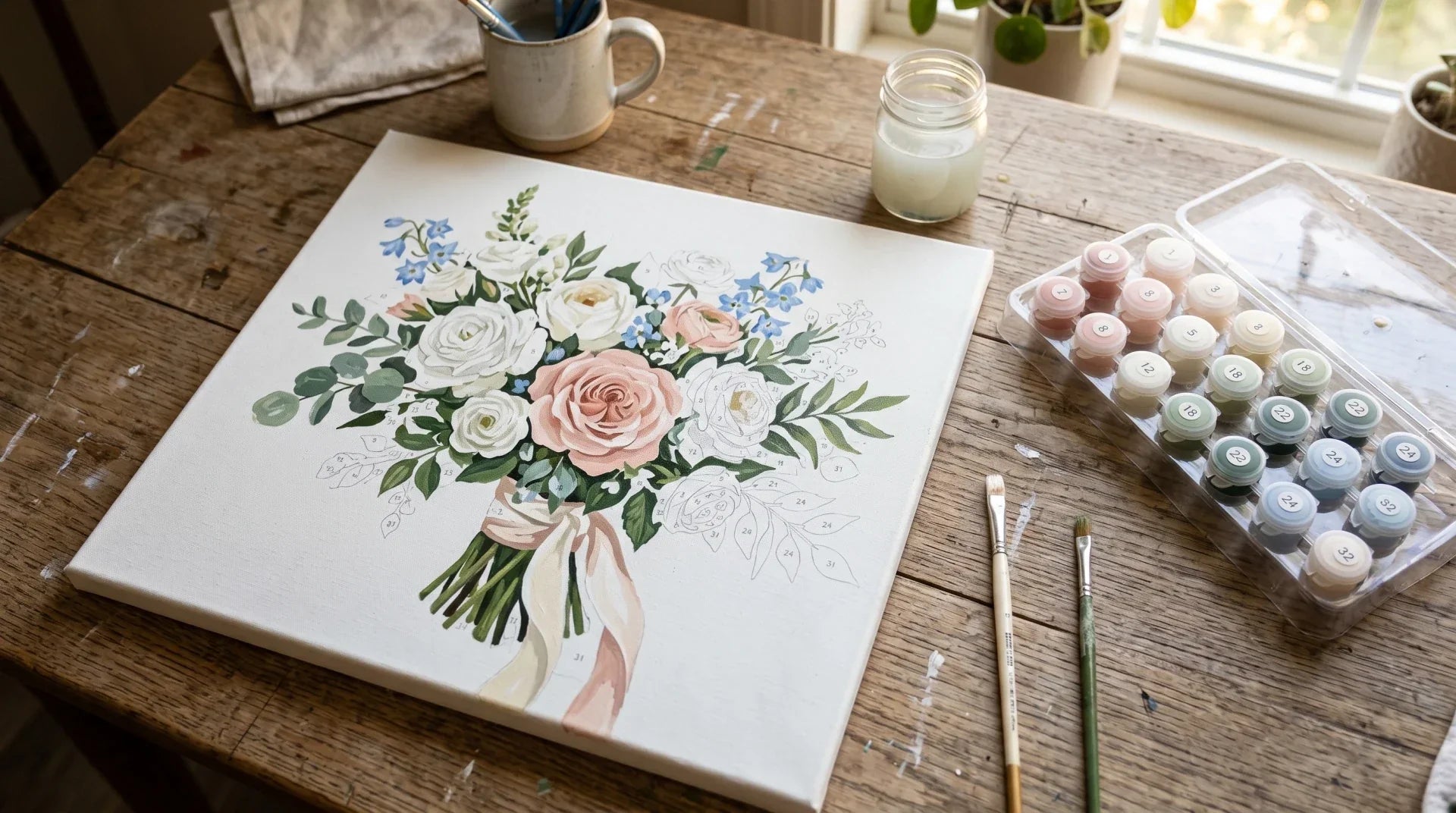
The bouquet. The bride's bouquet photographed shortly after the ceremony, while the flowers are still fresh. This becomes a still-life canvas in the format of our flower-collection kits. The bouquet has the advantage of being a real artifact the couple can hold up to compare against the painting later. We sometimes get a follow-up email asking us to add a specific flower we missed; we usually adjust the canvas and reprint.
The first-dance moment. A photograph from the first dance, usually wider than a close-up so the venue and the band are partially visible. This is harder to convert well because it usually involves the couple themselves, and PBN kits do not handle two adult figures dancing as well as they handle landscapes or still lifes. We do it, but we recommend the venue or the bouquet over the first-dance shot unless the couple specifically asked for it.
The honeymoon view. Less common as a wedding gift, more common as a one-year-anniversary gift. The view from the honeymoon hotel balcony. The beach. The piazza. The cabin in Vermont. This kit lands as a memory of the trip rather than the wedding itself, and works well for couples who took a memorable honeymoon shortly after the ceremony.

Why couples paint it together in the first month of marriage
The first few months of marriage are a quiet logistical scramble. Moving boxes, paperwork, name changes, addressing the thank-you notes, settling into a shared bathroom routine. The honeymoon is over, the wedding is over, and the couple is on the early-marriage flatness that nobody warns them about.
A custom kit of the wedding gives the couple a small repeating evening event during exactly this period. They sit down at the kitchen table at 8 PM on a Tuesday, paint a numbered section of the venue together for an hour, and get up. The next Tuesday they paint another section. Over four or five weeks the canvas gets finished, and during those four or five weeks the couple has built a habit of sitting at the table together in the evening doing something that is not scrolling phones.
The Smithsonian Museum Conservation Institute notes that acrylic paint "dries" by evaporation of solvent of water
and that acrylic emulsion films will always be soft at room temperature
(Smithsonian MCI). The fast drying is what makes shared painting practical. The couple can paint side by side on Tuesday, walk away, return on Saturday, and the canvas is ready for the next pass. Oil paint would interrupt this; watercolour would not survive two painters at the same canvas. Acrylic on a paint-by-numbers kit is the friendliest surface for two beginners working together.
Paint-by-numbers was designed in the 1950s for a different reason. Smithsonian Magazine has written about the kits as a post-war design intervention meant to give office workers a productive evening activity (Smithsonian Magazine, "Paint by Number"). The 1950s use case was a solo painter. The 21st-century version, in our experience, is a couple at a kitchen table during the early months of a marriage. The original mechanism (zones, defined colours, no drawing, fast acrylic) handles the new case unchanged.
If a custom kit is not the right move
A few situations where a stock kit lands better than a custom one.
The wedding has not happened yet. If you are giving the gift before the wedding (at the engagement party, the rehearsal dinner, or the bridal shower), you cannot have a photograph of the venue from the day. In that case a stock floral kit or a landscape kit in a related genre is a stronger pick than guessing at a custom photograph the couple might not love.
The giver does not have a strong photograph. Custom kits work best from a clear, well-lit, high-resolution photograph. If you only have a phone-snapshot of the church at dusk, the kit's line work will not capture the church well. A stock landscape from our mountains and lakes collection or seascape collection in a similar mood is a more reliable gift.
The couple does not yet have wall space. If the couple is moving into a small first apartment, a 40cm × 50cm canvas may be larger than the wall budget can accommodate immediately. A stock kit of any size becomes a useful "paint later" gift the couple can finish when they move into a larger space.
The couple has been together for ten years before the wedding. Long-relationship couples who marry are often less moved by venue paintings (they have many shared artifacts already) and more by a kit that captures something specific to their pre-wedding life: the first apartment, the dog they raised, the city they met in. A custom kit can still do this; the photograph subject just shifts.
Logistics that wedding-givers ask about
Order three weeks before the gift-giving moment. Custom kits take about a week to produce and ship. Two weeks is the minimum; three is comfortable.
If the wedding has not happened yet, plan for after. If you are giving the kit at the engagement party or rehearsal dinner, the photograph you use is probably going to be a pre-wedding photograph (the engagement-session photograph, a photograph of the proposed venue, the bride's bouquet from the bridal shower). Save the wedding-day photographs for a one-year-anniversary kit later.
Include the photograph. Slip the original photograph into the wrapping. The couple sees the connection immediately and the kit makes sense the moment they open the box.
Do not write "Some assembly required" on the card. The kit takes 20-30 hours to finish; that is the gift, not a chore. Frame the card around the experience of painting it together, not around the time it will take.
Plan for framing later. The kit ships unframed. A simple wooden frame from a frame shop or one of the better online frame services finishes the painting after the couple completes it. Expect $40-$80 for a 40cm × 50cm canvas, paid by the couple, not by you. The gift is the painting; framing is the couple's choice.
How to order
The custom kit turns one photograph into a numbered canvas in about a week. Upload one photograph from your phone or a wedding photographer's gallery. The custom kit is $34.95; stock kits are $29.95. Both ship in a flat brown box.
If you would rather pick a stock kit, the flowers collection handles bouquet-style gifts, the paint by numbers for adults collection is curated for first-time adult painters (which most newlywed couples are), and the seascape and mountains and lakes collections handle destination-wedding and honeymoon-photograph adjacent landscapes.

The gift you are giving is not the canvas. The gift is the four or five Sunday afternoons the couple paints together in the first month of marriage, and the painting that hangs in their kitchen for the next forty years.
Browse our complete paint by numbers kits for more designs a couple would love.