Famous Paintings: A Guide to the 12 Most Recognizable Artworks
By Simon I., co-founder, Paint Kit Studio. Published 7 May 2026.
I started keeping a notebook of customer requests three years ago. Whenever someone wrote in asking for a custom paint by numbers kit of a specific famous painting, I logged it. The list was almost the same list every month. Mona Lisa. Starry Night. Hokusai's wave. Sometimes the Scream, sometimes the Vermeer girl. Once in a while a Klimt. The pattern is so consistent it stopped surprising me. People reach for the same dozen paintings, decade after decade.
This article is the long version of that list. I have grouped them roughly by era, kept each painting short, and given you the date, the museum, and the actual reason it became one of the most-recognised images in art. Where we have a deep-dive article on a specific painting, I have linked it. Where you can paint a related design from one of our kits, I have linked that too. The aim is to be the one page you bookmark when you want to remember whether the Birth of Venus is Botticelli or Boucher, or where the Starry Night actually is.
Why are some paintings "famous" and others forgotten?

This is the question I find more interesting than the list itself. A painting becomes famous through a mix of factors that do not include "is good." Theft helps. The Mona Lisa was a quiet curiosity until 1911, when an Italian handyman walked it out of the Louvre under his coat. The two-year manhunt put it on every front page in Europe, and it was a global icon by the time it came home. Scandal helps too: Manet's Olympia was the talk of Paris because the model was clearly a sex worker looking the viewer dead in the eye. So does science. Vermeer's pearl earring went on a global tour of pigment analysis labs, and a generation of paintings got scanned with the kind of attention usually reserved for crime scenes.
Reproductions matter as much as anything. The Great Wave became globally recognisable not because most people stood in front of an original (a relatively small number of first-edition prints survive worldwide) but because it ended up on countless T-shirts, posters, and phone cases. A painting that does not reproduce well stays famous mostly inside its home museum. A painting that reproduces well, even badly, keeps spreading.
The Renaissance heavyweights
Mona Lisa, Leonardo da Vinci, c. 1503 to 1519

You can watch the crowd at the Louvre flow past it like water around a rock. Millions of people view the painting at the Louvre each year, and a 1911 theft is the single biggest reason for its modern fame. Leonardo started it around 1503 in Florence, possibly as a portrait of Lisa Gherardini, the wife of a Florentine silk merchant, and he kept fiddling with it for over a decade. King Francis I of France acquired it after Leonardo's death in 1519, which is why the painting ended up in Paris and not in a Florentine private collection. The famous half-smile is a sfumato effect, a soft transition between tones with no hard edge, and Leonardo invented that technique. The panel is poplar wood, about 77 by 53 centimetres. Smaller than people expect. The room around it does most of the work.
The Last Supper, Leonardo da Vinci, 1495 to 1498

This one is technically not a painting, it is a wall. Leonardo painted it directly on the dining-room wall of the monastery of Santa Maria delle Grazie in Milan, using an experimental tempera-and-oil mix on dry plaster instead of the usual fresco method. The technique failed within decades. The mural has been crumbling and being restored for five centuries. You book a 15-minute slot to see it. Christ has just announced one of the apostles will betray him, and the painting captures the table reaction frozen at the worst possible second. The composition is a textbook in linear perspective, with all sight lines pointing at Christ's head. If you want to make sense of how Renaissance painters thought about space, this is the one painting that explains it without words.
The Creation of Adam, Michelangelo, c. 1512

The famous fingertips-almost-touching panel is one section of the Sistine Chapel ceiling, which Michelangelo painted (lying mostly on his back, on scaffolding) between 1508 and 1512. The chapel is the Pope's private chapel in Vatican City. Millions of visitors pass through every year. The ceiling holds nine narrative scenes from Genesis plus an enormous supporting cast of prophets and sibyls. The Creation of Adam is the one everyone photographs, and it has been parodied so many times that the gap between God's finger and Adam's is now a universal visual joke. The sustained physical and emotional toll on Michelangelo, who hated the project most of the way through, is worth a separate article.
The Birth of Venus, Sandro Botticelli, c. 1485

A standing nude on a giant scallop shell, blown ashore on a wind made of flowers, with a maiden waiting with a robe. The painting was made in Florence for a member of the Medici family, possibly Lorenzo di Pierfrancesco, and it now hangs in the Uffizi. The pose comes from a classical Greek statue type called Venus Pudica, and the painting is one of the first life-sized non-religious nudes in Western art since antiquity. Botticelli painted it on canvas, which was unusual at the time, using egg tempera. The colours are still surprisingly fresh because the medium does not yellow the way oil does. If you walk into the Uffizi and the line is short, this room is the one to head for first.
The Dutch and Flemish years
Girl with a Pearl Earring, Johannes Vermeer, c. 1665

It is small, about 44 by 39 centimetres, and it is not a portrait. It is a tronie, a Dutch 17th-century genre piece showing a "head" of an imagined or anonymous figure dressed up. The sitter's identity has never been established. She might be Vermeer's daughter, a model, or invented entirely. The painting hangs at the Mauritshuis in The Hague, where it has been since the early 20th century (the bequest from collector Arnoldus Andries des Tombe), and it became globally famous after Tracy Chevalier's 1999 novel and the 2003 film that followed. Pigment analysis has shown that Vermeer used natural ultramarine (made from lapis lazuli) for the headscarf, an extravagant choice for the period. The pearl earring itself is two confident strokes of lead-tin yellow on top of a thin grey shadow. There is no jewel underneath. It is paint pretending to be light.
The Asian export that quietly conquered Europe
The Great Wave off Kanagawa, Katsushika Hokusai, c. 1831

A breaking wave, three fishing boats, and Mount Fuji small in the centre. Hokusai's woodblock print is the first in his series Thirty-Six Views of Mount Fuji, and it has been called "possibly the most reproduced image in the history of all art." The Smithsonian's National Museum of Asian Art notes that Hokusai created "an estimated thirty thousand images" over his seven-decade career (Hokusai: A Mad Man Before His Time, Smithsonian National Museum of Asian Art, March 2012, retrieved May 2026). The print is small (about 25 by 37 centimetres), uses a then-new synthetic pigment called Prussian blue, and reached Europe through trade in the late 19th century. It went on to influence Manet, Monet, Whistler, and especially Van Gogh. The Getty Trust describes the print as one whose openness to reinterpretation "is precisely what makes the 'Great Wave' great" (Why the Iconic Great Wave Swept the World, J. Paul Getty Trust, n.d., retrieved May 2026). For the full story see our deep-dive on the Great Wave, or paint your own version with our Great Wave Painting kit.
Impressionism and post-Impressionism
The Starry Night, Vincent van Gogh, June 1889

Van Gogh painted it from the east-facing window of his bedroom at the Saint-Paul-de-Mausole asylum in Saint-Rémy-de-Provence, where he had voluntarily admitted himself after the breakdown that ended his Arles year. The view is real (the village in the foreground, the Alpilles mountains, the cypress) although the village is partly imagined. The sky is not. He painted the swirling clouds and stars from direct observation, with ultramarine and cobalt blue laid down in long curling brushstrokes. The painting has belonged to the Museum of Modern Art in New York since 1941. Van Gogh himself thought it was a failure and wrote so to his brother Theo. He was, as usual, wrong about which of his paintings would last.
Café Terrace at Night, Vincent van Gogh, mid-September 1888

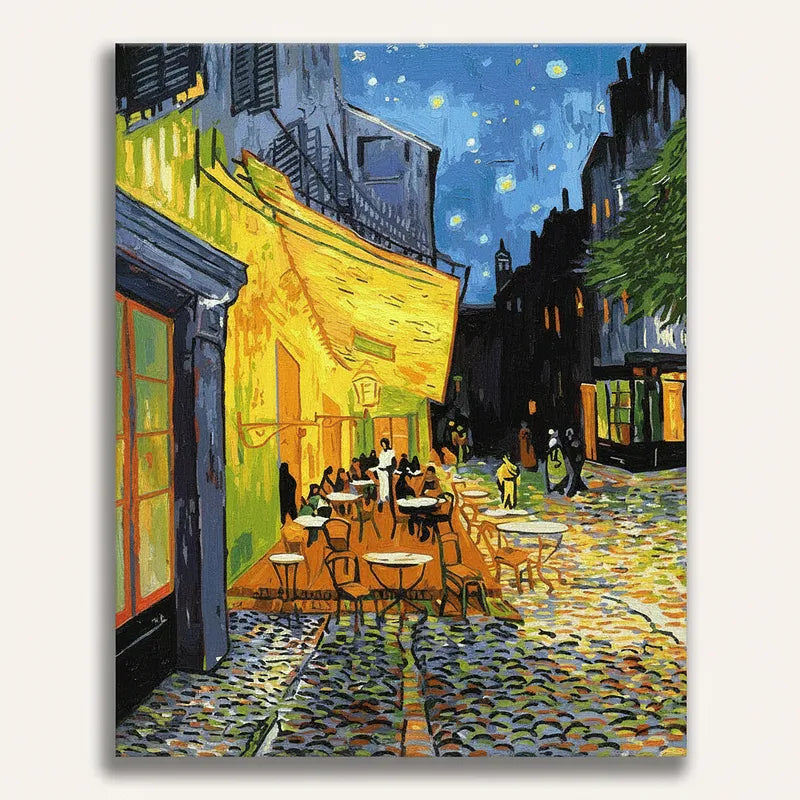
The yellow-against-blue night painting that comes up almost as often as the Starry Night, and the one Van Gogh painted on-site, outdoors, by gas-lamp in Arles. The Van Gogh Museum has dated it to 16 or 17 September 1888 by analysing the position of the stars he painted (Where is Van Gogh's Terrace of a Café at Night?, Van Gogh Museum, n.d., retrieved May 2026). The painting now belongs to the Kröller-Müller Museum in Otterlo, Netherlands. It is unsigned. Van Gogh wrote about painting "night without black" in a letter to his sister Willemien (Van Gogh Letters Project, September 1888, retrieved May 2026). For the full story see our Café Terrace deep-dive.
Water Lilies (Nymphéas), Claude Monet, 1899 to 1926

This is not a single painting, it is a series of about 250 oil paintings made over the last 27 years of Monet's life, almost all of them depicting the lily pond in his garden at Giverny. Some are on conventional rectangular canvases. The most famous (and the ones people post pictures of from museum visits) are the panoramic murals at the Musée de l'Orangerie in Paris, where Monet specifically intended visitors to step inside an oval room and be surrounded by water and reflected sky. He painted the late ones with cataracts in both eyes, and the colour shifts in the late panels are partly because he could no longer see them clearly. The MoMA, the Art Institute of Chicago, the Met, the Tate, and dozens of regional museums all hold individual canvases. Pinning down "the" Water Lilies is impossible by design.
Modernism and the 20th century
The Scream, Edvard Munch, 1893 (with later versions)

Munch made four versions of the image (two paintings, two pastels) plus a lithograph. The figure on the bridge is not, in the painter's own words, screaming: it is hearing "a scream passing through nature." Munch wrote in his diary about the moment he conceived it, walking at sunset with two friends, the sky turning "blood red." He was apparently genuinely upset; the painting is a self-portrait of an anxiety attack. The most famous version is at the National Museum in Oslo. The Munch Museum holds another. Two of the four versions have been stolen from those museums (in 1994 and 2004) and recovered, which is the kind of statistic that does not appear next to other paintings.
The Persistence of Memory, Salvador Dalí, 1931
The melting clocks. Dalí painted it in his late twenties, in a small Spanish village, on a panel about 24 by 33 centimetres. It hangs at the Museum of Modern Art in New York. He claimed the soft watch idea came to him after eating Camembert cheese and watching it run on a hot day, which is either true, a Dalí joke, or both. The painting is a tiny manifesto for Surrealism: photographic clarity in a landscape that does not obey any rule of physics. The cliffs in the background are based on the actual coast of Catalonia near Dalí's home village of Port Lligat. Behind the obvious clock joke is a real lesson about how dream imagery rewards specificity, not vagueness.
American Gothic, Grant Wood, 1930

The Iowa farmer with the pitchfork and his (probably) daughter standing in front of a wooden farmhouse. The models were Grant Wood's sister, Nan, and his dentist, Dr. Byron McKeeby. The house is real and still standing, in Eldon, Iowa, in a small town park you can walk up to. Wood painted it in 1930, and the Art Institute of Chicago bought it for $300 the same year. It has been parodied more times than any other American painting, mostly because the two faces are so blank and so specific that any caption sticks to them. The painting was first read as satire of rural America. As the Depression deepened, audiences started reading it as a celebration of stubborn pioneer endurance. Grant Wood himself never settled the question.
How do these famous paintings translate to paint by numbers?

The honest answer is that some translate well and some do not. Café Terrace at Night, the Starry Night, and Hokusai's Great Wave all reduce to numbered colour zones reasonably well, because the original artists worked in flat areas of strong colour with clear edges. Water Lilies and the Mona Lisa do not, because both depend on incredibly subtle gradations the medium cannot reproduce. A paint-by-numbers Mona Lisa is always going to look like a children's puzzle of a Mona Lisa.
| Painting | Translates to PBN well? | Why |
|---|---|---|
| The Great Wave | Yes | Flat colour areas, strong edges, three or four dominant tones |
| Café Terrace at Night | Yes | Big yellow vs big blue; loose cobblestones reward textured brushwork |
| The Starry Night | Mostly | Sky and cypress translate well; foreground village can flatten |
| The Scream | Mostly | Strong outlined figure, simple background; the swirling sky is the test |
| American Gothic | Yes | Two faces, hard edges, simple palette; almost designed for it |
| Mona Lisa | Poorly | Sfumato gradations are exactly what numbered zones cannot do |
| Water Lilies | Poorly | Whole painting is gradation; no clear zones to number |
| Girl with a Pearl Earring | Mostly | Clean dark background and a face; the earring needs you to keep brushwork loose |
If you want to start painting and the paintings on this list pulled you in, two routes work. You can buy a kit of an existing famous painting (the most direct option is our Great Wave Painting kit, a paint-by-numbers homage to the Hokusai print, with related ocean scenes in our Seascape collection, plus the Cities & Villages collection and Flowers collection), and the painting will give you something to think about every time you sit down at the canvas. Or you can pick a scene of your own (your street at night, your dog, your grandmother's garden) and have us turn it into a custom kit. The custom route is what most of our long-term customers end up doing, because the painting that hangs on your wall ends up being more meaningful than a copy of someone else's masterpiece, even Hokusai's.
Frequently asked questions
What is the most famous painting in the world?
By visitor count and search volume, the Mona Lisa. Millions of people see it at the Louvre every year. By image saturation (number of T-shirts, posters, mugs) Hokusai's Great Wave is probably the leader. By artistic influence on later painters, Las Meninas, Impression, Sunrise, and Picasso's Demoiselles d'Avignon all have credible claims.
Why is the Mona Lisa so famous?
Three reasons stacked: it was painted by Leonardo (who was already a legend by 1500), it was acquired by a French king and ended up in the Louvre (a museum visited by everyone), and it was stolen in 1911 by an employee, which made every front page in Europe for two years. The fame predates and survives the painting itself.
Where can I see Van Gogh's Starry Night in person?
The Museum of Modern Art (MoMA) in New York. It has been there since 1941, acquired through the Lillie P. Bliss Bequest. There is no entry queue specifically for it; you walk to the fifth floor and there it is. The room is usually crowded; the painting is small.
Why is The Scream so famous?
Because of the face. Munch found a visual shorthand for modern anxiety that has no rival. Every cartoon, internet meme, and emoji-style "ahh!" reference traces back to that figure. Plus two of the four versions have been stolen from museums. Theft is its own publicity engine.
Are there famous paintings that are still privately owned?
Yes. The most expensive painting ever sold (Leonardo's Salvator Mundi, sold for $450 million in 2017) is reportedly held in a private collection in the Middle East. Van Gogh's Portrait of Dr. Gachet sold to a Japanese private collector in 1990 for $82.5 million and disappeared from public view for decades. Most of the famous paintings on this article are in public museums precisely because famous paintings tend to end up donated or bequeathed to public institutions over time.
If you want to keep going from here
Two of the most-painted scenes on this list have their own deep dives: The Great Wave off Kanagawa and Café Terrace at Night. If you want to start painting, our main paint by numbers hub walks through what is in our kits and how the difficulty levels work. The Paint by Numbers for Adults page is the right starting point if you are buying for yourself rather than a child. And if you want a quick read about the artists themselves, our companion piece on famous painters covers the people who made these paintings.
Last updated 7 May 2026 by Simon I., co-founder, Paint Kit Studio.