Café Terrace at Night: Van Gogh's 1888 Painting Explained
By Simon I., co-founder, Paint Kit Studio. Published 7 May 2026.
Last winter a customer named Aaron sent me a photo of his finished kit propped on a kitchen table in Brooklyn. He had painted a coffee-shop window scene at night, and in the email he wrote: "I kept thinking about the Van Gogh terrace one. The yellow against the blue. I tried to do that with my coffee shop." It is the kind of email I keep, because it is exactly the thing I am about to write about. A 138-year-old painting still teaches people how to paint at night. The trick is yellow against blue, and Van Gogh worked it out by sitting in a chair on the cobblestones and looking up.
I have been thinking about Café Terrace at Night a lot lately because we keep getting requests for night scenes in the custom kit form. People want their own café, their own street, their own porch with a lantern on. They are reaching for the same effect Van Gogh chased in Arles. So this article is the long version of what I tell them.
What does the painting actually show?
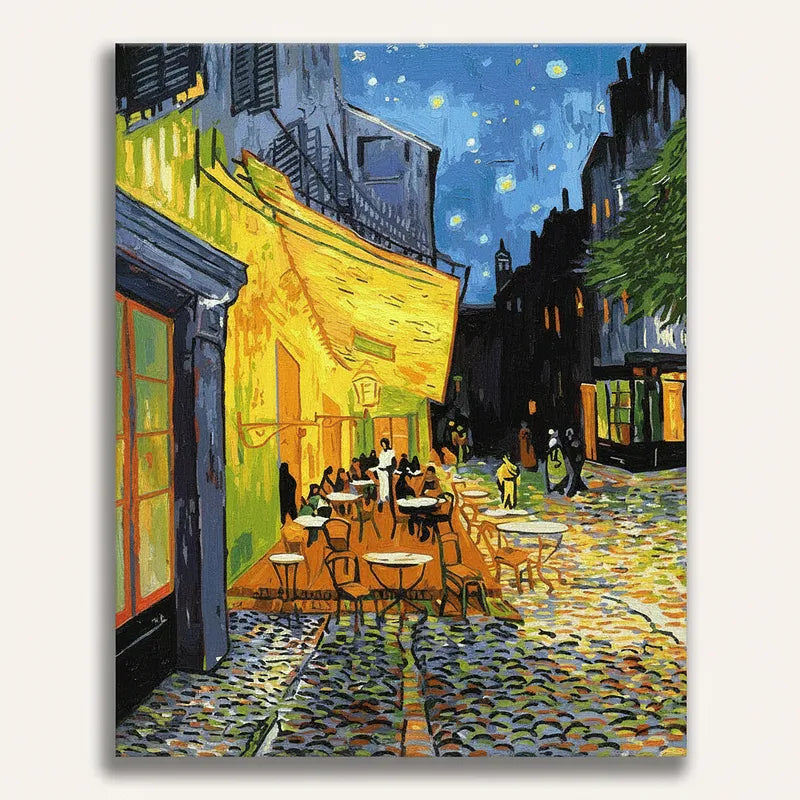
A café terrace at night. The building's front is washed yellow under a single huge gas lantern. Customers sit at tables on the cobblestones, talking, drinking. A waiter or server stands among them. The street curves away into a deep blue alley with a small horse-drawn cart in the distance. Above all of it, a sky stippled with stars.
The setting is real. The café was on the Place du Forum in Arles, in the south of France, where Van Gogh had moved earlier in 1888 chasing what he called the southern light. The site still exists. It has been remodelled and rebranded as "Cafe Van Gogh," which is a tourist trap. The 1888 building is still recognisable in the bones, but the warm yellow light he painted is now a marketing palette.
The Van Gogh Museum confirms the location and the date with a beautifully nerdy piece of detective work. Astronomers compared the star positions Van Gogh painted to historical sky data and pinned the night to 16 or 17 September 1888 (Where is Van Gogh's Terrace of a Café at Night?, Van Gogh Museum, n.d., retrieved May 2026). He painted what he saw, including Ursa Major hanging over the rooftops.
Why does the painting feel so warm, given the absence of black?

This is the part that floors me every time I think about it. There is no black on the canvas. None. Van Gogh worked the entire night scene out of yellows, oranges, blues, violets, and greens. Where you think you see black (the dark windows, the deep alley, the shadow under the awning) you are actually seeing very dark blue or blue-violet, applied next to its complementary colour to read as shadow.
He told his sister Willemien about it in a letter from 9 September 1888, while the canvas was either being planned or in early stages. The Van Gogh Letters Project preserves the exchange. He wrote about painting "the night even more richly coloured than the day, coloured in the most intense violets, blues and greens." He went on: "Now there's a painting of night without black. With nothing but beautiful blue, violet and green" (Letter 678 to Willemien van Gogh, Van Gogh Letters Project, 9 and about 14 September 1888, retrieved May 2026). And the line I find most useful as a painter: "A huge yellow lantern lights the terrace, the façade, the pavement, and even projects light over the cobblestones."
That sentence is essentially the painting in words. Big yellow lantern. Light flooding the terrace and the façade. Light bouncing off the pavement. The entire visual logic of the painting is a single source of warm artificial light pushed against an almost monochromatic blue sky. The contrast does the work that black usually does.
How did he paint it on-site at night?

This is the part everyone asks about. How does anyone paint outdoors at night, with a wet canvas, by gas-lamp? Van Gogh's answer was practical and a little weird. He set up at the edge of the terrace, with a candle or lamp on his hat, and he worked from direct observation.
He had tried this technique a few times that summer. It is the same approach he used for Starry Night Over the Rhône, painted earlier the same month, and similar in spirit to The Starry Night (the famous swirling-sky painting), which came a year later from his asylum room in Saint-Rémy. The Arles night paintings are sometimes called the "yellow-and-blue" paintings, because of how aggressively he leaned on that one colour pair.
The benefit of painting on-site, as he explained to Willemien, was that "candlelight produces the richest yellows and oranges." He felt it gave him access to colours that no daylight studio could replicate, and that "conventional black night with a poor, pallid and whitish light" was a lie. So he painted what he actually saw: warm artificial light against a real night sky, with all the colour saturated up to its limit.
You can see why this took a particular kind of stubbornness. It is hard to mix paint by lamp light. Your colour decisions in the moment look slightly different the next morning. He was doing this while also writing 30-plus pages of letters a week, eating mostly bread and coffee, and starting to come apart at the seams. Café Terrace is from the productive Arles period, before the breakdown later that autumn.
Where is the painting now, and how do I see it?
It belongs to the Kröller-Müller Museum, in a forest in Otterlo, in the Netherlands. Helene Kröller-Müller, a Dutch art collector with very good taste and a lot of money, bought it directly for her private collection in the early 20th century. She and her husband eventually donated their entire holdings to the Dutch state in 1935. The museum holds 91 Van Gogh paintings and 180 drawings, the second-largest collection in the world after the Van Gogh Museum in Amsterdam.
The painting itself is on tour through 2026. It is currently being shown in Japan (Kobe, Fukushima, and Tokyo) and returns to Otterlo for permanent display from September 2026 onward. If you are thinking of making a special trip, double-check with the museum's calendar. Loans for headline paintings sometimes run later than originally announced.
| Detail | Information |
|---|---|
| Title | Terrace of a Café at Night (also: Café Terrace at Night, Place du Forum) |
| Date | c. 16 September 1888 (dated by star positions) |
| Medium | Oil on canvas |
| Dimensions | 80.7 × 65.3 cm (about 32 × 26 inches) |
| Signed? | No |
| Letters referencing it | Three (most prominently Letter 678 to Willemien) |
| Original setting | Café on Place du Forum, Arles, France |
| Current home | Kröller-Müller Museum, Otterlo, Netherlands |
Why is the painting so popular as a paint-by-numbers subject?
I will give you the practical answer. The painting is unusually friendly to the medium. The colour zones are large and clear. The yellows hold their shape under the gas lamp. The blue alley reads as a single area, not a complicated gradient. The figures at the tables can be reduced to clean shapes without losing the scene.
Compare that to something like The Starry Night, where every cypress tree has thirty different greens and the sky is a swirling impasto. Café Terrace is much easier to translate to numbered zones, which is why it shows up on the cover of so many cheap kit boxes. The risk is that a poor reproduction reads as flat, like a children's puzzle. The trick is to keep the brushwork loose where Van Gogh kept it loose, especially in the cobblestones and the spray of stars.
Van Gogh painted the cobblestones with rapid, slightly varied strokes that catch the spilled light. If you are painting our Cities & Villages collection or any nighttime street scene, the move is to break up the pavement with two or three closely related colours, applied with deliberate inconsistency. Single flat fill kills the warmth.
How did Hokusai end up in a French café painting?
This sounds like a stretch and it is not. Van Gogh kept Japanese prints, including ones by Hokusai, on the walls of the yellow house in Arles. He and his brother Theo had collected hundreds of them. He wrote letters comparing his painting practice to Japanese print makers. He believed, by 1888, that the future of European painting was going to come through Japan, not through the academy in Paris.
You can see the influence in the diagonal of the building, the way the alley recedes, the flatness of the colour areas. He is not copying Hokusai. He is using a way of looking at composition that he learned by studying Japanese prints for years. If you have read our piece on Hokusai's Great Wave, you will recognise the same compositional logic underneath, even though the subjects could not be more different.
What can a painter today actually take from this painting?
Three things, in order of practical use.
One: pick a single warm light source. The whole painting hinges on that one yellow lantern. Without it, you have a blue painting. With it, you have a scene. If you are painting any night image, decide where the warm light is coming from before you mix anything.
Two: do not reach for black. Van Gogh's lesson is that "shadow" is not a colour, it is a relationship. Mix a deep blue or a violet next to your warm tone and the eye reads it as dark. The warmer your highlight, the deeper the apparent shadow next to it. This is the same trick that makes a paint by numbers kit work. The kit hands you a pre-mixed deep-blue zone next to a yellow zone, and your eye does the rest.
Three: paint slightly looser than you think. Van Gogh let the cobblestones and the stars do most of the texture work. The figures at the tables are not detailed. The waiter is barely a face. The alley is a single colour area. The painting reads from across the room because the simple things are simple, and the one or two textured things (cobblestones, stars) carry the weight. If you are working a kit, keep your brush relaxed where the painting is loose.
Frequently asked questions
Is Cafe Van Gogh in Arles the actual cafe from the painting?
The building is on the same site, on the Place du Forum, and it has been styled to match the painting in a heavy-handed way. The yellow façade you see in tourist photos today is a modern repaint, not the 1888 wall colour. The interior has been remodelled multiple times.
Why isn't the painting signed?
Van Gogh did not sign every canvas. He often signed only the works he was sending to a dealer or a specific recipient. Café Terrace at Night was painted on-site for himself and the family. He referred to it in three surviving letters but did not put his name on the canvas.
How big is the painting?
About 80.7 by 65.3 centimetres, roughly 32 by 26 inches. It is taller than it is wide, which is unusual for a street scene and helps push the eye up the building façade and into the sky.
Can I see the original up close?
Yes, normally at the Kröller-Müller Museum in Otterlo, in the Netherlands. The painting is currently on tour in Japan and returns from September 2026. The Van Gogh Museum in Amsterdam holds related Arles-period paintings and is the standard pairing trip for serious Van Gogh fans.
What other "yellow and blue" night paintings did Van Gogh make in Arles?
Starry Night Over the Rhône, painted earlier in September 1888, uses the same blue-and-warm-yellow logic with stars reflected on water. The two works are siblings. The Starry Night, the more famous spiral-sky one, was painted later in the asylum at Saint-Rémy and belongs to a different chapter.
If you want to keep going from here
If you found yourself thinking about the Hokusai influence, our Great Wave article covers the print and the trade route by which it reached Van Gogh. If you want to start painting a night scene of your own, the Cities & Villages collection has the cafe-and-street designs that pull from this same visual world, and our main paint by numbers hub walks through what is in our kits and how the difficulty levels work. If you would rather paint your own café (a real one, the corner shop near your house, the place where you got engaged) we offer custom kits that will translate a photo into the same kind of numbered zones, with the same yellow-against-blue logic available in the palette.
You can recreate it from the adults’ paint by numbers collection, where the Van Gogh-style night scenes live.
Last updated 7 May 2026 by Simon I., co-founder, Paint Kit Studio.