What Is Landscape Painting? A 400-Year History from Dutch Masters to Paint by Numbers
By Simon I., co-founder, Paint Kit Studio. Published 2026-05-16.
Key takeaways
- Landscape painting only became a standalone genre around the 17th century. For most of Western art history before that, the view out the window was a backdrop, not the subject.
- The Dutch made the first real break by painting their own country, low horizons and weather and all, without an angel or a saint anywhere in the frame.
- Constable and Turner turned landscape into something emotional. Hudson River School painters like Thomas Cole turned it into a national symbol.
- Impressionism blew the whole thing open by painting the light hitting a haystack instead of the haystack itself.
- Most people who pick up a landscape paint-by-numbers kit today never read any of that history. They just want a quiet hour with a mountain. That counts too.
Greg from Asheville bought our Autumn Lake Reflection kit in late October. He emailed three weeks later with one of those notes I always save. He said the painting was for his father, who had cataract surgery scheduled in November and was nervous about not being able to drive up to the Blue Ridge for fall colours that year. Greg painted it sitting at the kitchen table after his kids were in bed, finished it the night before the surgery, and gave it to his dad in the recovery room. I think about that one a lot when people ask what landscape painting is actually for.
Landscape is the genre most people think of when they think of "real" painting. Mountains. A lake at dawn. Trees with light coming through them. A road that bends out of sight. It feels like it has always been there, the natural subject of any painter holding a brush.
But it wasn't. Not for a long time.
So what counts as a landscape painting anyway?
Loose definition: a painting where the natural world is the main subject. Trees, sky, water, rocks, weather. People might be in the frame, but they are scale figures, not the point. If you covered the human and the painting still works, you are probably looking at a landscape.
This sounds obvious. It wasn't obvious for centuries.
When did artists start painting nature for its own sake?
According to Tate's glossary, "until the seventeenth century landscape was confined to the background of portraits or paintings dealing principally with religious, mythological or historical subjects" (Tate, "Landscape," n.d.). Read that sentence again. Before 1600, if you wanted to paint a Tuscan hillside, you had to put the Madonna in the foreground first. The hillside was decoration.
This had a few causes. Patrons commissioned what they would pay for, and they paid for religious scenes, portraits of themselves, and history paintings showing important moments. There was no market for "here is a field." The Catholic Church was the biggest patron in Europe, and the Church wanted saints. A meadow without a saint in it was nice but unpaid.
The technology mattered too. Oil paint was a fifteenth-century invention. Before that, tempera dried fast and didn't blend the soft atmospheric edges that landscape rewards. Once oil paint got around, painters could fade a treeline into mist or build a sky in layers. The medium and the genre showed up roughly together, but the cultural market took another hundred years to catch up.
Why did the Dutch get there first?
The Netherlands in the 1600s was a strange situation in art history. Protestant reformers had stripped the churches of paintings. The new buyers were merchants, sea captains, brewers, and lawyers, the people running the Dutch trading empire from row houses in Amsterdam and Haarlem. They wanted paintings for their homes, and they wanted paintings of things they already cared about: ships, market scenes, dinner tables, and the flat, brown, cloud-covered country outside the windows.
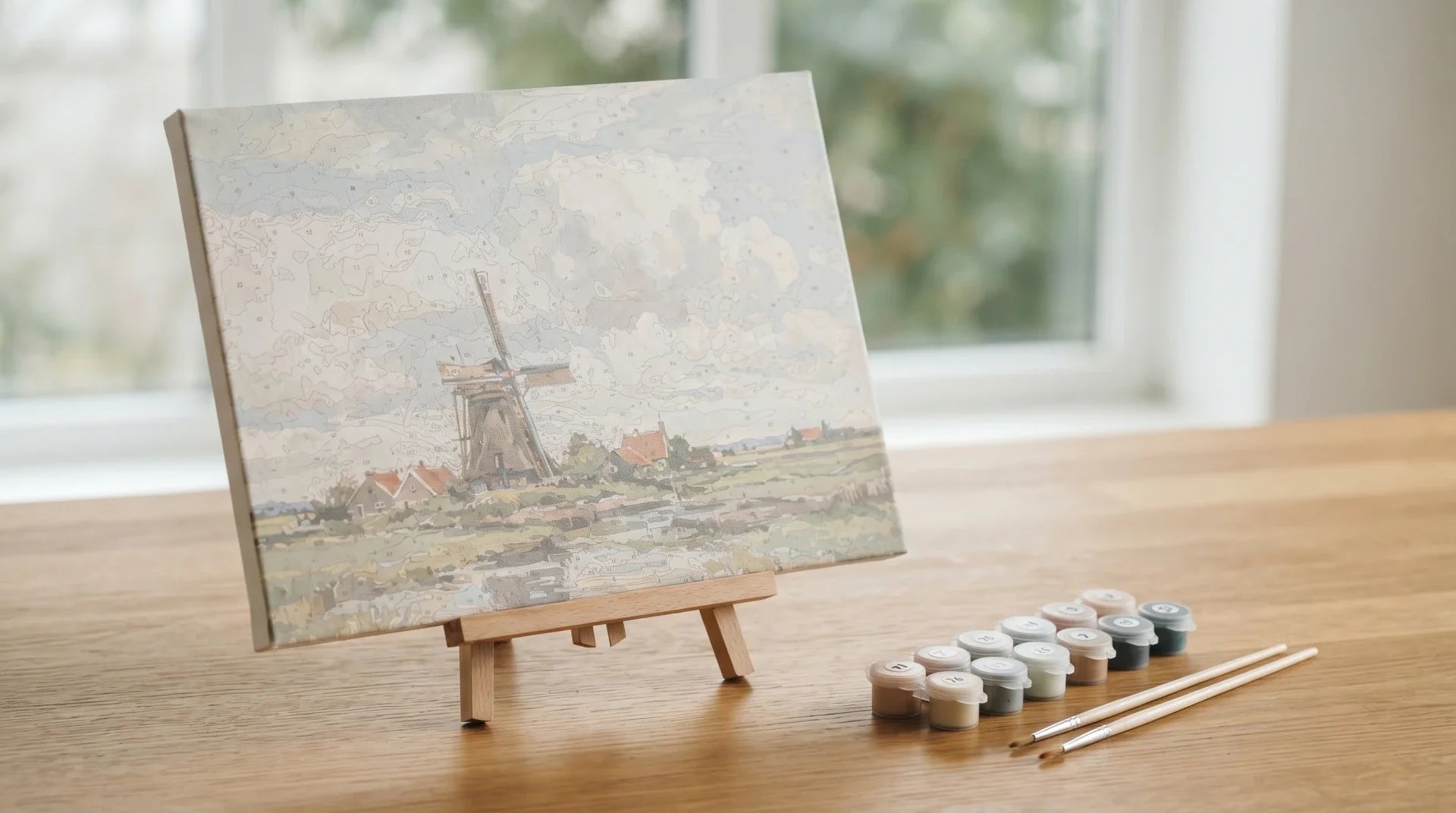
Painters obliged. Tate notes that "Dutch landscape painters such as Jacob van Ruysdael were developing a much more naturalistic form of landscape painting, based on what they saw around them" (Tate, "Landscape," n.d.). Ruysdael painted windmills, dunes, beech trees, and skies that take up two-thirds of the canvas. No story. No moral. Just the country.
If you sail far enough in any direction from Amsterdam you hit water, which is why our seascape kits still look so Dutch in their bones. Low horizon, big sky, working boat. That visual vocabulary was being invented when the Mayflower was still tied up at the dock.

What did Constable and Turner change about landscape painting?
Skip forward to early-1800s England. Tate puts it cleanly: "Britain produced two outstanding contributors to this phenomenon in John Constable and J.M.W. Turner" (Tate, "Landscape," n.d.). Constable painted his home territory in Suffolk with such open affection that you can feel the air on his pictures. Hay carts in shallow streams. Towering English cumulus. Wet trees.
Turner was different. He painted weather. Storms over the sea, sun burning through fog, ships dissolving into atmosphere. By the end of his career the recognisable shapes were almost gone, just colour and light. Painters fifty years later would catch up to where he ended.
Together they shifted what landscape could carry. It could now be quiet love for a specific place (Constable). It could be terror and awe (Turner). It didn't have to be a backdrop anymore. It could be the whole emotional weight of the painting.
Did America's landscape painters do something different?
Yes. They turned landscape into a national identity, which Europe never quite did.
The Hudson River School wasn't a school. It was the loose name for a group of painters working in the 1820s through the 1870s, mostly based in New York, mostly painting the Catskills, Adirondacks, and points further west as the country expanded. The first of them was Thomas Cole, an Englishman who arrived in Philadelphia in 1818 at age seventeen.
The Smithsonian American Art Museum credits him plainly: "Because he was the first American artist to picture the wilderness with the passion of a poet and to capture its spaciousness and grandeur with technical skill, Cole exerted a strong influence on the new direction landscape painting was to take" (Smithsonian American Art Museum, "Thomas Cole," n.d.). Cole roamed the Hudson Valley making sketches of trees and waterfalls, then assembled them into composite scenes in his studio that depicted the look and feel of the wilderness rather than any one literal view.
What came next was bigger. Albert Bierstadt painted vast Sierra Nevada scenes. His Among the Sierra Nevada, California (1868, Smithsonian American Art Museum) measures ten feet wide. Frederic Church painted the Andes and icebergs and tropical storms. The paintings were exhibited like events, with ticketed crowds queuing to see a single canvas. Landscape painting had become spectacle. It was also national propaganda in a quiet way, arguing that the American continent was sacred and worth keeping.
Our mountains and lakes collection sits in that visual lineage whether painters of those kits know it or not. The compositions follow conventions Cole and his followers worked out: foreground rocks for scale, middle-ground water for stillness, distant peaks for the suggestion of more world out there.
How did the Impressionists break landscape painting open?
Tate writes that "in the hands of the impressionists, landscape painting became the vehicle for a revolution in Western painting (modern art) and the traditional hierarchy of the genres collapsed" (Tate, "Landscape," n.d.). The hierarchy used to be: history paintings at the top, then religious, then portrait, then landscape, then still life at the bottom. Landscape was middle of the pack. Within twenty years of Monet putting his first easel in a wheat field, the whole ranking system was gone.
What the Impressionists figured out was simple to describe and hard to do. They painted the light, not the thing. Monet painted his haystacks twenty-five times in different weather and different hours because the hay didn't change but the light on it did, and the light was the painting. Pissarro painted the same boulevard from his hotel window in every season. They worked outdoors, fast, before the sun moved. The technique was called plein air, painting in the open air, and it required portable equipment that hadn't existed a generation earlier.
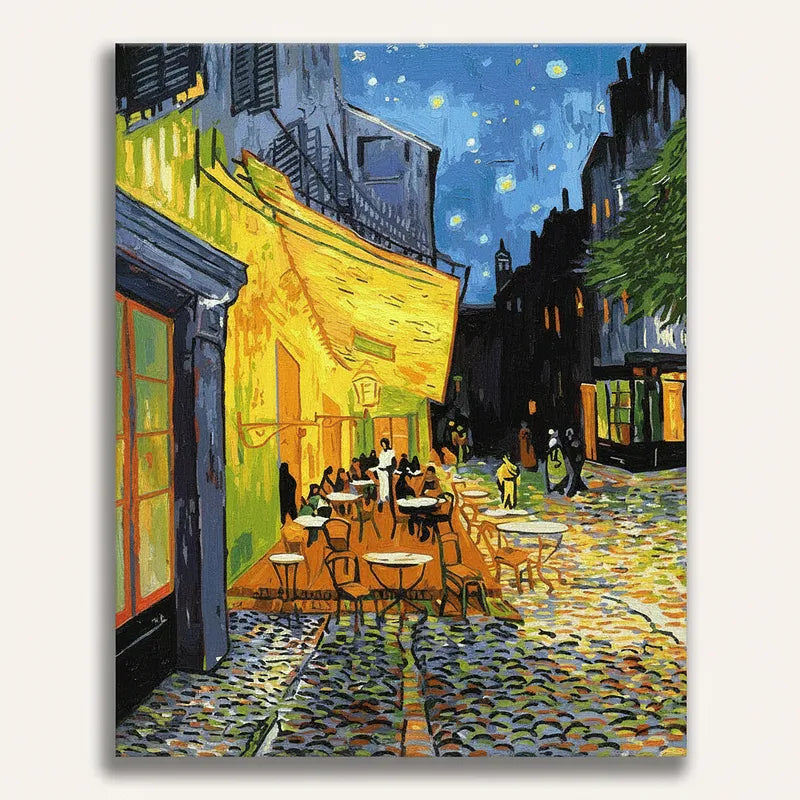
This is where landscape painting essentially became the modern art conversation. Cézanne built whole mountains out of patches of colour. Van Gogh painted cypresses in Saint-Rémy as twisting green flames. Both of them were calling themselves landscape painters when they did it. A century earlier no one ambitious would have admitted that.
What makes a landscape painting feel like a place?
I get this question from new painters all the time. They finish a kit and it looks fine, but it doesn't feel like the place. Some of the trick is technical. Some of it is older than that.
Atmospheric perspective is the technical part. Distant things lose contrast and shift slightly cooler and bluer because there is more air between you and them. Mountains seventeen miles away aren't dark green. They are grey-blue and almost transparent. If you paint them at the same intensity as the foreground pine, the painting flattens. The Dutch worked this out by observation. The Impressionists used it more aggressively.

The older part is what you choose to put in the foreground. Cole's wilderness scenes almost always have a broken tree somewhere in the lower third, a snag with one branch left. It anchors the eye, gives the rest of the painting a sense of scale, and quietly suggests time. The land is old. Trees fall. The mountain is still there. Look at any Hudson River School canvas and you will find one of those broken trees, or the rock standing in for it.
| Landscape tradition | Roughly | What it cares about | Compositional signature |
|---|---|---|---|
| Dutch Golden Age | 1600s | Specific Dutch country, weather, daily life | Low horizon, big sky, working boat or windmill |
| English Romantic | 1800-1850 | Emotion, atmosphere, place as feeling | Soft trees, dramatic clouds, dissolved light (Turner) |
| Hudson River School | 1820-1870 | America as wilderness, national identity | Foreground broken tree, middle water, distant peak |
| Impressionist | 1860-1900 | Light hitting the subject, not the subject itself | Small visible strokes, no black, plein-air freshness |
Where does paint by numbers fit in this lineage?
It fits, even if no one in 1955 thought of it that way. The original Craft Master kits sold by the millions starting in 1951 were marketed as a relaxing pastime, not a serious art form. The early compositions Dan Robbins designed were mainly landscapes: barns, harbours, mountain scenes, country roads. He picked landscapes for the same reason Dutch buyers did three hundred years earlier. They were friendly subjects that hung well in a living room and didn't argue with anyone's decor.
Today our most-painted kits are still landscapes. Some buyers chase specific places, like the customer last spring who ordered four custom kits from photos she had taken on a road trip through the Tetons. Some buyers chase memory: the dock at the lake where the family used to spend July, the back garden of a house someone grew up in. Painting a landscape, even one from a numbered template, is a slow way of saying I was paying attention here.
The seventeenth-century Dutch were doing the same thing with their windmill paintings. The Hudson River School was doing it on a vastly grander scale with the Catskills. Cole spent weeks roaming and sketching before he ever put a brush to a finished canvas. Most of our customers spend their weeks differently, but I have come to think the impulse is older and more shared than the difference in technique suggests.
Frequently asked questions
What is the difference between a landscape and a seascape?
A seascape is a landscape where the sea is the main subject, often with ships, harbours, or shoreline. The boundary blurs in Dutch painting (where coastline scenes are sometimes called both) and in nineteenth-century English work (Turner painted both). If a painting is mostly water, call it a seascape. If it's mostly land with a strip of distant ocean, it's a coastal landscape. Our seascape kits include both kinds.
Who painted the most famous landscape?
Probably Van Gogh's Starry Night (1889, MoMA), though it's a stretch to call that a landscape in the strict Cole-or-Constable sense. If you mean a painting that is purely about a place with no figures stealing focus, candidates include Constable's The Hay Wain (1821, National Gallery London) and Bierstadt's Among the Sierra Nevada (1868, Smithsonian American Art Museum). Monet's water lily paintings are arguably the most-reproduced landscape series in human history, which counts for something.
Can you call a cityscape a landscape?
Historically no. Cityscape (or veduta in Italian, especially for Venice paintings) was its own sub-genre. Today most museums use "landscape" loosely to include any wide outdoor view, urban or rural. Our cities and urban kits sit at this border, technically cityscapes by the strict definition but absolutely landscape in the everyday sense.
What is plein air painting?
French for "open air." It means painting outdoors, in front of the actual subject, fast enough to capture the light before it moves. Monet and the Impressionists made it famous, but Constable was already doing rapid oil sketches outdoors fifty years earlier. The portable paint tube (invented 1841) made it logistically possible at scale. Today it is still the proper way to learn how light behaves on land, if you have the patience and a folding easel.
Are paint-by-numbers landscapes "real" landscape painting?
Define real. The numbered template removes the composition and drawing decisions that historically defined a landscape painter. What it leaves you with is the part most beginners struggle with anyway: paint handling, edge control, colour mixing as you go, deciding when a passage is finished. Those are real painting skills. Many of our adult customers move on to larger kits and eventually to blank canvas after a year or two of numbered work. The genre stayed the same. The training wheels came off.
If you want to paint a landscape yourself, our paint by numbers kits include dozens of them.
Last updated 2026-05-16. Comments are closed; questions welcome at support@paintkitstudio.com.