What Is Canvas Painting? The 500-Year Story of a Surface That Changed Art
By Simon I., co-founder, Paint Kit Studio. Published 2026-05-17.
Key takeaways
- Canvas painting just means painting on canvas instead of wood, paper, or a wall. Sounds obvious. It wasn't for most of art history.
- Canvas was already used in the late Middle Ages, but it became the dominant Western painting surface in 16th-century Venice because sail-makers were already weaving it next door.
- The shift mattered because canvas is lighter, cheaper to ship, and behaves differently under a loaded brush than a hard wood panel.
- Linen is the traditional artist's canvas. Cotton duck is the modern student-grade alternative. Both need a layer of gesso before paint touches them.
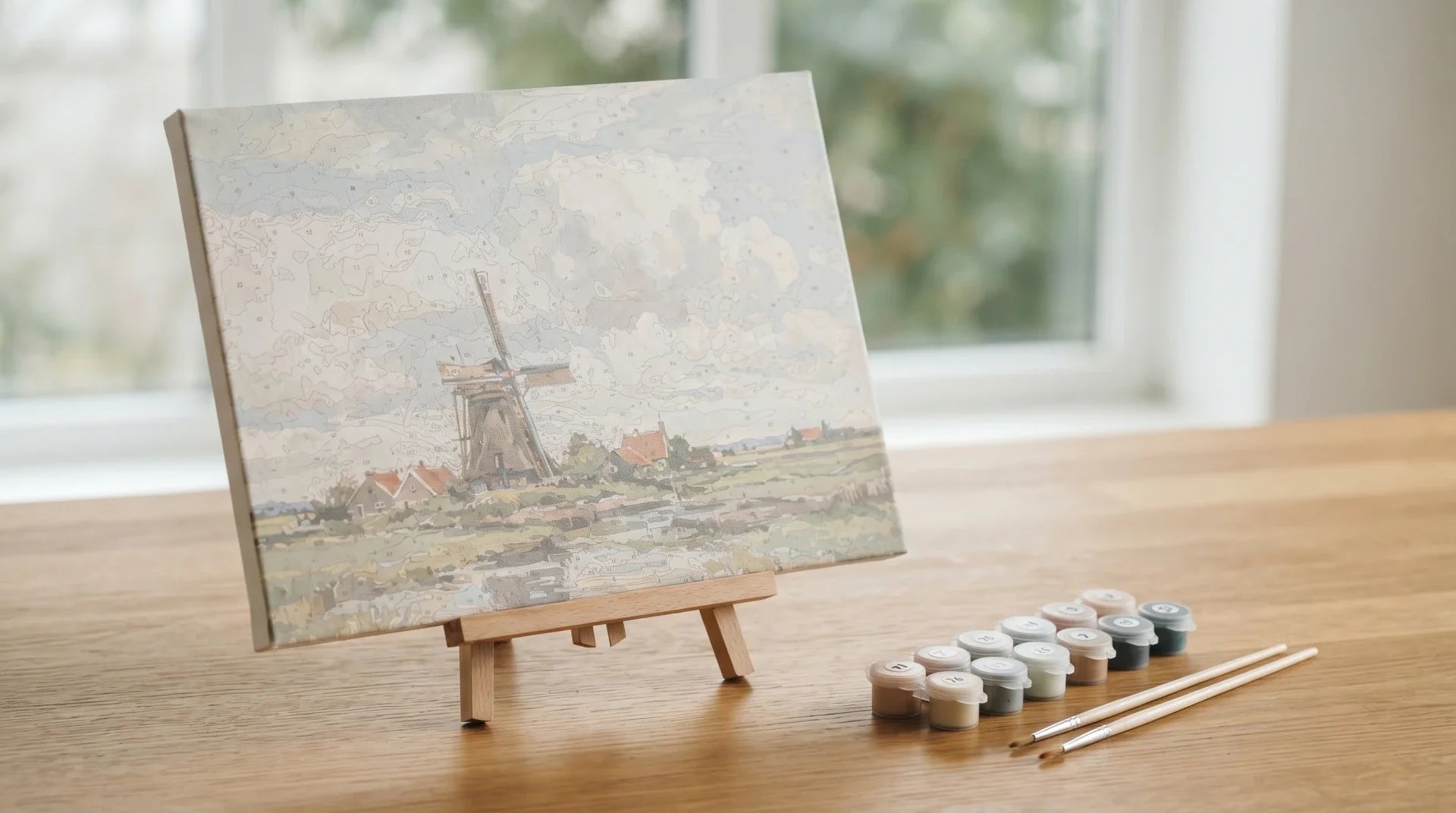
- Paint-by-numbers canvas is real artist's canvas with extra steps. The numbered template is printed on a primed surface that handles acrylic the same way a blank kit would.
Last winter Marisol from San Diego ordered a custom kit of her grandmother's house in Mexico City. After it arrived she sent us a photo of the back of the canvas resting on her kitchen island with a tape measure across it. Sixteen by twenty inches, she wrote, with a note that her grandmother's original 1960s photograph she had uploaded was smaller than that, and she wanted to know whether we had preserved the proportions correctly when re-cutting the print to fit. We had. She noticed because she paints. The back of the canvas, the part most painters never look at, told her what kind of weave she was working with.
I think about that note when people ask why we go on about canvas. The painted side of any canvas is what you see in a museum. The unpainted side is where the actual decisions were made centuries ago, by sail-makers in Venice and by Flemish merchants and eventually by the people stretching cotton over pine stretcher bars in factories in 2026.
So what counts as canvas painting?
The Tate glossary keeps it minimal: "Canvas is a strong, woven cloth traditionally used by artists as a support (surface on which to paint)" (Tate, "Canvas," n.d.). That is the whole definition. A canvas painting is any painting where the substrate is woven cloth rather than wood, board, paper, plaster, glass, or metal.
The cloth part matters. Cloth flexes. Cloth has tooth that holds wet paint differently from a slick panel. Cloth absorbs sound when you tap it. Cloth can be rolled up and shipped across an ocean. None of these qualities were available before painters started working on canvas, and once they did, what painting looked like changed within a generation.
When did artists start painting on canvas?
Earlier than most people think. The Art Newspaper noted in a recent essay on Venetian canvas adoption that "canvas, so strongly associated with the Venice Cinquecento, was actually a very familiar support in the late Middle Ages" (J.S. Marcus, "How the adoption of canvas in Venice changed the way artists painted," The Art Newspaper, 5 May 2026). Banners, processional decorations, theatre backdrops, and modest devotional paintings were being made on cloth long before any Florentine master signed his name on stretched linen.
What changed in the 1500s was prestige. Canvas stopped being the cheap option for transient work and became the surface major painters chose for major paintings. Bellini's pupil Vittore Carpaccio in late-1400s Venice is generally credited as the painter who established it as a serious working surface. By the time Titian was in his prime, canvas was the default. The Art Newspaper essay describes Carpaccio as the painter who "first mastered canvas, in all its intricacies."
Why did canvas beat wood panel in Venice?
Three reasons converged in one city.
First, Venice ran on ships, and ships needed sails. Sail-makers in the Arsenale wove the heaviest, tightest cloth in Europe and sold the offcuts cheaply to anyone with a use for them. Painters were across the canal. The Art Newspaper essay quoted above puts it that canvas was "more suited to the damp Venetian climate than plaster, and cheaper and easier to transport than wood." A wooden altarpiece warps badly in the standing humidity of a lagoon city. Canvas does not.
Second, the local guild structure made transporting big paintings around the islands and out to mainland clients easier on a roll than a plank. A Bellini polyptych made of "13 horizontal poplar planks that had been affixed together by glue and wooden pins" (Sarah Kuta, "Experts Are Carefully Restoring a 15th-Century Masterpiece by Giovanni Bellini," Smithsonian Magazine, 2 April 2026) was a logistical nightmare. A Tintoretto canvas the same height could be rolled, shipped, and re-stretched on arrival.
Third, oil paint and canvas turned out to be a chemistry match. Oil, brushed onto a slightly absorbent primed cloth, dried into the weave instead of sitting on top of it like tempera on a panel. The slight texture of the canvas held visible brushstrokes. By the time Titian was painting in his late style, those visible brushstrokes were no longer mistakes to smooth out. They were the painting. That whole vocabulary of expressive brushwork that runs from Tintoretto through Rembrandt through Van Gogh through Lucian Freud was structurally enabled by the surface the paint was on.
Linen or cotton, does it matter?
Yes, but probably less than online forum arguments make it sound.
Tate notes that canvas is "commonly made of either linen or cotton thread, but also manufactured from man-made materials such as polyester" (Tate, "Canvas," n.d.). Linen comes from flax fibres. The threads are irregular and have a slight tooth, which holds an even film of paint. The fibres also resist stretching over time, which is why painters working for longevity have traditionally reached for linen first. Cotton duck is woven from cotton boll fibres. The threads are more uniform, the surface is smoother, and it is roughly half the price. Most school art classes use cotton.
For practical painting, the difference comes down to thread irregularity. Linen rewards loose, gestural brushwork because the irregular surface itself adds visual interest. Cotton is friendlier to flat, controlled colour work where you do not want the weave intruding. Both will hold paint reliably for a century if properly primed. Our paint-by-numbers kits use a 280gsm cotton-linen blend. The cotton half gives a smooth, even surface that takes acrylic without fighting back. The linen content adds a bit of tooth so the numbered template still reads through thinned washes. The numbered method assumes you are filling areas with clean passes rather than gestural strokes, and the blend is tuned for that kind of work.
What does it mean for a canvas to be primed?
If you paint directly onto raw cloth, the oil or acrylic soaks in unevenly, the fibres rot over time, and the colour you mixed in the palette is not the colour that ends up on the surface. Priming solves all three problems.
Modern priming is a layer of acrylic gesso. Gesso is a white liquid made of chalk, pigment, and acrylic polymer that brushes on, dries hard, and seals the canvas. Pre-primed canvases typically come with two coats already applied. Some painters add another themselves to build a smoother working surface. The result is a slightly bright, slightly toothy white surface ready to take paint. Pre-primed canvas, sold ready-to-go in art stores, is the default for most painters today. Older artists still prime their own when they want a specific tooth or tint.
Historical primers used animal-skin glue topped with a chalk-and-pigment ground. They worked beautifully for centuries on properly stored paintings. They are also the reason older canvases sometimes crack or flake when humidity swings, because animal glue moves with temperature in ways modern acrylic primers do not. This is the fight conservators are still having on Bellini, Caravaggio, and Titian canvases. Every paint-by-numbers kit we ship arrives pre-primed with modern acrylic gesso. The numbered template is printed on top of that ground.

Stretched, panel-mounted, or loose, which is which?
Once you have a primed canvas you have three ways to use it.
| Format | How it's set up | What it's best for |
|---|---|---|
| Stretched canvas | Cloth pulled tight over a wooden frame (stretcher bars) and stapled at the back | Most finished paintings. Hangs ready. The default for studio + gallery work. |
| Canvas panel | Cloth glued onto a flat board (MDF or hardboard) | Practice work, plein air sketching, school art classes. Cheaper and sturdier in transit. |
| Rolled canvas | Cloth shipped flat-rolled, you stretch it after | Long-distance shipping. Custom large formats. What we ship in our larger kits to keep shipping reasonable. |
For paint-by-numbers, the default is stretched. Our standard kits ship on pre-stretched cotton over pine stretcher bars, ready to paint and hang. Larger custom sizes ship rolled with stretcher bars in a separate flat pack, because a stretched 24-by-32-inch canvas does not fit in any sensible shipping carton.

What paints work on canvas?
Oil, acrylic, and watercolour can all be used on properly primed canvas. They behave very differently.
Oil paint is the historical canvas paint. It dries slow, blends wet-into-wet, holds visible texture, and has been the medium of every Old Master from Titian through Sargent. The downside is the much slower dry time compared with acrylic and the solvents needed for clean-up.
Acrylic paint is the modern compromise. It dries quickly, cleans up with water, holds bright colour, and now matches the lightfastness of professional oil paint. Most contemporary painters work in acrylic. All paint-by-numbers kits use acrylic because the fast-dry behaviour is what makes the numbered method possible. You can paint section 14 in cobalt blue, give it a short pause, then paint section 15 in white right next to it without the blue bleeding.
Watercolour technically works on canvas but is fussy, because watercolour relies on the paper absorbing pigment evenly and primed canvas does not. Watercolour-prepared canvas exists for the painters who really want it. Most do not.
For finishing, the layer that sits on top of the dried acrylic surface protects from dust and UV. A clear gloss medium or varnish brushed on adds a uniform sheen and seals the surface. Our acrylic gloss gel medium is the one we recommend for kit work; the gel-medium guide we published last week walks through application.
Where does paint by numbers fit in canvas painting?
Honestly, squarely in the middle.
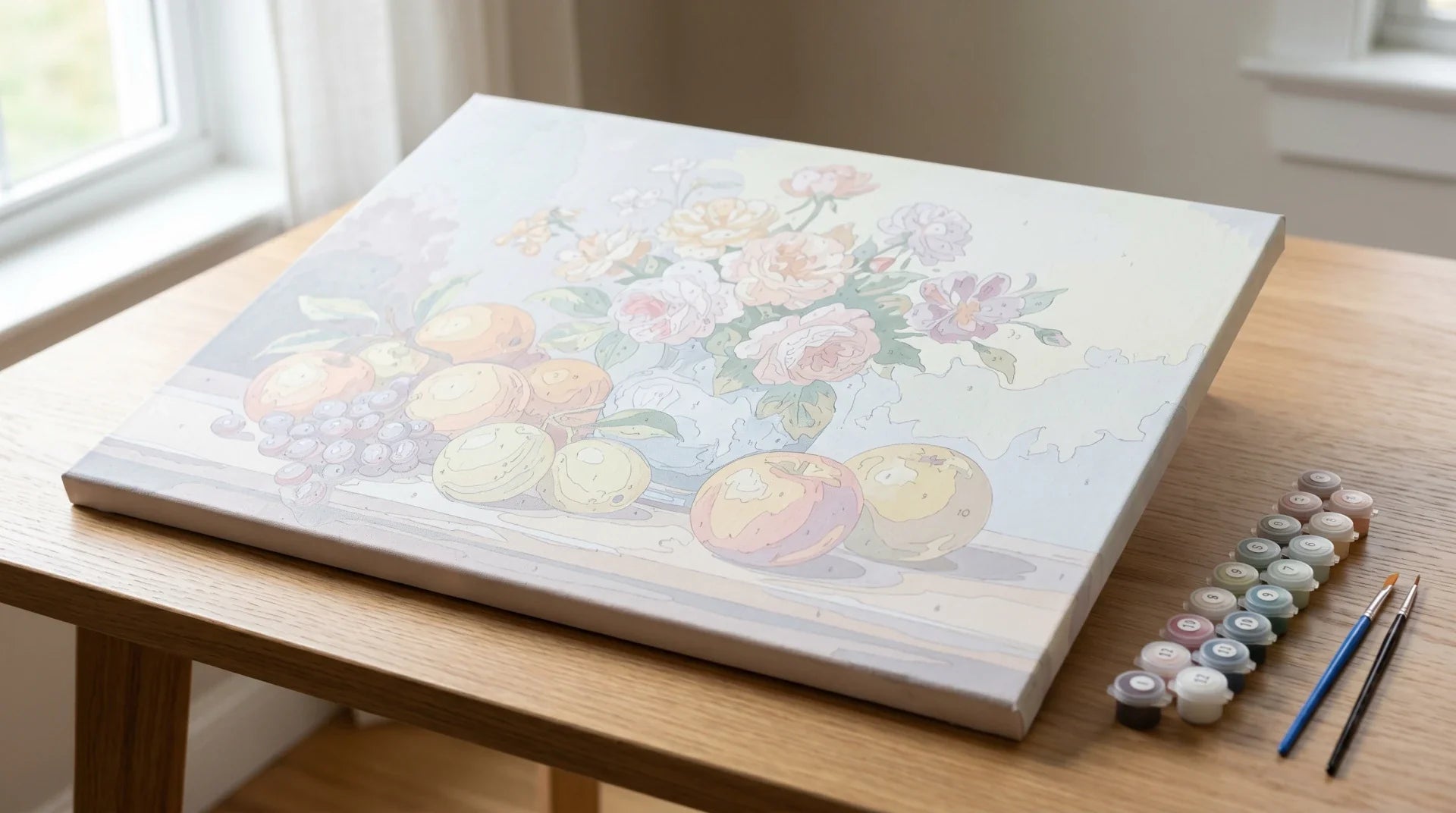
The substrate is real artist's canvas, pre-stretched on a real pine frame, primed with real acrylic gesso. The paints are real acrylic in lightfast pigment. What is different is that the drawing has been done for you and printed in a faint grid of numbered shapes. Everything that follows, the colour mixing where you blend two numbers, the edge work where two colours meet, the decisions about how thick a passage should be, is the same thing a blank-canvas painter is doing.
About a third of our customers move on to blank canvas within two years of starting kits. The drop-off in scaffolding happens gradually. Numbered kit, then numbered kit with their own colour choices, then a custom kit of their own photo, then a small blank canvas with a pencil sketch. Marisol from the opener is well past that ladder. She still buys kits because she likes the meditative section-by-section flow of a numbered painting. Painting on canvas is what she is doing either way.
If you want to try the on-ramp, our full paint by numbers collection ships on stretched cotton canvas with all the materials included. Our adult-focused kits use the same canvas with subject matter and complexity tuned for evening-and-weekend painting time. Both are real canvas painting in the strict Tate-definition sense.
Frequently asked questions
Can you paint over a finished canvas?
Yes. Sand the existing paint lightly to dull the surface, apply one fresh coat of gesso, and you have a primed canvas again. Painters have been reusing canvases this way for centuries, which is why X-ray analysis of museum paintings sometimes reveals an entirely different painting underneath. The reused canvas was usually a budget decision, not an artistic one.
How long does a canvas painting last?
With proper priming, paint application, and storage out of direct sunlight, a well-made canvas painting can last several hundred years. The Bellini altarpiece referenced above is from around 1478 and is being restored, not replaced. Modern acrylic paintings on primed cotton are not as old as the oldest oils on linen, but accelerated-ageing tests suggest comparable longevity when stored properly.
What size canvas should I start with?
All our paint-by-numbers kits ship in one size, 16 by 20 inches. We chose that on purpose. Big enough that detail areas do not cramp under a regular brush. Small enough that a first-time painter can finish over a few evenings without losing the thread. Once you finish a kit and want to scale up, the usual next move is a blank canvas in 18 by 24 or larger, painted freehand from a printed reference.
Is paint-by-numbers canvas different from blank canvas?
The canvas itself is the same fine cotton stretched on the same pine bars. The difference is that ours has a numbered template printed on the gesso layer in a faint, water-soluble ink that disappears under the paint as you work. Underneath the template, it is just primed canvas. If you finished a kit and never painted certain sections, you would be looking at the visible template forever, but most kits are finished.
Do I need to varnish a finished paint-by-numbers canvas?
Optional but recommended. Acrylic paint dries to a slightly inconsistent sheen depending on pigment, and unprotected acrylic can attract dust. A thin coat of gloss medium or varnish evens out the surface and adds protection. Our companion framing guide covers the order of operations: paint, dry thoroughly, varnish, frame.
Last updated 2026-05-17. Comments are closed; questions welcome at support@paintkitstudio.com.