Famous Realist Painters: A Tour from Gustave Courbet to Edward Hopper
By Simon I., co-founder, Paint Kit Studio. Published 2026-05-18.
Key takeaways
- Realism started in 1840s France as a deliberate rejection of grand historical and mythological subjects. Gustave Courbet was the loud, bearded centre of it.
- The movement spread fast because cheap printmaking and early photography were already showing audiences what real working-class life looked like. Painting had to keep up.
- American Realism is largely a separate tradition that grew up parallel to French Realism, with Eakins in the 19th century and Hopper in the 20th.
- Realist painters share a stubborn interest in ordinary subjects: peasants, dock workers, fishermen, motel rooms, empty diners, sunlight on a brick wall.
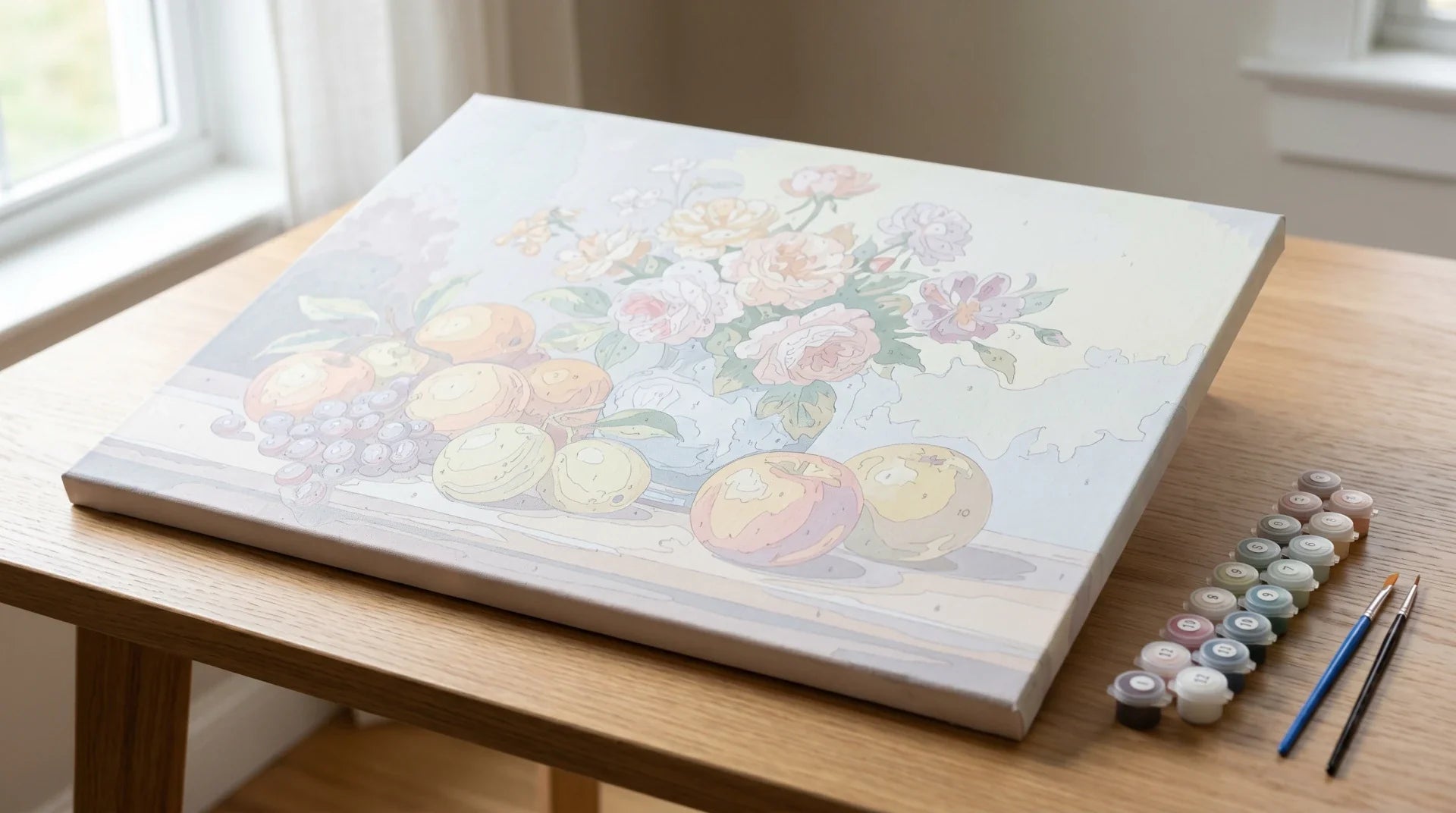
- Paint by numbers sits closer to this tradition than to most others. The numbered template was always meant to put a finished landscape, dog, or quiet scene on the wall of an ordinary house.
Last March a regular customer named James in Portland, Maine sent us a custom kit photo of his late-1930s family fishing cabin. Sharp afternoon shadows on weathered grey clapboard. One empty Adirondack chair on the porch. No people anywhere. When we wrote back to confirm the framing crop he asked if we could pull the saturation back even further. Real life looked like that, he said. Before everything got bright.
I thought about Hopper when that note came in. Hopper would have understood exactly what James meant, and exactly why James wanted that one chair in the painting. Realism is the tradition where painters refuse to make ordinary things more dramatic than they actually are. James was placing an order in that tradition without using the word.
So what counts as a realist painter?
The Tate glossary keeps it specific: "in its specific sense realism refers to a mid nineteenth century artistic movement characterised by subjects painted from everyday life in a naturalistic manner" (Tate, "Realism," n.d.). The phrase "in its specific sense" matters. People throw the word around to mean any painting that looks like the thing it represents. Tate is pointing at something narrower: a deliberate movement, with a name, that started in the 1840s and shaped how artists thought about subject matter for the next century.
A realist painter, in the strict sense, did three things. Painted from real life, not from history or mythology. Chose subjects from ordinary experience: workers, washerwomen, peasants, gravediggers, dock crews, the empty rooms of someone's house. Worked in a naturalistic style instead of an idealised one. None of these are unique on their own. Put together they are a position, almost a politics.
Why did Realism start in 1850s France?
Three things converged in Paris around 1848. There had just been a revolution. Cheap lithography meant working-class subjects were already in newspapers every morning. Photography was about ten years old and was making it embarrassingly easy for anyone to see what people actually looked like compared to how painters had been depicting them. The combination created a market and an audience for a kind of painting that took regular life seriously.
Tate notes that the word itself "was coined by the French novelist Champfleury in the 1840s and in art was exemplified in the work of his friend the painter Gustave Courbet" (Tate, "Realism," n.d.). The shock value of the new movement came not from the technique, which was traditional, but from the subjects. As Tate puts it, "in practice realist subject matter meant scenes of peasant and working-class life, the life of the city streets, cafes and popular entertainments, and an increasing frankness in the treatment of the body and sexual subjects." Upper-middle-class audiences who had paid for centuries to see goddesses and martyrs were not used to being asked to look hard at gravediggers.
Gustave Courbet, the painter who started it all
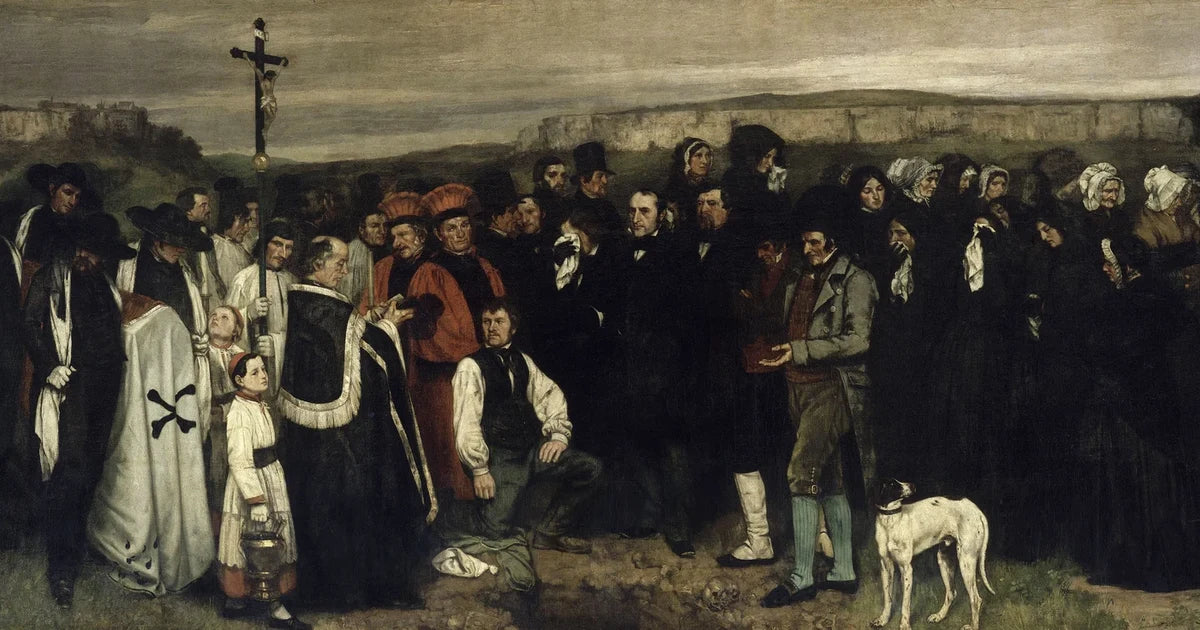
Courbet was a large, loud, bearded provincial from Ornans in eastern France who arrived in Paris in his twenties and refused to do what was expected of him. His A Burial at Ornans (1849–50) showed a working-class village funeral on a canvas roughly twenty-two feet wide. That size had been reserved for biblical or historical scenes for centuries. He used it for his uncle's funeral instead. Critics were furious.
The Stone Breakers (1849, destroyed in WWII) showed two labourers, one elderly, one young, breaking rocks on a roadside. No moral elevation. No symbolism. Just the work, and the bodies doing it. In 1855 his ambitious The Painter's Studio was rejected by the jury of the Exposition Universelle, and Courbet responded by opening his own one-man show nearby, calling it the Pavilion of Realism. Marketing as much as politics, but the gesture stuck. The movement had a name and a manifesto and a place to gather.


Jean-François Millet, peasants and dignity
Millet worked outside Paris in the village of Barbizon. His subject for thirty years was the rural poor. The Gleaners (1857) shows three women bending in a field, picking up grain left behind after the harvest. The Angelus (1857–59) shows a man and woman pausing in a field at the evening bell, heads bowed. Both paintings are small. Both became wildly famous reproductions, the kind that hung in millions of European working-class homes for the next sixty years.
Millet's politics were complicated. He painted the rural poor with reverence rather than radical critique. The result was a kind of dignified depiction of agricultural labour that conservative critics could accept and that progressives could read as quietly subversive. Either reading was available. Both audiences bought prints.

Honoré Daumier, caricature with conscience
Daumier made his living drawing caricatures for satirical newspapers, several thousand lithographs over forty years. The work that sat alongside that day job was painting, mostly small canvases of working-class subjects done in his off hours and rarely sold. The Third-Class Carriage (around 1862–64) shows passengers crammed into the cheapest railway compartment, faces tired, light coming in through a high window. Almost a Hopper painting eighty years early.

Daumier's realism is harder than Courbet's. He spent years in prison for caricaturing King Louis-Philippe and never lost the bite. His painted figures are not noble. They are just there, in the carriage, going home.
Did America have its own Realist tradition?
Yes, and it ran more or less in parallel rather than as a direct French export.
American Realism is best understood as a stubborn refusal of the dominant European trends. While Paris went through Impressionism, Post-Impressionism, Cubism, Surrealism, and Abstract Expressionism, a quiet line of American painters kept painting recognisable American subjects in recognisable styles. Eakins anchored it in the 19th century. Homer ran alongside him with his own marine focus. Hopper carried the line through the entire mid-20th century while everyone around him went abstract. Wyeth held onto it almost into the 21st.
None of these painters called themselves part of a movement in the way Courbet did. They were just painting what they saw. But the shared refusal to abandon recognisable subjects is what makes American Realism legible as a tradition.
Thomas Eakins, Philadelphia and the swimming hole
Eakins was a Philadelphia native who studied in Paris in his twenties, came home in 1870, and spent the rest of his career painting his neighbours, his students, his city, and the male bodies of his friends with an anatomical precision that was both his strength and the thing that eventually forced him to resign from the Pennsylvania Academy of Fine Arts in 1886. The Gross Clinic (1875) shows a surgical operation in graphic detail. The Swimming Hole (1885) shows a group of his male friends naked at a creek. Both paintings made juries uncomfortable.


What Eakins gave American painting was the conviction that you could paint your own life and have it count. Edward Hopper later named Eakins as the greatest American painter, drawing a direct line between Eakins' Philadelphia and his own New York. The lineage was Eakins to Hopper, with the same stubborn relationship to American subject matter.
Winslow Homer, the sea and the watercolor
Homer started as a magazine illustrator covering the Civil War for Harper's Weekly. By the 1880s he had retreated to a small studio on the coast of Maine and was painting the sea: fishermen, dories, breaking waves, hurricane clouds. The Gulf Stream (1899) shows a Black sailor on a dismasted boat surrounded by sharks, a storm closing in. Sentimental adventure painters had been doing variations of that scene for fifty years. Homer painted it without rescue, without redemption, just the man and the water and the unresolved problem.

Homer's watercolours from his Caribbean and Adirondack trips are what most painting students study now. They are technically dazzling and they are also unmistakably reportorial. You can identify which Bermuda reef he was looking at when he made each one. That documentary quality, combined with the painterly freedom of his late style, kept American watercolour painting alive as a serious medium for the next century. Our seascape collection owes more to Homer than to any single painter.

Edward Hopper, the lonely American
Hopper painted in oils, in his New York apartment and on summer trips to Cape Cod, for sixty years. The Smithsonian Magazine essay quoted above calls him "arguably the supreme American realist of the 20th century, encapsulating aspects of our experience so authentically that we can hardly see a tumbledown house near a deserted road or a shadow slipping across a brownstone facade except through his eyes" (Avis Berman, "Hopper," Smithsonian Magazine, July 2007).
Nighthawks (1942) is the famous one. A late-night diner, three customers, one cook, plate-glass corner window, the rest of the city beyond it black and empty. Early Sunday Morning (1930) shows a row of New York shopfronts in flat early light, no one in frame. Automat (1927) shows a woman alone at a small table with a cup of coffee.


The Smithsonian essay credits Hopper with making us see urban quiet differently: "His stark yet intimate interpretations of American life, sunk in shadow or broiling in the sun, are minimal dramas suffused with maximum power" (Avis Berman, "Hopper," Smithsonian Magazine, July 2007). Our cities and urban kits include several Hopper-inspired compositions for exactly this reason. The customers who want them tend to be the ones who already know.
Andrew Wyeth and what came after
Wyeth carried the realist line through to the end of the 20th century from his studio in Chadds Ford, Pennsylvania. Christina's World (1948) is his famous one: a woman lying in a field, looking up at a distant grey farmhouse. The model was a polio-paralysed neighbour. The painting hangs in MoMA, which is unusual for a realist work in that collection.
Photorealism showed up in the late 1960s with painters like Chuck Close and Richard Estes painting from photographs at the scale of small billboards. Close did portraits, Estes did empty city street scenes reflected in shop windows. Whether photorealism is realism or its own thing is a museum-label argument. The intent is different. Courbet wanted to show you what working life looked like. Estes wants to show you what a perfectly empty Manhattan corner looks like at 6 a.m. Both are subjects pulled from real life. The politics around them are different.
| Painter | Era | Subject focus | One painting to know |
|---|---|---|---|
| Courbet | 1849-1870 France | Provincial workers, funerals, labour | A Burial at Ornans (1849-50) |
| Millet | 1840-1870 France | Rural peasant life | The Gleaners (1857) |
| Daumier | 1830-1870 France | Urban poor, satire, railway carriages | The Third-Class Carriage (around 1862) |
| Eakins | 1870-1916 USA | Philadelphia portraits, anatomy, sport | The Gross Clinic (1875) |
| Homer | 1870-1910 USA | The sea, fishermen, watercolour landscape | The Gulf Stream (1899) |
| Hopper | 1920-1965 USA | Urban quiet, light, empty rooms | Nighthawks (1942) |
| Wyeth | 1940-2009 USA | Rural Pennsylvania, portraits, weathered surfaces | Christina's World (1948) |
Where does paint by numbers fit?
Closer to Realism than to any other tradition, if we are being honest.
The original Craft Master kits were marketed for ordinary homes, painted by ordinary people, hung on ordinary walls. The subjects in those first kits were quiet: barns, lakes, the family dog, a coastal sunset, a vase of flowers. Nothing baroque. Nothing abstract. The whole pitch was that you, a person who had never picked up a brush, could put a real-looking painting on the wall over your couch. That's a realist project at heart.
Our most-painted kits today fall in the same lineage. The portrait collection includes Hopper-quiet figures alongside more lively faces. The seascape collection draws straight from Homer's vocabulary of dories, lighthouses, and wave-foam. The James anecdote at the top is a real example of how this lineage shows up unprompted. He didn't have to know about Hopper to want a Hopper-looking painting of his cabin. The painting reached for him.
If you want to try it, our custom kit turns any photo into a numbered template, which is the closest most of us will come to painting what we see in front of us at the scale Realist painters were working in. For more on the broader history this sits in, the famous painters pillar covers movements that surround Realism, from the Renaissance through Impressionism.
Frequently asked questions
What is the difference between Realism and Naturalism?
Naturalism focuses on faithful reproduction of how something looks. Realism adds an emphasis on subject matter: ordinary people, ordinary scenes, no idealisation. A 1500s Flemish painter doing a meticulous portrait of a duke is naturalistic. Courbet doing a meticulous painting of a gravedigger is realist. The distinction matters most in the 19th century when both ideas were live at once.
Was Impressionism a kind of Realism?
Sort of, and also no. The Impressionists came out of the same Paris generation as the late Realists and shared the interest in everyday subjects. What they broke from was naturalistic technique. Monet wanted you to see his brushstrokes. Courbet wanted you to see his subject. Both refused historical and mythological scenes, which is the Realist position. After about 1880 the two lines diverge.
Are there any women in the Realist tradition?
Many, often under-credited. Rosa Bonheur was the most commercially successful Realist painter of the 19th century, specialising in animals at work. Her The Horse Fair (1855) is enormous and still hangs in the Met. American painter Cecilia Beaux did Eakins-level portraiture in the same period. Lily Martin Spencer painted domestic scenes that are quietly devastating about gendered labour. The famous-painters histories that focus on French men miss most of this.
Is Norman Rockwell a Realist?
By technique yes, by movement no. Rockwell painted in a meticulously naturalistic style but his subjects were idealised Americana for the Saturday Evening Post. Realism wants to show you what life looks like. Rockwell wants to show you what life ought to look like. He is closer to a 20th-century illustrator with realist tools than a Realist painter in the Courbet sense.
Can I paint a Realist-style kit if I am new to painting?
Yes. Most of our beginner kits sit comfortably in this tradition: small canvas, recognisable subject, naturalistic colour. The adult-focused kits include Hopper-quiet compositions and Homer-style seascapes. Start with a 12 by 16 inch canvas, finish it across a few evenings, and you will have a real-looking realist painting on your wall by the end of next week.
Many realist subjects are recreatable from our paint by numbers collection.
Last updated 2026-05-18. Comments are closed; questions welcome at support@paintkitstudio.com.