The Starry Night: How Van Gogh Painted His Most Famous Night From Memory
By Simon I., co-founder, Paint Kit Studio. Published 2026-05-20.
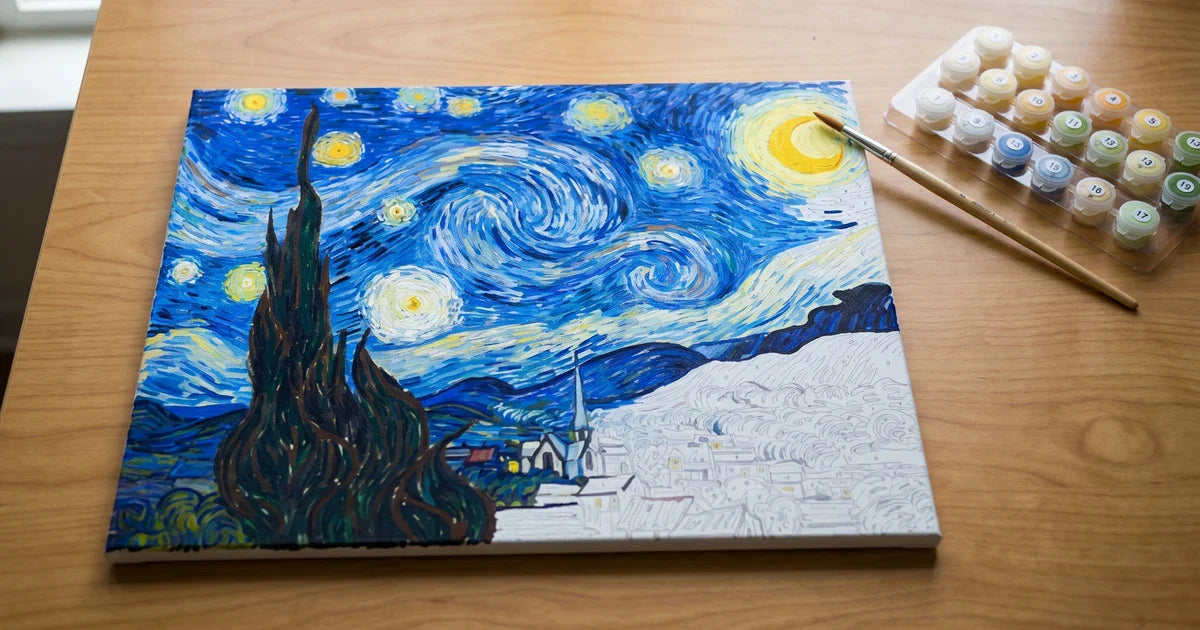
A customer named Megan emailed at 9:14 PM last Thursday. She had been working on our Starry Night Kit for three weekends. Her question stopped me. "Did Van Gogh actually see this view from his window?" My first instinct was to type back yes. Of course he did. That is what every wall label and every tote bag will tell you. I sat with the email longer than I usually do. The actual answer is no. Most of what the painting shows was invented, in his studio, during the day, from memory. The longer answer is what this article is.
This is about the 1889 painting now hanging at MoMA, the iconic swirly one. Van Gogh also painted a different starry night in 1888 from the Rhône embankment in Arles. That earlier work is its own story (see The Starry Night Over the Rhône). The Saint-Rémy version, the one Megan was painting, came together very differently.
Where was Van Gogh when he painted The Starry Night?
He was in a converted monastery in Provence. The Saint-Paul-de-Mausole asylum sits at the edge of Saint-Rémy-de-Provence, about 25 kilometres south of Avignon. Van Gogh checked himself in voluntarily on May 8, 1889, four months after the breakdown in Arles that ended with him cutting part of his own ear. He had asked his brother Theo to find a place where he could be looked after but still allowed to paint.
The asylum gave him two rooms. One was a bedroom on the upper floor with a barred window facing roughly east, looking toward the Alpilles mountain range. The other was a studio on the ground floor. He was permitted to leave the grounds with an escort to paint olive groves and wheat fields. He stayed until May 16, 1890.

The window matters because it is where almost every account of The Starry Night begins. The view it actually gave him does not match what he painted.
When did he actually paint it?
June 1889. The first surviving reference comes in a letter to Theo dated June 18, where Van Gogh writes, "At last I have a landscape with olive trees, and also a new study of a starry sky" (Letter 782 to Theo van Gogh, Vincent van Gogh Letters, Van Gogh Museum, n.d., retrieved 2026-05-20). The word "study" matters. He used étude for composed work assembled from sketches and memory, not for paintings done direct from life.
This is the part that often surprises people. He painted it during the day, in his studio. Not at night, not outdoors, not by candlelight at his window.

A year earlier in Arles, when he painted The Starry Night Over the Rhône and Café Terrace at Night, he had insisted on working at the actual location after dark, by gaslight and candlelight, with the painting wedged on his easel against the river breeze. The Saint-Rémy painting reversed that method. He went indoors and composed.
Did Van Gogh really see this view?
Parts of it. Most of it, no.
The sky is the most defensible part. Two scholars have separately mapped the celestial bodies in the painting against real configurations visible from Provence in late spring 1889. The art historian Albert Boime first did this work in 1984, proposing the painting depicts the pre-dawn sky of June 19, 1889. The astrophysicist Jean-Pierre Luminet later refined the argument, suggesting May 25 fits the painted positions of Venus and the crescent moon more precisely (The Starry Nights of Vincent van Gogh: Saint-Rémy, Jean-Pierre Luminet, Futura-Sciences, 8 January 2021, retrieved 2026-05-20). Both agree on one thing. The bright object in the painting is Venus. The crescent moon is the crescent moon. The configuration is dateable.
Beyond the sky, the painting departs from his window's actual view. The asylum bedroom faces east toward the Alpilles. There is no village visible in that direction, and there was none in 1889. The steepled town below the swirling sky in the painting did not exist on that horizon. Some scholars read it as a remembered image of Zundert, Van Gogh's Dutch hometown, where the steeple of the local church dominated his earliest visual memories.
The cypress is even further from observation. Van Gogh's window looked out over a walled garden. The cypresses around Saint-Rémy were a short walk away but were not the foreground of his window view. He pulled the cypress into the composition because he wanted it there.
What does the swirling sky represent?
Three reasonable readings, none of which cancels the others.
Religious. The painting shows eleven stars, a crescent moon, and the morning star (Venus). Boime read this as a deliberate reference to Genesis 37, where Joseph dreams of eleven stars, the sun, and the moon bowing to him. Van Gogh was the son of a Protestant pastor and knew his scripture cold. He had abandoned his own brief attempt at the ministry years earlier but never abandoned the imagery.
Optical and medical. Van Gogh's care at Saint-Rémy is widely thought to have included digitalis, a heart medication that in nineteenth-century doses could produce xanthopsia (a yellowing of vision and bright haloes around light sources). He also drank absinthe, which contains thujone, another source of visual disturbance. Some art historians read the swirls and aureoles as direct transcription of what altered vision actually looks like. Others find this reductive. The prescription itself is inferred rather than documented, so treat this reading as suggestive, not settled.
Aesthetic and cross-cultural. Van Gogh had been collecting Japanese woodblock prints since his time in Antwerp. Hokusai's Great Wave off Kanagawa is often cited as an influence, with its rhythmic curling forms that turn nature into pattern. The same logic. Take a force you cannot draw directly (water, wind, light), and convert it to a moving line that the eye can follow.
All three readings have evidence. The painting is overdetermined, meaning multiple causes converge on the same brushstroke.
Why is the cypress so huge?
Look at the painting. The cypress takes up the entire left third of the canvas. It runs from the very bottom edge to the top, dwarfing the church steeple beside it, dwarfing the mountains, dwarfing everything except the sky itself. There is no other element in the painting given that much vertical space.
A week after writing the "starry sky" letter, Van Gogh wrote Theo again. He had become obsessed with cypresses. "It's beautiful as regards lines and proportions, like an Egyptian obelisk. And the green has such a distinguished quality" (Letter 783 to Theo van Gogh, Vincent van Gogh Letters, Van Gogh Museum, n.d., retrieved 2026-05-20). The Egyptian obelisk comparison is the key. He saw the cypress as architecture, not vegetation.

Cypresses are also Provençal funerary trees, planted historically at cemeteries. Whether Van Gogh consciously meant the painting as a bridge between earth and sky, mortality and infinity, is unanswerable. He died by suicide thirteen months after painting it. Art historians read backward into the cypress what they could not have read forward.
The table below summarizes the gap between what was actually visible east of his bedroom window and what made it into the painting.
| Element | What Van Gogh saw | What he painted |
|---|---|---|
| Time of working | Daytime, indoors | A night scene |
| Sky | Pre-dawn moon + Venus | Swirling movement, 11 stars + Venus + crescent moon |
| Village | No village visible east | Steepled town, possibly remembered Zundert |
| Cypress | Distant Provençal trees | Single massive foreground obelisk |
| Mountains | Alpilles range | Stylized wave-like shapes |
How did this become the most famous painting in the world?
Slowly, then suddenly.
When Van Gogh died in July 1890, Theo inherited the canvas along with the bulk of his brother's unsold work. Theo himself died six months later in January 1891. The painting passed to Theo's widow Jo van Gogh-Bonger, who had been married only two years and was now caretaker of the largest private Van Gogh collection in the world.
Jo sold the painting in 1900 to the French poet Julien Leclercq for the equivalent of a modest workshop wage. A year later it sold again to the painter Émile Schuffenecker. Jo bought it back from him at some point and then resold it through the Oldenzeel Gallery in Rotterdam to Georgette van Stolk in 1906. It stayed with the Van Stolk family for over thirty years.
In 1938 the dealer Paul Rosenberg acquired it. Rosenberg was Jewish and based in Paris. When the Nazis occupied France in 1940 he fled to New York with his inventory. In 1941 the Museum of Modern Art arranged the trade that brought the painting to New York. MoMA's own provenance line records "acquired by exchange from Paul Rosenberg Gallery." Secondary sources have detailed the exchange as two Cézannes and a Toulouse-Lautrec for the Van Gogh. MoMA accessioned it as 472.1941.
For another thirty years it was a recognized but not universally famous painting. Don McLean's 1971 song "Vincent (Starry Starry Night)" did more to lodge the image in mass consciousness than any museum loan. The song reached No. 1 in the UK and peaked at No. 12 on the US Billboard Hot 100 in 1972. Calendar reproductions, dorm posters, screen savers, the tail end of the twentieth century saw the painting become inescapable.
None of that was the painting's intent in 1889. Van Gogh called it an étude, a study, painted while he was a voluntary patient in an asylum in a year when his brother Theo was running out of money to support him. The thing that became a global brand is, in his own description, a sketch made indoors by an unwell man working from memory. Our love for the painting runs in the opposite direction from his own account of it. That contradiction is most of what makes it interesting.
Want to paint your own Starry Night?
This is the part where I tell you about our kit.
Frequently asked questions
Where is The Starry Night now?
The Museum of Modern Art in New York City, on Manhattan's 53rd Street. The painting is part of the permanent collection and is almost always on display, usually on the fifth floor in the Painting and Sculpture I galleries.
Can I see The Starry Night in person?
Yes, with standard MoMA admission. Plan for a queue at the painting itself in the busy hours (mid-morning through early afternoon on weekends). Photography without flash is permitted. The room around it is usually crowded enough that you will want a wide shot of the wall, not a face-on close-up.
Why did Van Gogh use such thick paint?
Two reasons. First, the technique itself. Impasto, the loading of paint thick enough that the brushstroke holds its shape, was something Van Gogh used deliberately as a way to make light itself feel physical. Second, the paint-tube revolution. By the 1880s, oil paint came premixed in collapsible metal tubes (a relatively new invention) that let painters work outdoors and use much more paint per canvas than the older hand-ground pigments allowed. Van Gogh used those tubes harder than almost anyone of his generation.
Was Van Gogh on drugs when he painted The Starry Night?
Possibly digitalis, possibly absinthe, both inferred rather than proven. Digitalis is a heart medication that in nineteenth-century doses can cause xanthopsia (yellowed vision) and bright haloes around point light sources. Absinthe contains thujone, another source of visual disturbance. Some scholars have argued Van Gogh's care at Saint-Rémy included digitalis treatment, though the prescription itself is not documented in surviving records. Whether any of this materially affected the painting is debated. The swirls and aureoles do match what altered vision can look like, but they also match Hokusai's wave forms, which Van Gogh openly admired.
What's the difference between The Starry Night and Starry Night Over the Rhône?
Different paintings, different years, different methods. The Rhône version is from September 1888, painted by Van Gogh at night by gaslight on the riverbank in Arles, looking at actual reflected city lights on water. It is more naturalistic, no swirls. The MoMA painting is from June 1889, painted in his studio at the Saint-Rémy asylum from memory and composed elements, with the famous swirling sky. The Rhône version came first and was a step toward, not the same painting as, the iconic later one. We have a separate article on the Rhône painting.
Starry Night is one of the most-requested designs in our paint by numbers for adults collection.
Browse the wider paint by numbers collection for more classic-art designs.
Last updated 2026-05-20.