Article: Famous Female Painters: 7 Women Who Built Western Art
Famous Female Painters: 7 Women Who Built Western Art
By Simon I., co-founder, Paint Kit Studio. Published 2026-05-19.
A customer named Sarah emailed last week. Her teenage daughter was painting copies of Frida Kahlo's self-portraits in a sketchbook and wanted to graduate to a real canvas. Which of our kits should she start with? I sent over our portraits collection with three suggestions. Then I sat with the broader question her email implied. Where are the female painters in our catalogue? In our blog? In most people's art history?
My first instinct was to write a triumphant catch-up piece. The more I read, the less that worked. These painters were not missing in their own time. They were celebrated, paid, written about, and taught from. They were removed later. That is a different problem from being overlooked, and it changes what an article like this is supposed to do.
So this article walks through seven painters who deserve to be back in view, from a Baroque painter who out-Caravaggio'd Caravaggio to an American who painted desert skulls bigger than a wall. Five of them are now in the public domain in the United States and we can show their work directly. Two of them are still in copyright and we link out to the museums that hold them.
Who are the most famous female painters?
If you asked a museum-going adult to name three female painters in 1985, you would probably get Frida Kahlo and a long pause. In 2026 you might get Frida, Georgia O'Keeffe, possibly Hilma af Klint after her 2018 Guggenheim show, and the same long pause. The earlier four centuries of women who painted seriously, sold seriously, and taught seriously remained a footnote until art historians started rebuilding the canon in the 1970s.
The seven painters covered here are not a complete list. They are the entry points. Each one is well-documented enough that you can keep reading after this article and find a wall to look at. They span roughly four hundred years and five movements, and they tell you most of what you need to know about why the gap exists.
Was Artemisia Gentileschi the first feminist painter?
Probably not in any way she would have recognised. Artemisia Gentileschi (1593-1654) was a Baroque painter working in the style of Caravaggio, and she would have called herself a painter. But her biography keeps pulling readers into the 21st century. In 1611 she was raped by her teacher Agostino Tassi. During the subsequent trial in Rome she was tortured to test her testimony and held to her account. Tassi was convicted and the sentence was never enforced.
What followed in Florence is what art-historically matters. She became the first woman admitted to Florence's Accademia delle Arti del Disegno in 1616 and painted her Uffizi Judith Slaying Holofernes around 1613-14. The painting shows two women decapitating a man on a bed with the unhurried concentration of butchers. Whether her trauma drove the subject choice is debated. What is not debated is the technical command, the violence rendered with Caravaggio's chiaroscuro but pushed further into the foreground, the muscular forearm of Judith pressing Holofernes down (Artemisia Gentileschi, Tate, n.d., retrieved 2026-05-19).

She painted multiple Judiths across her career. The National Gallery's 2020-21 Artemisia exhibition in London marked a major institutional milestone in her reception in Britain.
Vigée Le Brun: How did Marie Antoinette's portraitist survive the Revolution?
Élisabeth Vigée Le Brun (1755-1842) painted, by her own account, about 600 portraits and roughly 900 works overall. More than twenty were of Marie Antoinette. She was the queen's official portraitist, painted her in court dress, in muslin, with her children, as a private friend, and she was admitted to the Royal Academy in 1783 on the queen's personal insistence over the academy's resistance.
October 1789 was the test. The Bastille had fallen in July. The royal family was forced from Versailles to Paris. Vigée Le Brun fled France in October 1789 with her young daughter and ten gold louis. She spent the next twelve years in exile, painting her way through Italy, Austria, and Russia, where she became the portraitist of choice for the Habsburgs and the Russian imperial court. She returned to France in 1802 and lived another forty years.

The Met's 2016 retrospective was the first comprehensive American show of her work. The catalogue makes the case she did for portraiture what David did for history painting: gave the genre a moral seriousness it had lost.
Berthe Morisot: the only woman in the founding Impressionist exhibition
The first Impressionist exhibition opened in Paris on April 15, 1874, in the photographer Nadar's studio. The reviews were savage. The artists were called daubers, lunatics, sketchers who had abandoned finish. Of the thirty-one painters in the show, one was a woman: Berthe Morisot (1841-1895).
She participated in seven of the eight Impressionist exhibitions across the next twelve years, missing only the 1879 show when her daughter Julie was born. Her painting The Cradle from 1872, now at the Musée d'Orsay, was in that first exhibition (Le Berceau, Musée d'Orsay, n.d., retrieved 2026-05-19). It shows her sister Edma watching her newborn sleep, the gauze of the cradle softening the entire right half of the canvas into something almost abstract.

She married Édouard Manet's brother Eugène in 1874, the same year as the exhibition. Édouard had been her painting mentor and her closest professional sparring partner for years. The marriage gave her family stability and the freedom to keep painting, which she did until her death in 1895 at age 54.
Mary Cassatt: the Pennsylvanian who built America's Impressionist collections
Mary Cassatt (1844-1926) was born in Allegheny, Pennsylvania, and spent most of her career in Paris. She had submitted to the Salon for ten years and been rejected enough times to be losing interest. In 1877 Edgar Degas walked up to her work in a Paris exhibition and invited her to show with the Impressionists instead. She exhibited with the Impressionists in 1879, 1880, 1881, and 1886.
Her painting is calmer than Morisot's. The subjects are mothers, children, women at the opera, women at tea. The Child's Bath from 1893, at the Art Institute of Chicago, is the one most people know: a woman in a striped dress pouring water over a small child's foot, the perspective tipped forward as if seen from a balcony above.

Her quieter contribution was as an advisor to American collectors. Her closest friendship was with Louisine Havemeyer, whose husband Harry was one of the richest sugar magnates in the United States. With Cassatt as their consultant, the Havemeyers acquired Impressionist work on a scale no other American collector matched. Most of that collection now lives at the Metropolitan Museum of Art. If you have visited the Met's nineteenth-century galleries, you have walked through paintings Mary Cassatt picked out.
Why did Hilma af Klint hide her abstract paintings?
Hilma af Klint (1862-1944) painted her first abstract series, Primordial Chaos, in 1906. That was before Kandinsky's early abstract breakthroughs in the 1910s and before Mondrian arrived at full abstraction in 1913. Af Klint was working in Stockholm in near-total isolation from the avant-garde conversations happening in Paris and Munich.
She painted 193 works in The Paintings for the Temple between 1906 and 1915, and continued producing abstract work afterward. She believed the works were dictated to her by what she called High Masters during séance sessions she ran with four other women. Whether you take the spiritualism seriously or not, the paintings are large, confident, geometric, and decades ahead of their public moment.

She knew the work would not be understood. She stipulated in her will that the abstract paintings remain unshown until twenty years after her death. They were opened in 1964 and largely ignored for two more decades. The 2018-19 Guggenheim exhibition Hilma af Klint: Paintings for the Future drew over 600,000 visitors and became the most-visited show in the museum's sixty-year history (Hilma af Klint: Paintings for the Future, Solomon R. Guggenheim Museum, 2018-2019, retrieved 2026-05-19). Standard art-history textbooks are now being rewritten to recognise her as an early pioneer of abstract painting, working years before the abstract breakthroughs usually credited to Kandinsky and Mondrian.
How did Frida Kahlo and Georgia O'Keeffe redefine the 20th century?
Frida Kahlo (1907-1954) and Georgia O'Keeffe (1887-1986) are the two most-recognised female painters of the twentieth century. Their work is still in copyright in most jurisdictions, so we link to the museums that hold it rather than reproduce it here.
Frida's autobiography is hard to separate from her painting. A bus accident in 1925, when she was eighteen, left her with multiple fractures including her spine and pelvis, and an iron handrail punctured her abdomen. During her three-month recovery her parents rigged a mirror above her bed and a custom easel across her lap. "I paint myself because I am often alone and I am the subject I know best." She made about 143 paintings, including more than 55 self-portraits, most of them small. She married the muralist Diego Rivera in 1929. Her Self-Portrait with Thorn Necklace and Hummingbird (1940) is held at the Harry Ransom Center at the University of Texas at Austin.
Here is the awkward part of Frida's fame. The icon has overtaken the painter. The eyebrows, the flowers, the necklace, the face printed on tote bags and laptop stickers and Halloween costumes are more recognised than any specific work she ever made. Mass culture flattened her into a brand. If you can name three Kahlo paintings without checking, you are in the minority of people who know who she is.
Georgia O'Keeffe ran a different experiment. She painted flowers larger than humans, then mountains and bones and desert sky. She first visited New Mexico in 1929 and relocated there permanently in 1949. Her late work flattened landscape into shape and colour in a way that anticipated minimalism by twenty years. Sky above Clouds IV from 1965, at the Art Institute of Chicago, shows a cloud pattern flat as wallpaper, taken from an airplane window. In 2014 her Jimson Weed/White Flower No. 1 sold for $44.4 million, then the highest auction price ever paid for a work by a female artist.
O'Keeffe has the opposite problem from Frida. Everyone knows the giant flower paintings. Almost no one outside of art-history programmes knows the late work, the abstract cloud studies, the minimalist landscapes, the bone-and-pelvis paintings from the 1940s and 50s, which is arguably her strongest period. Fame is uneven even after you arrive. The painting most likely to define you in the public imagination is rarely the one you would have picked.
What do these seven painters have in common?
They were not a movement. They never met. The earliest died a century before the latest was born. What ties them together is structural.
Every one of them faced an institutional ceiling that was specific to being female. Vigée Le Brun was admitted to the Royal Academy only on the queen's personal intervention, over the academy's vote. Morisot was the only woman in the Impressionist founding group. Cassatt's Salon submissions were rejected for ten years. Af Klint hid her abstract work because she did not expect a serious reading in her lifetime, and she was right.
| Painter | Era | Famous for | Where to see one work |
|---|---|---|---|
| Gentileschi | 1593-1654 | Baroque, Caravaggesque violence | Uffizi, Florence (Judith Slaying Holofernes) |
| Vigée Le Brun | 1755-1842 | Royal portraitist, ~600 portraits | National Gallery, London (Self-Portrait in a Straw Hat) |
| Morisot | 1841-1895 | Impressionism founding member | Musée d'Orsay, Paris (The Cradle) |
| Cassatt | 1844-1926 | American Impressionist, Met collection builder | Art Institute of Chicago (The Child's Bath) |
| af Klint | 1862-1944 | Early Western abstract pioneer | Guggenheim shows; Hilma af Klint Foundation, Stockholm |
| Kahlo | 1907-1954 | Mexican Surrealism, self-portraits | Harry Ransom Center, Austin (Thorn Necklace and Hummingbird) |
| O'Keeffe | 1887-1986 | American Modernism, flowers and desert | Art Institute of Chicago (Sky above Clouds IV) |
The other thing they shared, and this is the boring useful fact, was technical discipline. None of them were self-taught hobbyists. They drew from life, studied the painters before them, ran apprenticeships or workshops, and were respected in their own lifetimes by other painters even when official institutions resisted. The "rediscovery" stories of the last fifty years are partly the rediscovery of work that was always there.
There is one more uncomfortable thing to say. Lining these seven up under the banner "famous female painters" is itself a workaround. None of them set out to be a famous female painter. They set out to be painters. The category we are reading them under exists because their gender is what got them removed from the canon, and gender is the lens we are now using to bring them back. The work this article is doing is real and needed. It is also a reminder that the regular canon, the one without the modifier, is still half-complete.
Want to paint something by these masters?
This is the part where I tell you about our kits.
Frequently asked questions
Who is considered the most famous female painter of all time?
There is no single answer that any art historian would defend without footnotes. By current museum attendance and merchandise sales, Frida Kahlo. By art-historical influence on the formation of a major movement, Berthe Morisot for Impressionism and Hilma af Klint for abstraction. By technical impact within an existing tradition, Artemisia Gentileschi for the Baroque. The honest answer is that "most famous" is a function of which century and which country you ask the question in.
Why are there so few female painters in art history books?
The reasons compound. Until the late 19th century most academies excluded women from formal training (no life drawing classes, no anatomy study, no apprenticeships in major workshops). Without those credentials women could not show in the Salon, could not get major commissions, and could not pass paintings into the institutional collections that became the basis of art-history textbooks. Some did anyway, by being daughters or sisters or wives of male painters who let them into the studio. Even then, their work was attributed to male relatives or sold under their husband's name. The rebuilding of the canon since the 1970s has restored a lot of these attributions.
Did female painters paint differently from male painters?
Subject matter sometimes differed because of access. Morisot painted indoor domestic scenes partly because she could not roam Paris cafés alone the way Manet could. Cassatt painted mothers and children partly because that is what she had constant access to model. But technically and stylistically, no, the painters above worked entirely within the movements their male contemporaries did. Artemisia is Caravaggesque. Morisot and Cassatt are Impressionist. Af Klint was painting abstract canvases years before the male names usually credited with that move. The "feminine style" framing comes mostly from later critics, not from the painters themselves.
Where can I see the most female painter work in one museum?
The National Museum of Women in the Arts in Washington DC holds more than 6,000 works and is the first museum in the world dedicated solely to championing women through the arts. The Musée d'Orsay in Paris has the strongest Morisot holdings. The Hilma af Klint Foundation in Stockholm and the Guggenheim in New York both periodically show major af Klint exhibitions.
Who else should I look up after this list?
Sofonisba Anguissola (1532-1625, the Renaissance Italian who taught Philip II of Spain how to draw), Rachel Ruysch (1664-1750, Dutch still-life master who outsold Rembrandt in her lifetime), Rosa Bonheur (1822-1899, French animal painter, the first female artist to receive the Legion of Honour, in 1865), and Käthe Kollwitz (1867-1945, German Expressionist printmaker and sculptor whose work on grief and war is unmatched in the early 20th century).
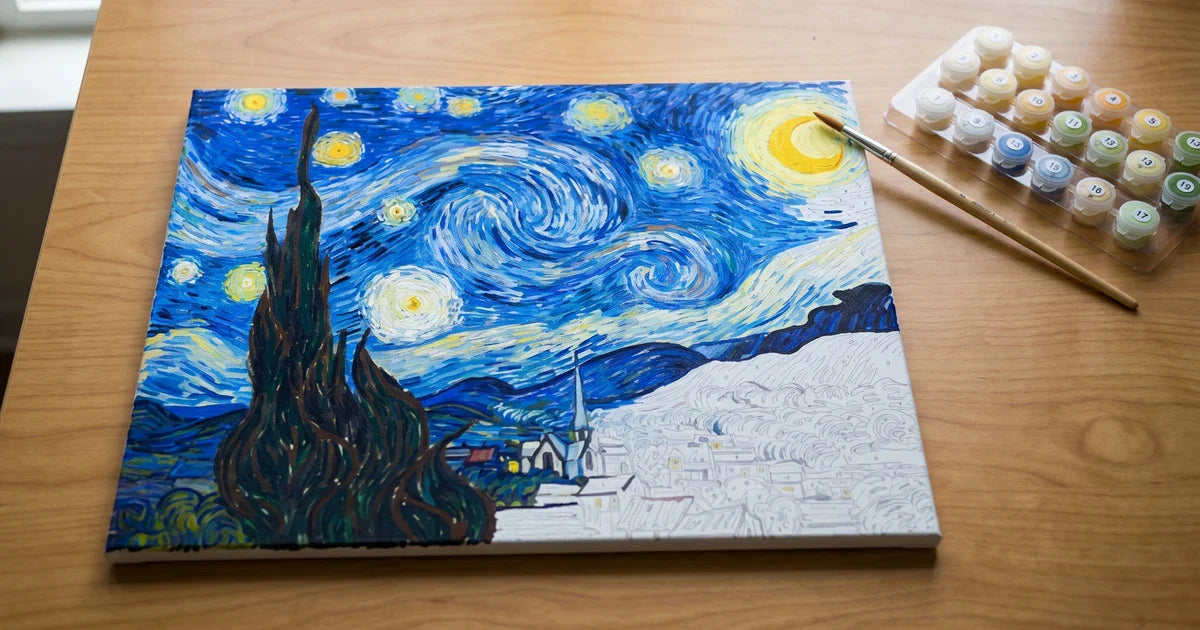
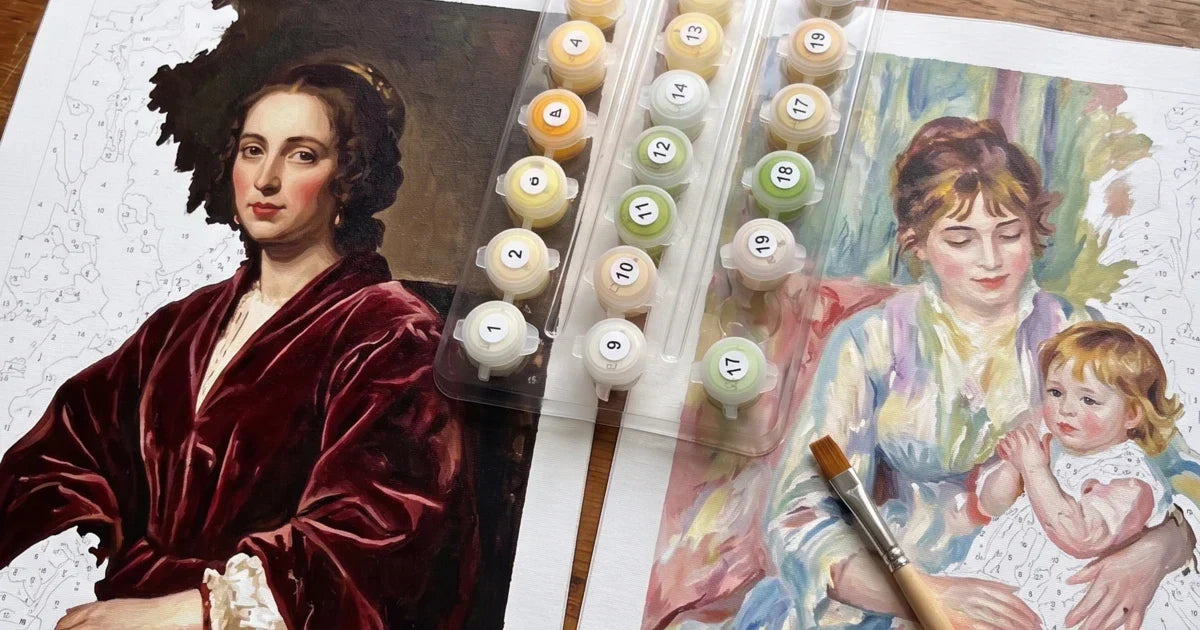
Many of these artists’ works are recreatable from our paint by numbers for grown-ups collection.
Several of these works are recreatable from our paint by numbers kits.
Last updated 2026-05-19.