How to Paint a Sunset: The Beginner's Path That Skips the Sky Blend
By Simon I., co-founder, Paint Kit Studio. Published June 3, 2026.
Key takeaways
- Most sunset tutorials drill the colour-blending sequence: yellow into orange into red into purple into blue. The blend is the easy part.
- Sunset paintings work or fail on the value contrast between the lit sky and everything sitting in shadow underneath it. Trees, rocks, water, the horizon line. Get the value gap right and a sloppy blend still reads as a sunset. Get the gap wrong and a perfect blend looks like a tie-dye t-shirt.
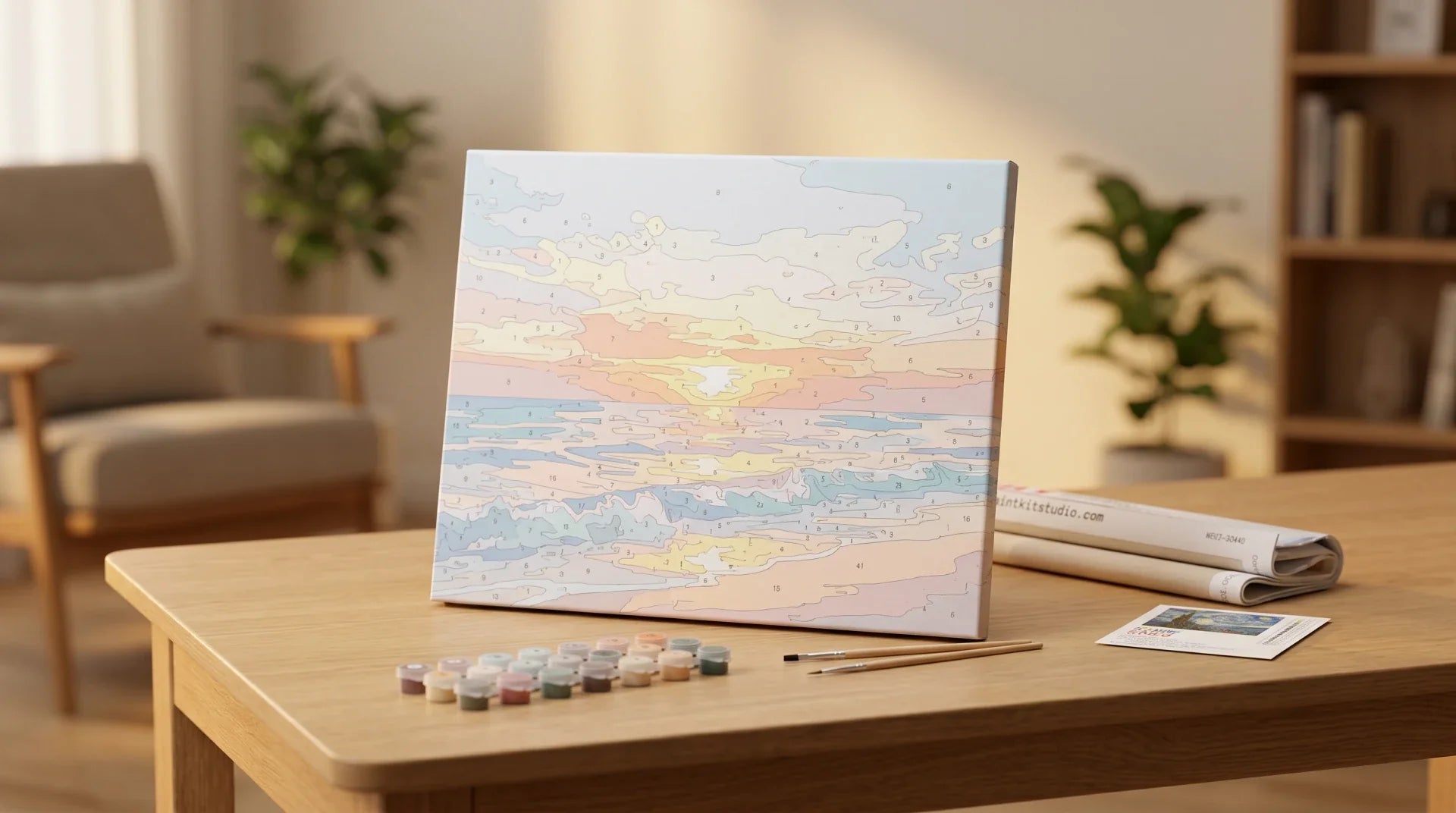
- Paint-by-numbers solves the value structure for you. The dark zones are numbered, the sky transitions are numbered, the shadow shapes are numbered. What is left for you is one specific skill: applying paint inside the right zone.
- The path runs from a beach-foreground sunset (easy), through tropical and coastal sunsets (mid), into wave-and-sunset combinations and dramatic silhouette scenes (harder).
- The mistake nobody warns you about: painting the sky last. Acrylic dries fast and the sky is the area you most want to feather, which means it should go on early, while the underlying canvas is still receptive.
Bottom line: sunsets feel impossible to paint until you accept that the painting lives in the shadow underneath, not in the sky above it. The kit puts the shadow shapes in place for you so the sunset can do its job as decoration on top.
A customer named Erica ordered a sunset kit in February. She wanted it as a birthday gift for her mother, who was recovering from surgery and bored on a couch. The kit arrived at her mother's house, the sunset wrapped in brown paper. Her mother opened it and called Erica two days later, in tears, because the sky was pink and the sky in her own life had been hospital-fluorescent for six weeks. She painted it over the next few weeks of evenings. The canvas hangs above her bed now.
Erica forwarded me her mother's email. It said: "I cannot believe I painted this. I cannot draw. I cannot mix colour. But I painted this." That email is most of what I want to tell you about painting a sunset.
What actually carries a sunset painting
If you go to YouTube and search for "how to paint a sunset", the top tutorials walk you through the colour-blending sequence. Start with yellow and white at the horizon. Move out to orange. Then red. Then purple. Then deep blue at the canvas edges. Blend wet-on-wet, soft transitions, no hard edges. None of this is wrong. It is just answering the wrong question for a beginner.
A sunset painting reads as a sunset for one reason: the value contrast between the bright sky and everything underneath it in shadow. The trees are nearly black silhouettes. The water reflects, but at a darker value than the sky itself. The horizon line is a sharp edge between the light and the dark. The painter who blends the most beautiful gradient but paints the foreground a medium green ends up with a sunset that looks like a tie-dye t-shirt. The painter who keeps the foreground in deep shadow, even with a crude sky gradient, ends up with a painting that reads as a sunset from across the room.
The reason sunsets even look the way they do is physics. The Britannica entry on Rayleigh scattering notes that blue light, which is at the short wavelength end of the visible spectrum, will be scattered much more strongly than will the long wavelength red light
(Britannica, "Rayleigh scattering"). At sunset the sunlight is travelling through more atmosphere, so more of the blue has scattered away and what reaches your eye is the warm end of the spectrum. The reds and oranges win because the blues have already left. The painting needs to honour the same physics: bright warm light in the sky, deep cool shadow under it.

Why the colour-blending advice from YouTube stalls beginners
The blending advice is not wrong. It is wrong order.
The standard sunset tutorial assumes you have already chosen a composition where the foreground works, that you have judged the value gap between sky and ground, that you know which areas should sit in deep shadow. If any of that is wobbling, the colour-blending lesson is being applied to a foundation that is not there.
The result is a painter who watches three tutorials, blends a beautifully soft warm-to-cool gradient across the sky, and ends up with a canvas where the trees in the foreground are friendly mid-tone green that competes with the sky for attention. The eye does not know what to look at. The painting reads as decorative rather than as a sunset.
The customers who finish their first sunset painting are not the ones who studied colour-blending technique. They are the ones who stayed inside the lines and trusted the kit's value judgements about which areas should be very dark.
The skill-isolation path
Paint-by-numbers was built in the 1950s to teach paint application by stripping out everything else. You do not draw the composition. You do not mix the gradient. You do not decide which trees should be black silhouettes versus mid-tone. The kit already made all of those decisions before the canvas left our shop.
For sunsets specifically, this means the value structure is pre-solved. The shadow shapes are numbered with dark colours; the sky transitions are numbered with bright warm colours; the horizon line is drawn. Your job is to fill in the colour inside the right zone. By the time you have finished one or two sunset kits, you have developed a feel for the depth of shadow a sunset needs and the warmth a sky needs to read as evening light, and you are ready to attempt one freehand.
Where acrylic comes in, and why it forgives you
Our kits ship acrylic paint. Not oil and not watercolour. There is a reason.
The Smithsonian Museum Conservation Institute notes that acrylic paint "dries" by evaporation of solvent of water
and that acrylic emulsion films will always be soft at room temperature
(Smithsonian MCI). The fast evaporation gives you a second pass on the sky. Painted the orange too flat? Add a wash of pink over it in the same evening once the orange is dry to the touch. Because dried acrylic is not water-soluble, the second pass sits cleanly over the dry layer instead of reactivating the colour beneath the way watercolour would.
Oil paint would have the sky's underlayer wet for days, and any warm wash you put on top would mix into the layer beneath. Watercolour cannot recover from a wet stroke that ran into the wrong area. Acrylic on a paint-by-numbers sunset kit is the friendliest learning surface there is, because every sunset benefits from at least one second pass on the sky's brightness, and acrylic lets you have that pass within the same sitting.
Eight sunset kits that teach you something
The path I would walk a first-time customer through, in roughly increasing order of what each kit asks of you.
The Heart Beach Sunset is the kit I send to people who have never painted a sky. The composition is friendly. A beach foreground sits in cool shadow, the sky takes up two-thirds of the canvas, and the gradient runs from gold at the horizon up to a deep evening blue at the top. The shadow shapes are uncomplicated. You finish this kit in two or three evenings and you have a feel for how acrylic dries on a wide flat area.
The Sunset Stream is the second-easiest. A forest stream catches sunset light through trees on either side. The water reflection adds one layer of complexity (the reflected sky is darker than the sky itself, which surprises beginners), and the tree silhouettes give you practice on the value contrast that matters most. Customers who paint Heart Beach Sunset first often choose this one next.
The Tropical Sunset Beach introduces the warm-palette saturation that defines a tropical scene. Palm tree silhouettes against a bright orange and pink sky. The challenge is keeping the palm trees properly dark without losing the texture of the trunks. The kit's numbered shadow zones handle the structure; you decide how patient to be on the small detail areas.
The Coastal Village Sunset brings architecture into the composition. Houses in shadow against a sunset sky. This is the kit for the painter who has finished one or two sunsets and wants to attempt straight-edged silhouettes (rooftops, windows, walls) instead of organic ones.
The Sunset Gateway is a path-leading-into-the-distance composition. A stone gateway or wooden frame holds the foreground while the sunset sits in the middle distance. Perspective work shows up here for the first time on the path. Easier than it sounds because the kit already drew the vanishing line for you.
The Ocean Wave Sunset combines a breaking wave with sunset light reflecting off the foam and the wet sand. The challenge is the warm-tone reflection on what would normally be cool foam. This is the kit for the painter who has done at least one wave painting and one sunset painting separately and is ready to combine them.
The Roses Sunset Seascape introduces flowers in sunset light. Red roses in the foreground, sunset over the ocean behind them. The colour relationship between flower-red and sunset-red is what this kit teaches you. Save for after you have finished one of the simpler sunsets.
The Wetland Bird Sunset is the dramatic silhouette kit. Birds in flight against an orange-red sky. The bird silhouettes are tiny and exact; getting them clean is the kit's main ask. Reserve this for when you have built confidence on three or four earlier sunset kits.
And if a particular sunset from your own life is what you actually want on the wall, the custom kit turns a photograph into a numbered canvas in about a week. We have done customers' wedding-evening skies, the view from their porch in Vermont, and one specific October sunset from a beach trip the customer's father took before he passed. The custom kit is the version of sunset painting that hangs on the wall for the rest of your life.

The mistakes that quietly kill sunset paintings
Sky-blending technique is rarely the problem on a first painting. The mistakes that actually finish a sunset kit's chance of looking right are these.
The foreground painted too light. Every sunset has a dark foreground; without it, the sky has nothing to contrast against. Beginners look at the numbered foreground zones, see a colour darker than they were expecting, and water it down or skip past to the sky. Trust the kit's darks. Paint them as dark as the number says, and the sky on top will glow.
The sky painted last. Acrylic dries fast, and a sky you blend last has to compete with already-dried foreground edges. Sky first, while the rest of the canvas is still fresh and absorbent. The kit's number ordering hints at this; follow it.
The horizon line softened. Sunset horizons want a sharp boundary between the light sky and whatever sits in front of it. Beginners blend the horizon line in an attempt to look painterly, and the painting loses its anchor. Keep the horizon line crisp. The kit's number outline is there for a reason.
The water reflection too bright. Reflections are always darker than what they reflect. A bright sunset sky reflects on water a step or two darker, not at the same brightness. Beginners mirror the sky exactly into the water and the painting flattens out. Follow the kit's reflection numbers; they will be a tone or two darker than the sky numbers.
The muddy colour from mixing brush passes. Acrylic loaded on a brush, dragged from a warm orange zone into a cool purple zone, picks up paint and contaminates the next colour. Light load. Multiple short strokes. Wash the brush between colour families (warm to cool especially).
How long does a sunset painting actually take?
Realistic numbers, based on customer emails about timing.
A first sunset kit (Heart Beach Sunset, Sunset Stream) takes around eight to twelve hours total, spread across three or four evenings. The painter spends the first session on the sky gradient and the second on the foreground silhouettes.
A tropical or architectural sunset (Tropical Sunset Beach, Coastal Village Sunset) is in the twelve-to-eighteen-hour range. The structural elements (palm trunks, rooftops) want patience because their silhouettes are what carry the painting.
A combination kit (Ocean Wave Sunset, Roses Sunset Seascape) is fifteen to twenty hours. The colour relationships between the wave or flower and the sunset are the time-consuming part.
A silhouette kit (Wetland Bird Sunset) is the wildcard. We have seen customers finish it in two weekends and we have seen others take a month. The variable is the small bird silhouettes; whether you get one clean on the first pass or have to redo it determines the pace.
A custom sunset often takes longer because the photograph means something, and that slows the painter down on the lighting.
Frequently asked questions
Should I paint the sky or the foreground first?
Sky first. Always. Two reasons. First, the sky covers the largest area and you want it on the canvas while the underlying surface is still receptive to wet-on-wet blending. Second, the horizon line is the boundary between sky and foreground, and a crisp horizon is easier to achieve when the sky is painted up to a clean edge that you then bring the foreground down to meet.
What is the easiest sunset for a first painting?
A beach foreground with a simple horizon. Heart Beach Sunset or Sunset Stream. The composition has one dominant subject (the sky), one clean horizon line, and one supporting shadow area. Skip the silhouette-heavy kits or the architectural kits until you have at least one finished sunset under your belt.
Why does my sunset look muddy when I blend?
The brush is carrying paint from the previous colour into the next zone. Acrylic on a wet brush picks up surrounding pigment and contaminates the new colour. Wash the brush between warm and cool families, dry it on a paper towel, and reload with clean paint. Most muddy sunsets are a brush hygiene problem, not a colour-mixing problem.
Should I paint each tree silhouette as a solid black?
The kit will tell you what colour, and it will rarely be pure black. Pure black against a warm sky reads as cardboard. Most sunset silhouettes are very dark warm colours (deep red-brown, deep blue-black, deep purple-black) that still carry a hint of the sky's temperature. Trust the kit's number; do not substitute black.
Can I paint a sunset from a photograph without a kit?
Eventually yes. On a first painting, no. Freehand sunset painting is the highest-stakes version of the same problem: you are doing the composition, the value structure, and the colour gradient at once. The kit removes the first two so the emotional investment in the painting can land on the part you can control. Most of our custom-sunset customers tell us they could not have painted the sky without the kit doing the value judgements for them.
If our seascape collection or our mountains and lakes collection has the sunset you want, start there. If the sunset that means something is from your own life, the custom kit handles the photograph.
Sunsets are some of the most rewarding kits made for adult painters, all soft blends and no fiddly edges.
You will find more sky-and-water scenes across the full paint by numbers lineup.