Paint by Numbers Flowers: 10 Kits I'd Actually Recommend
By Simon I., co-founder, Paint Kit Studio. Published May 30, 2026.
Key takeaways
- Most flower-kit guides sort by colour or difficulty. The sort that actually predicts whether you finish is the category of the painting itself: single bloom, bouquet, or wild scene. Each has a different patience curve.
- Single-bloom kits forgive beginners. Bouquet kits punish whoever paints the leaves last. Wild scenes need a painterly mood more than a steady hand.
- Our flower collection clusters into those three categories, and most repeat flower-kit customers re-buy inside the category they finished first.
- Colour count matters less than the brush sizes you get. A 24-colour single-bloom kit will out-finish a 48-colour bouquet for most first-time painters.
- The mistake nobody warns you about: the green pots. Pot 14 looks identical to pot 41 in dim light, and that is where flower kits quietly stall around hour seven.
Bottom line: pick the category that matches the painting you actually want on the wall, then trust the kit. The flower itself is rarely the hard part.
A customer named Janet emailed us at 11:47 PM about a year ago. She was halfway through the Wildflower Bouquet, sitting at her kitchen table under a lamp that was not bright enough, and she could not tell pot 14 from pot 41. They are both green. They are both labelled. In the warm light of a 9 PM kitchen they look identical. Her question was whether to keep going or to wait until morning. I told her morning. She finished the kit the following week and Loox now has her review.
I think about Janet's email almost every time we ship a flower kit, which is most weeks. Our flower collection is now around 180 kits deep and grows by a handful every season. The customers who finish their kits and the customers who do not are not separated by talent or by the difficulty of the picture they chose. They are separated by something quieter that I am about to walk through.
The sort that actually predicts whether you finish
Every other flower-kit guide I have read sorts the kits by colour palette or by some kind of difficulty rating. Beginner, intermediate, advanced. Pastel, vibrant, moody. Those buckets feel useful and they are not. After shipping a few hundred flower kits and reading every Loox review that comes in, the bucket that actually predicts whether the canvas ends up framed is the structural category of the painting itself.
There are three.
A single-bloom kit is one flower, large on the canvas, close-focus.
A bouquet kit is many flowers arranged in a vase or a basket, mid-distance, often with leaves filling half the frame.
A wild scene is flowers as part of a landscape or an interior, with horizon, sky, or architecture doing as much work as the petals.
Each one demands a different temperament. A single bloom rewards patience inside a small area. You sit with one petal for twenty minutes and the painting moves. A bouquet rewards endurance across a wider surface, because the leaves alone can be ten hours of similar greens. A wild scene rewards mood, because if the sky is wrong the flowers will not save it. I have customers who finish three single-bloom kits a year and have never finished a bouquet. I have one customer in Ohio who only paints wild scenes and refuses every single-bloom kit we recommend.
So before we get to the ten kits, the only useful question is: which category do you want hanging on your wall? Pick that first and most of what follows takes care of itself.

Single-bloom kits: small subject, close focus
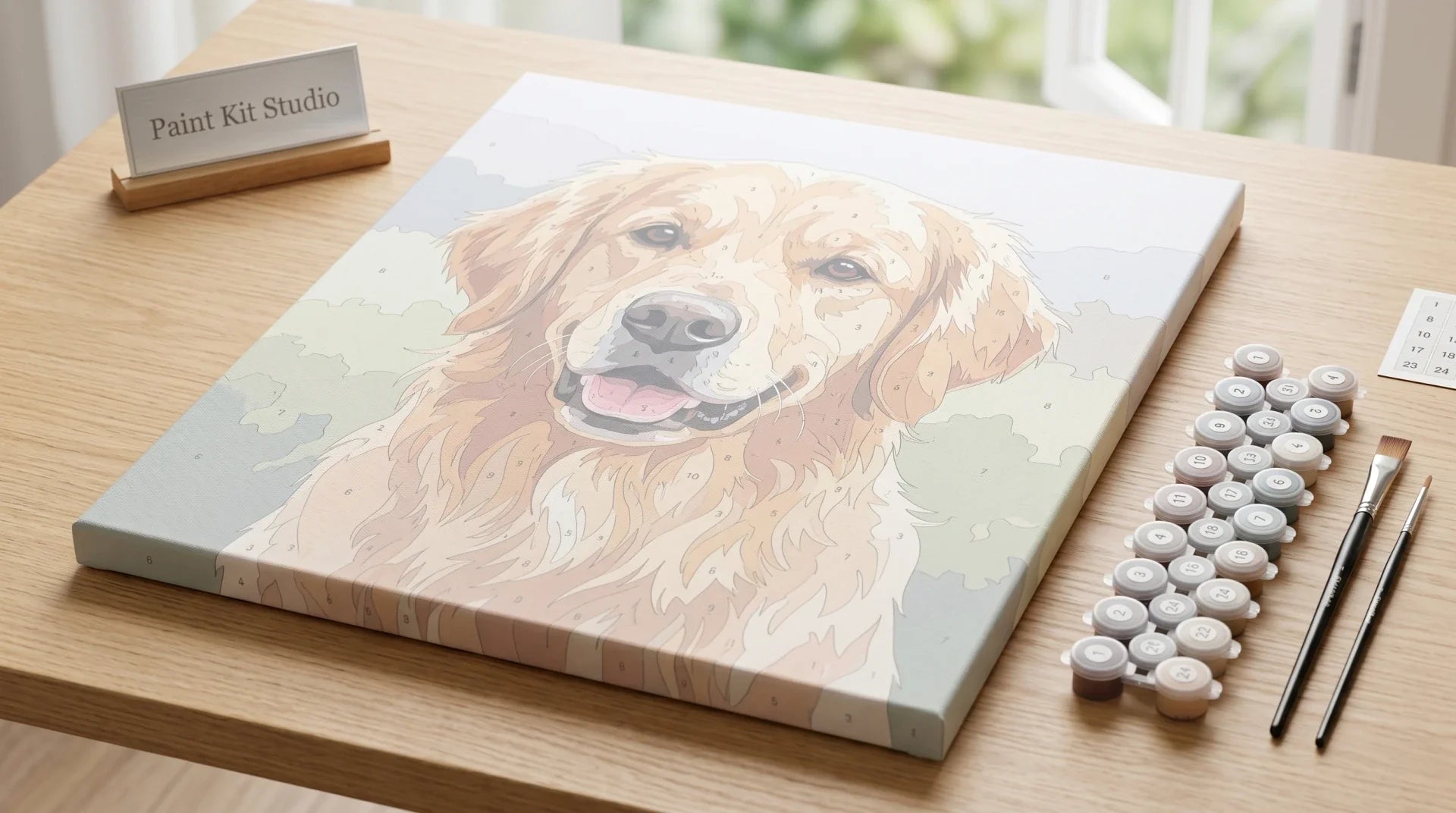
These are the kits I recommend to people who have never finished a paint-by-numbers before. The canvas might be the standard 40cm by 50cm but the flower itself is large, the negative space is generous, and the colour count is friendlier. You can finish one in six or seven evenings if you sit down most of them.
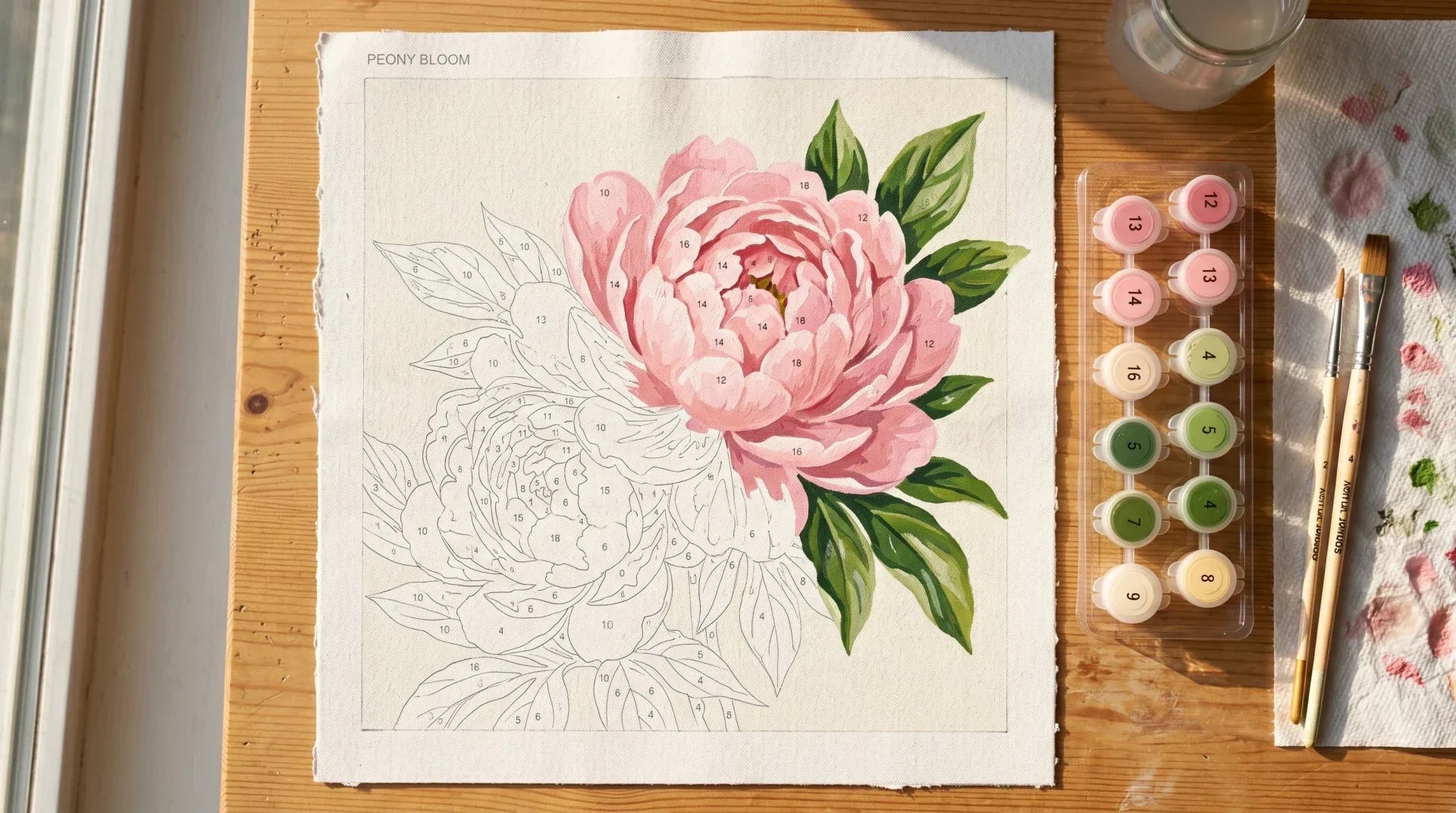
The Vibrant Peony Bloom is the most-requested single bloom we make. Peonies show up in our search-bar queries about three times more often than roses, which always surprises first-time customers and never surprises us. The bloom is centred, the petal layers are clear, and the pinks are warm enough that mixing errors barely show. If you want a flower kit that survives an awkward first weekend, this is it.
The Purple Iris Bloom is the kit I send to customers who want a vertical composition for a narrow wall. It paints faster than it looks. The iris itself has fewer petal divisions than a peony or a rose, and the purple range is forgiving. One customer in Vermont sent us a photo of three of these hanging in her stairwell, painted over three winters.
The White Rose Relaxation is the dramatic one. White on a dark background sounds intimidating and is the opposite. White pots are easy to track in dim light, the petal edges are crisp, and the dark background gets painted in a single long evening so the rose itself can take its time. Five-star reviews on this one read like the customer is surprised at themselves.
The Vibrant Flower Bloom is the colour-saturated outlier in this bucket. If your wall already has muted artwork on it and you want one piece that punches, this is the kit. The reds are aggressive and the kit ships enough variation in red that you do not have to mix. A finished Vibrant Flower Bloom photographs much better in evening light than a peony does, which is why we send it to gift-givers.
Bouquet kits: many subjects, one composition
Bouquet kits are where finishing rates fall. Not because the painting is harder but because the surface area of leaves and stems is larger and the colours assigned to that surface area are very close together. This is the category where Janet wrote me at 11:47 PM.
The Wildflower Bouquet has more verified reviews than any other flower kit in our store, eleven at last count, all five-star. The composition is busy but the colour cues are exaggerated and the colour count stays under 30. It is the bouquet I recommend to a customer who has finished two single-bloom kits and wants to scale up without bringing in a full hydrangea spray. Tara, who left review number seven, painted hers over a single rainy long weekend in March.
The Country Garden Arrangement is the slower bouquet. The colour count is higher, the bloom variety is wider, and there is foliage behind the vase that adds another layer of green. The customers who finish this kit tend to have finished one bouquet before. The four-and-a-half-star rating comes from a couple of reviewers who underestimated the time. Realistically this is a fifteen-hour kit, possibly twenty if you are slow on the leaves.
The Vibrant Hydrangea Bouquet is the one I am the most honest about. Hydrangeas have a deceptive number of tiny petal clusters and each cluster carries three or four near-identical blues. If you have not finished a bouquet yet, this is not your first bouquet. If you have, the finished result is striking enough that customers tend to frame it and send us the photo. Hydrangea sepals shift colour with soil pH in real life, which is a small fact that has nothing to do with the painting and everything to do with why the kit looks the way it does.
Wild scenes and stylised pieces: where flowers turn painterly
This category is the one I personally find the most rewarding to ship. The flowers are not the only subject. They share the canvas with a landscape, an interior, or an arrangement of shapes that hints at the floral form without spelling it out. The Tate, defining still life, notes that the genre covers all kinds of man-made or natural objects, cut flowers, fruit, vegetables
and that historically the genre was ranked at the bottom
of the French Academy hierarchy of subjects (Tate, "Still life"). Centuries later, the kits that take flowers out of a vase and put them in a landscape or a window scene are the ones that read as serious art on a wall.
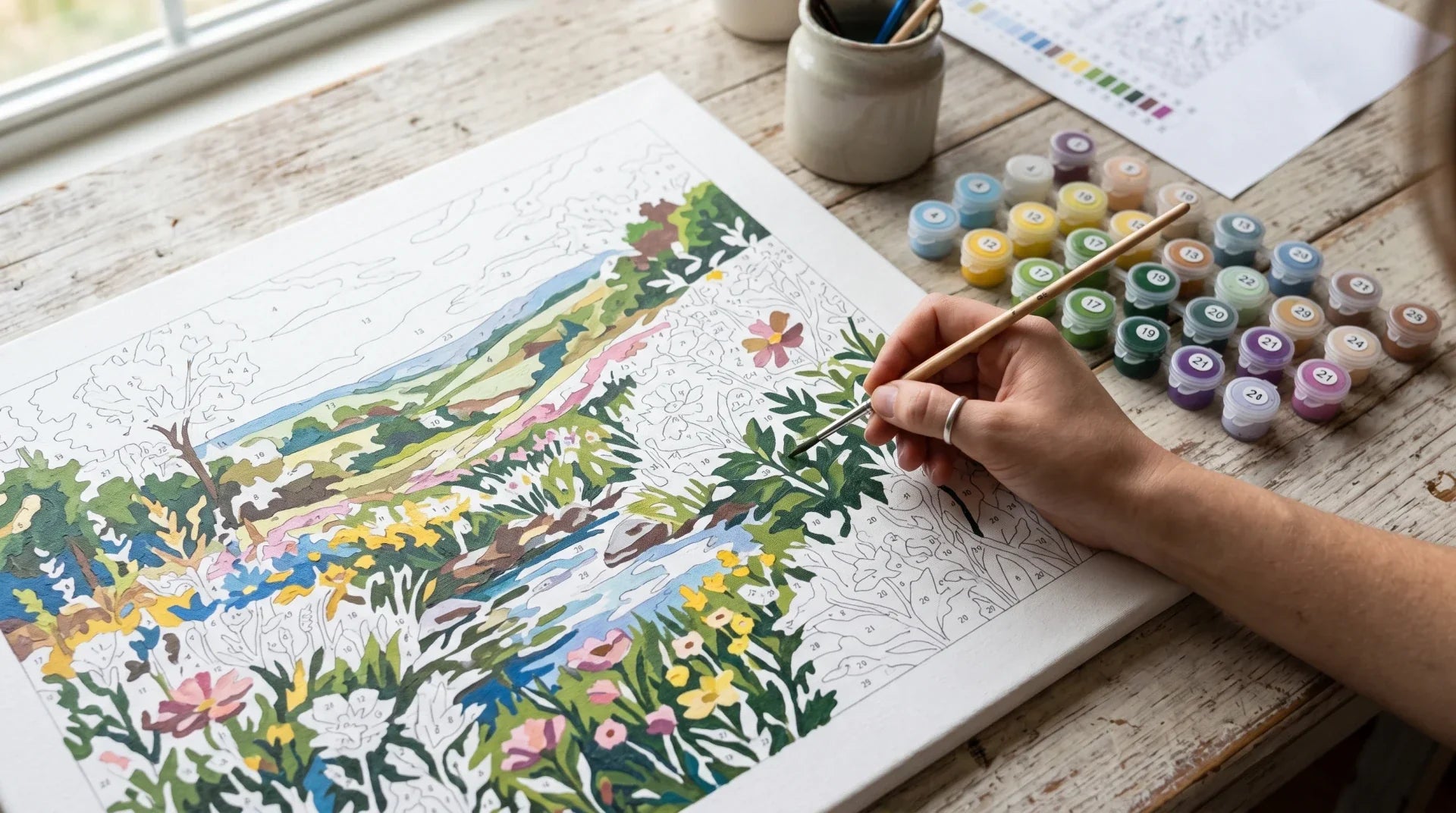
The Coastal Poppy Path is the wild-scene flagship. Red poppies scattered along a dirt path with the ocean behind it. The poppies themselves are the easiest part of the painting. The path and the sky are where the kit asks something of you. Customers who finish this one tend to email us a photo before it is even dry. Two of them have hung the finished piece in a guest bedroom by the coast and sent us pictures that we use, with permission, on the collection page.
The Window Hydrangea is the indoor cousin. A hydrangea spray on a windowsill, an interior wall behind it, light falling sideways across the leaves. Four-and-a-half stars from five reviews. The window frame and the wall do most of the structural work and the hydrangea sits inside it like punctuation. This is the kit I send to people who want a flower painting that does not announce itself as a flower painting.
The Floral Silhouette Portrait is the most stylised piece in the entire flower collection. A figure in profile, the silhouette filled with floral patterns. It is technically a portrait and it is technically a flower piece and it does not behave like either. The reviews are mixed because customers who buy it expecting a regular flower kit are disappointed, and customers who buy it expecting a stylised piece are delighted. Read the listing carefully and you will know which group you are in.

What 24, 36, and 48 colours actually mean for a flower kit
Our flower kits ship with somewhere between 24 and 48 numbered pots depending on the painting. Customers often assume more colours means more difficulty. The opposite is usually true.
A 24-pot kit is forgiving because the colours are far apart on the spectrum. The painting will read as a flower even if you mismatch a pot or two, because the next pot over is visibly different. A 48-pot kit packs in subtle gradients, especially in greens and pinks. Misreading pot 14 for pot 41 is a real risk and the painting will show the mistake.
For a first flower kit I would steer toward 24 to 30 pots. A peony, a single iris, a rose. The painting will look fine and you will finish it. For a second flower kit, once you have a feel for how acrylic behaves on the canvas, 36 to 48 pots becomes an invitation to a more nuanced piece. The Vibrant Hydrangea Bouquet and the Country Garden Arrangement both sit at the higher end and the result reads as more painterly.
The brushes matter more than the pot count, frankly. A small detail brush around size 0 is what gets you clean petal edges, and our kits ship three brushes across small, medium, and large. If you ever upgrade one piece of the kit, upgrade the detail brush. A 10/0 sable will let you paint pollen flecks on a stamen that the kit's smallest brush cannot reach.
The leaves are where flower kits quietly stall
Every guide warns you about the small petals. The actual stall point is the leaves.
A bouquet kit might have eight to fifteen near-identical greens. The painter sits down, paints the flowers, feels good, then opens the next numbered area and finds it is leaf. Then the next one is also leaf. By the third hour of leaves the painter wanders off to make tea and the kit sits on the table for two weeks. We send replacement green pots about forty times a year because the original is dried out from being left open.
There is a way around it. Paint the leaves first, with the flowers still un-touched. The colour shift between un-painted canvas number and finished green leaf gives you a visible signal of progress, and the petals are then the reward at the end. Most painters resist this because the flowers are what they want to paint. The customers who switch the order tend to finish. The ones who follow the canvas top-to-bottom are the ones who email us six weeks later asking how to revive the dried-out green pot. We tell people this in the packing slip but the only way it sticks is if a customer has stalled out at least once before.
Acrylic also helps. The Smithsonian Museum Conservation Institute notes that acrylic paint "dries" by evaporation of solvent of water
and that acrylic emulsion films will always be soft at room temperature
(Smithsonian MCI). Soft surface means you can paint a leaf, walk away for a day, and paint over the edge without lifting the underlying colour. The kit is designed for the way a real flower kit gets painted, which is in evening bursts.
How to pick if you have never finished one
The decision tree is short. If you have never finished a paint-by-numbers, start with a single bloom. The Vibrant Peony Bloom or the White Rose Relaxation are the two I would point you at first. They are forgiving, they finish in a week of evenings, and they hang on a wall like something you meant to make.
If you have finished one or two single blooms, the Wildflower Bouquet is the bouquet that almost everyone finishes. It is the bouquet for the painter who is ready for more surface area but not ready for fifteen hours of hydrangea blue.
If you have finished any kit at all and you want the most photographable result, go to the wild scenes. The Coastal Poppy Path or the Window Hydrangea reads as art on a wall in a way that single blooms sometimes do not.
If none of these pictures are quite the painting you want, our custom kit turns a photo of any flower into a paint-by-numbers in about a week. We have done customers' wedding bouquets, the last rose from a backyard garden, and a Polaroid of a great-grandmother's begonia from 1962. The custom kit lets you have a flower painting of the flower that actually means something. The full flowers collection is the next page over. And if flowers are the wrong genre entirely, the paint by numbers for adults collection might be a better fit.
Flowers are one of the most popular themes across our paint by numbers kits.