What Is Paint by Numbers? How the Kits Work and Where They Came From
By Simon I., co-founder, Paint Kit Studio. Published May 29, 2026. Last updated May 29, 2026.
Key takeaways
- Paint by numbers is a painting system. The canvas comes printed with outlined shapes, and every shape has a number that matches a labelled pot of premixed paint.
- You brush each shape with its matching colour. No drawing, no mixing, no deciding what goes where. The hard parts of painting are already done.
- A commercial artist called Dan Robbins invented the kits at the Palmer Paint Company, and the first ones sold under the Craft Master name back in 1951.
- It calms people down, and not just anecdotally. A Drexel study found 45 minutes of art making dropped stress hormones for about three-quarters of people, painters and total beginners alike.
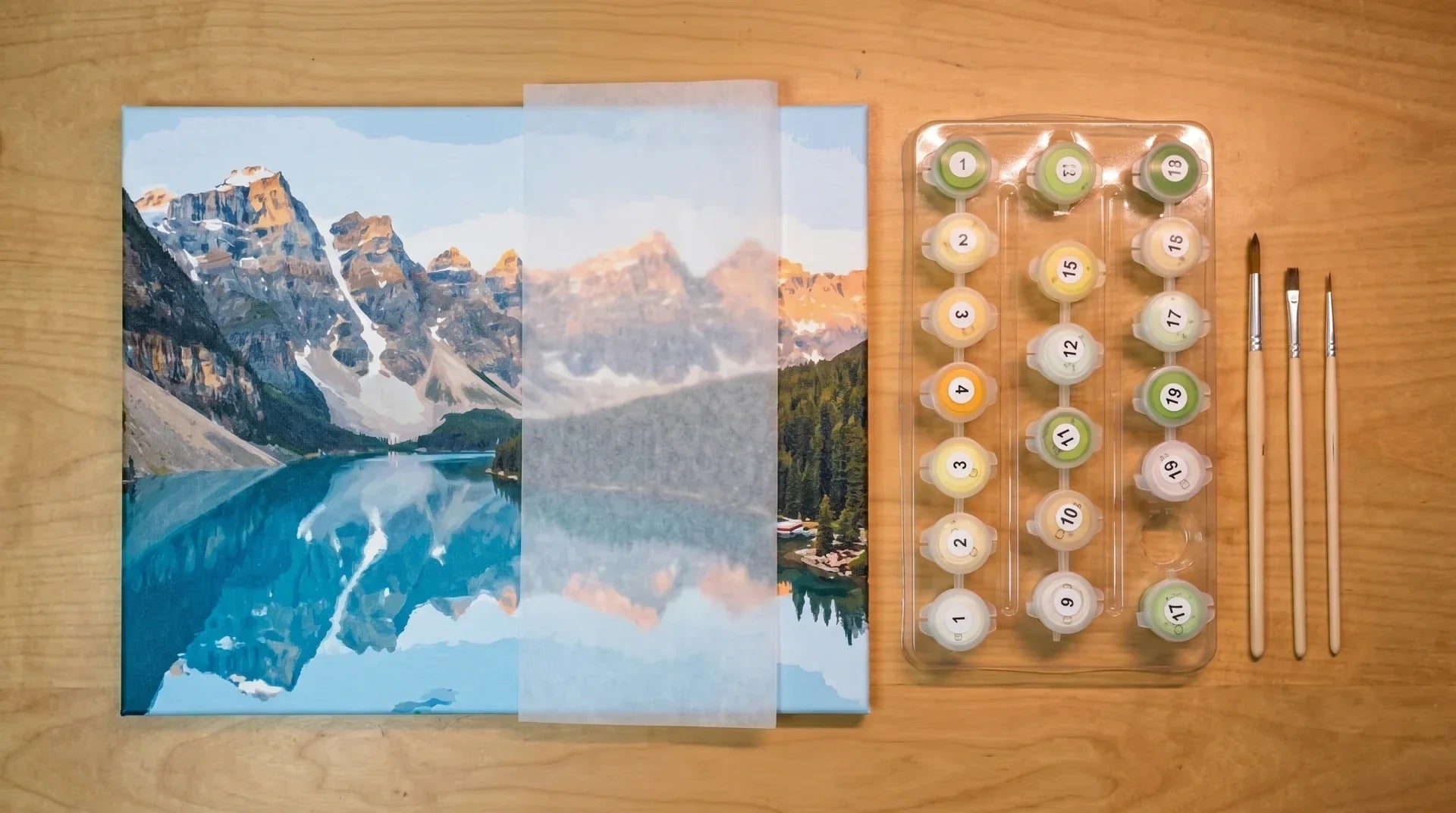
- A kit comes with everything: the printed canvas, numbered acrylic pots, brushes, a reference chart. Ours are one size, 40cm x 50cm.
Bottom line: it is the most forgiving way I know to spend a few hours making something, and the painting at the end turns out to be the smallest reason people keep coming back.
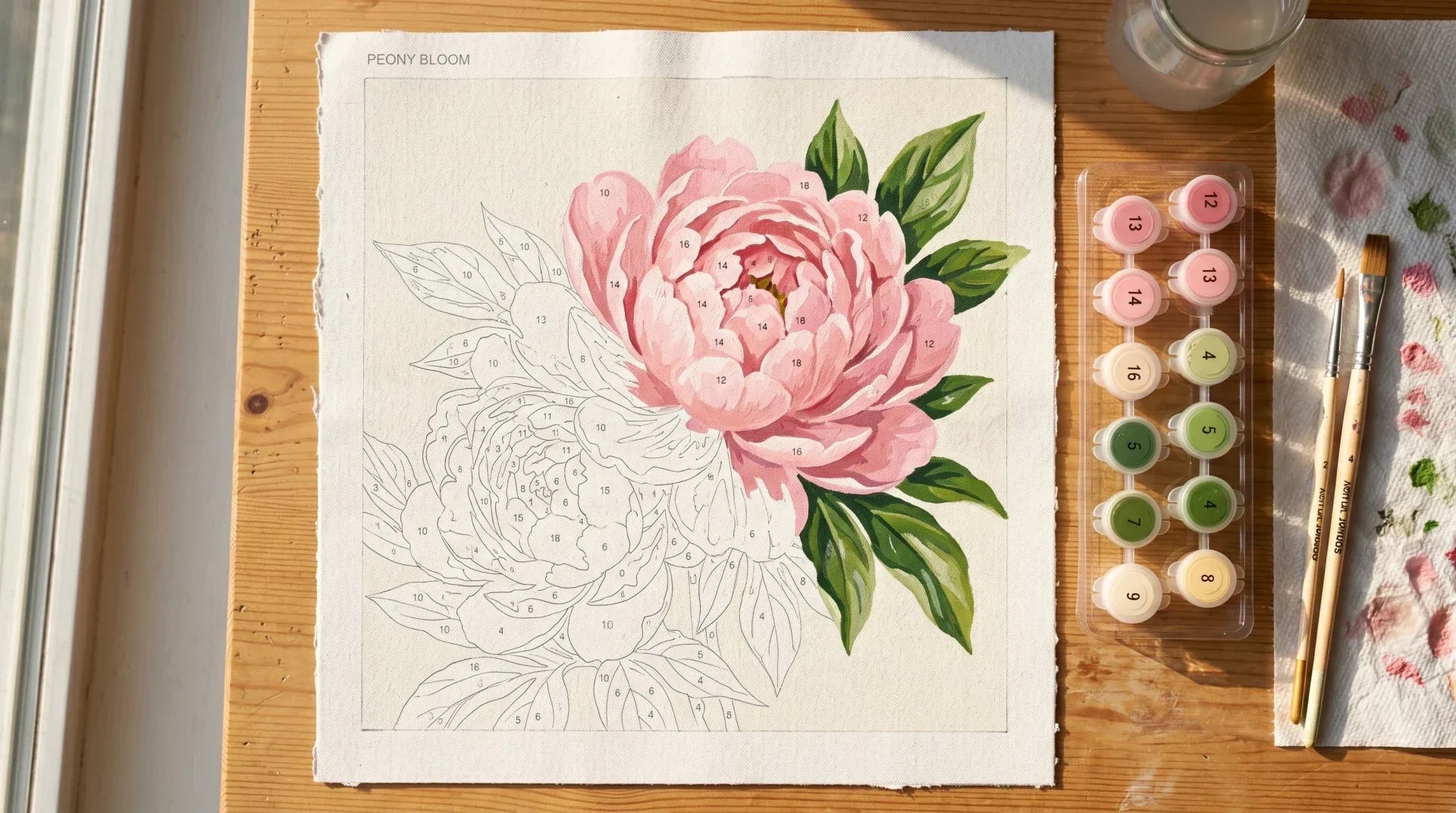
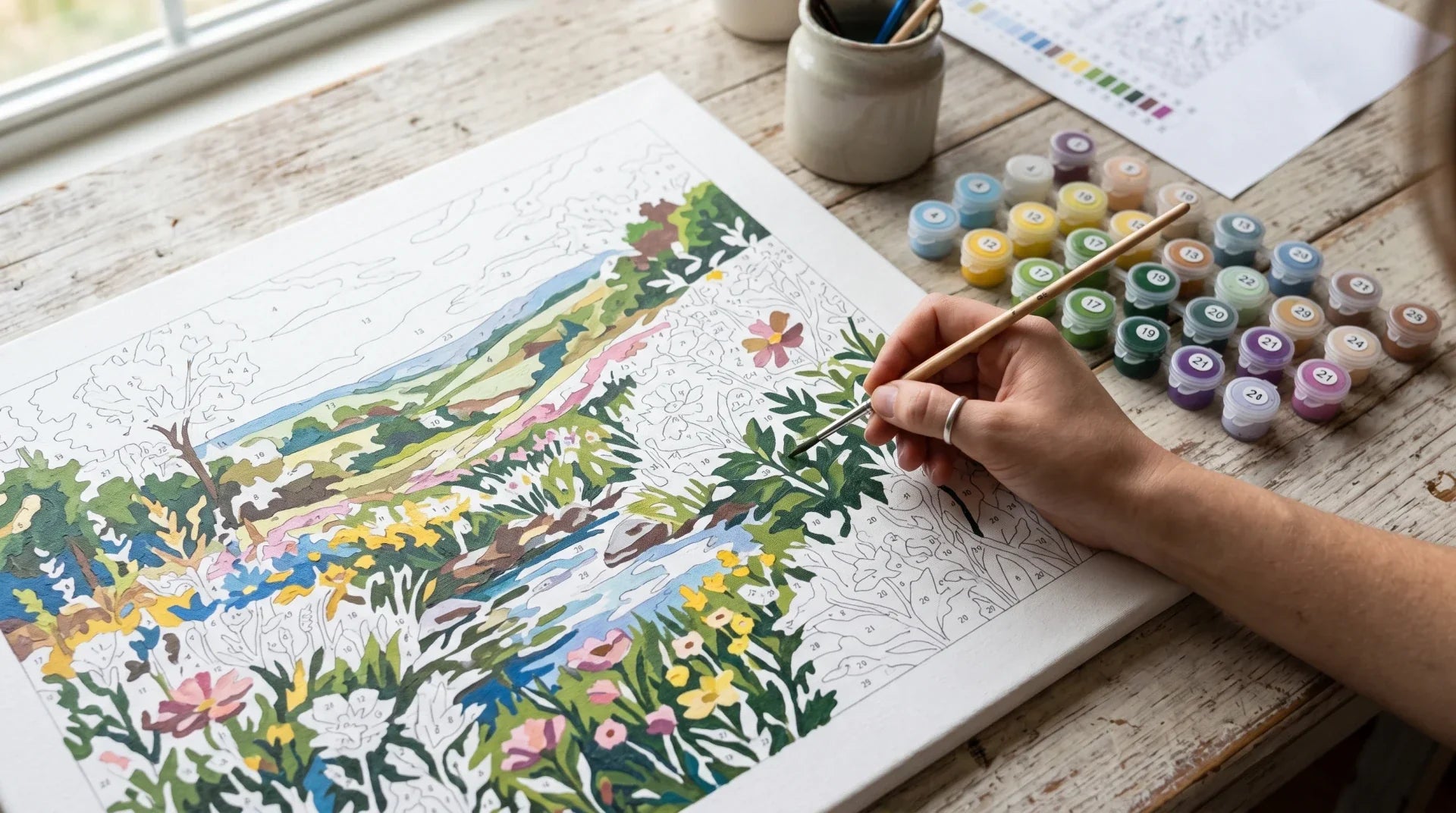
You have probably seen one. A blank canvas covered in little outlined shapes, each printed with a tiny number. That is paint by numbers, and the definition is genuinely that simple. Paint by numbers is a painting system where a picture is broken into numbered regions, and each number tells you which premixed colour to brush into that region. Number on the canvas, number on the pot, match them up, fill the shape. Do the next one. Keep going, and at some point the numbers disappear under the paint and there is a finished picture sitting where the puzzle used to be.
That is the whole trick. Think of it as the middle ground between a coloring book and a real painting. Easier to follow than a bare canvas, but it ends up looking like art, because the design underneath was drawn by somebody who can actually paint.
I got this wrong for a long time. When we started Paint Kit Studio I assumed people bought a kit for the painting, the finished thing they would hang in the hallway. Our reorder records said otherwise. The folks who come back for a second kit, and a third, are mostly buying back the two or three quiet hours the first one gave them. A customer named Carol wrote in last winter. She had painted a seascape most evenings through a rough few months and wanted two more. Three sentences about how the evenings felt. One line about the picture. After a few thousand emails like that one, I stopped thinking of this as art supplies. It is a couple of hours of quiet, and a painting happens to fall out the end of it.
How does a paint by numbers kit work?
Start with where the design comes from. It begins as a real image, usually a photo or a painting. Software chops that image into flat zones of similar colour, a bit like the way a weather map splits the country into temperature bands. Each zone gets an outline. Each outline gets a number. Each number gets its own pot of paint, premixed to the exact shade so you never have to.
So the work in your hands is mechanical, and I mean that as a compliment. You are not agonising over which blue the sky should be or where to put the shadow. Somebody already settled all of that. You read a number, hunt down the pot, lay the colour inside the lines. One finished shape looks like nothing. Twenty of them start looking like a sky. It sneaks up on you.
Most people fall into the same rhythm without anyone telling them to. Big background zones first, because they are forgiving and they loosen up your hand. Save the fiddly detail for last, since that is where a shaky line actually shows. You do not have to paint the numbers in order, by the way, and once you trust it, jumping around is half the fun. Want the full walkthrough? Our beginner's guide to paint by numbers goes through the order, the drying, all the little habits that keep your edges clean.
What comes in a paint by numbers kit?

This is the question new buyers ask us most, and the answer is basically the whole pitch of the format. A kit includes everything you need to finish the painting. You should not have to go buy a single extra thing.
Take a Paint Kit Studio kit, since it is the one I know inside out. You get:
- A pre-printed canvas, one size, 40cm x 50cm.
- Numbered pots of premixed acrylic paint, in your pick of 24, 36, or 48 colours.
- Three nylon brushes. A fine round for detail, a medium round, a flat wide one for the big background areas.
- A full-size numbered reference chart, plus a smaller desk copy so you are not unrolling the big one every five minutes.
The paints being acrylic matters more than it sounds. Acrylic is water-based, so your brush rinses clean under the tap and a finished patch is touch-dry inside an hour. Downside: it dries fast in the pot too. That is why we post out replacement pots about forty times a year, usually to someone who left a lid off overnight. A drop of water and a good stir normally rescues a pot before it gets that bad.
Our kits ship two ways. Rolled, at $29.95, which arrives flat in a tube for people happy to mount it themselves. Or framed, at $34.95, stretched on a wooden bar with the hanging hooks already screwed on the back. For a gift, framed wins every time. There is nothing to do between tearing off the wrapping paper and putting it on the wall.
And there is one thing a shelf kit simply cannot do. A custom paint by numbers kit takes a photo you upload and turns it into a numbered canvas, so the scene is your own dog, or your house, instead of a stock design. You upload the photo right on the product page and we build the canvas from it.
Where did paint by numbers come from?
The backstory is far better documented than a craft-store hobby has any right to be. After the Second World War, a package designer named Dan Robbins was working at the Palmer Paint Company in Detroit. His boss, the owner Max Klein, wanted something that would get adult hobbyists buying paint. Robbins built the answer around numbered regions. As NPR told it in its obituary of Robbins (NPR, 2019), he traced the whole idea to a technique he credited to Leonardo da Vinci, who supposedly handed his apprentices numbered patterns to fill in. Whether Leonardo really did that is a separate argument. The point is that is where Robbins said he got it.
Palmer started selling the kits as Craft Master in 1951. The critics were horrified by the thought of millions of identical "paintings" going up on living-room walls. Buyers could not have cared less. By 1955, roughly 20 million paint-by-number kits sold in that one year. It got big enough that the Smithsonian's National Museum of American History eventually built a 2001 exhibition around it, treating the kits as a real piece of mid-century American life rather than a joke. The fuller timeline, including an even earlier 1923 patent for a numbered-painting method that predates Robbins, is laid out on Wikipedia's paint by number entry.
Is paint by numbers actually good for you?
People call the kits relaxing so constantly that it starts to sound like a slogan. The relaxation has actually been measured, though, and the finding is more specific than I expected. In 2016, researchers at Drexel University published a study in the journal Art Therapy (Kaimal et al., 2016). They measured cortisol, the stress hormone, in the saliva of 39 people before and after 45 minutes of making art. It dropped for about 75 percent of them.
The bit that matters for paint by numbers is tucked into the results. The effect did not hinge on whether anyone had ever painted. Beginners got the same drop as the regulars. Which fits exactly what the format is for. When the colour choices and the drawing are already handled, there is nothing to get wrong, nothing to be anxious about, and the part of your brain that usually narrates whether you are "doing it right" finally shuts up. That quiet is the thing Carol kept reordering.
Is paint by numbers real art, or just colouring in?

Crack open a dictionary and the term is an insult. Dictionary.com files "paint-by-numbers" as an adjective meaning formulaic, no original thought. That sneer has trailed the hobby since the 1950s critics first piled on, and people still scrap about it online: is a finished kit art, or is it not?
My honest take, after years of shipping these: a finished kit is a real painting. Real acrylic, real canvas, a real person who picked the scene, held the brush, and decided when it was done. Nobody here is going to call it an original composition, either. The creative decisions are smaller than a bare canvas demands of you. They are real all the same. And for a lot of people a blank canvas is just paralysing, while a kit is the quiet way in. We see it constantly: someone paints a few kits, gets comfortable with a brush, then goes off and tries free-hand work they would never have dared touch cold.
How is paint by numbers different from other relaxing crafts?
Paint by numbers belongs to a little family of low-pressure, follow-the-guide hobbies. From across the room they look alike. In your hands they feel nothing alike. Here is the quick comparison.
| Craft | What you actually do | What you end up with | Pick it if you want |
|---|---|---|---|
| Paint by numbers | Brush premixed paint into numbered shapes | A painting on canvas | The feel of painting, minus the blank-page dread |
| Diamond painting | Press tiny resin gems onto a sticky numbered chart | A sparkly mosaic | Repetitive, almost hypnotic placing, and no wet paint |
| Adult colouring book | Fill printed line art with pens or pencils | A coloured page | Something portable with zero setup and nothing to dry |
| Free-hand painting | Everything. Drawing, mixing, composition, the lot | An original piece | Total control, and the steep climb that comes with it |
The real difference is how much gets decided for you. Colouring books and diamond painting hand you almost the entire result. Free-hand painting hands you a blank canvas and a cheerful good luck. Paint by numbers lands in the middle. The picture is decided. The brushwork is all yours.
Is paint by numbers good for beginners, and how do you start?
I struggle to think of a better first painting project, which is exactly why most of our customers are adults with no art training at all. There is no skill gate to clear. And the worry everyone shows up with, staying inside the lines, matters way less than they think. The printed outline hides under the paint, and a slightly wobbly edge vanishes the moment both neighbouring shapes are filled in.
Picking a first kit really comes down to two calls. One, choose a subject you genuinely want on your wall, because you are going to stare at it for ten to twenty hours. Two, the colour count sets the difficulty. If you are still weighing it up, our guide to the best kits for adults and our run-down of common mistakes to avoid are the two reads worth your time before you ever open a pot. When you are ready to actually pick something, the full paint by numbers range is the place to browse by theme.
Frequently asked questions
Is paint by numbers worth it?
For most people, yes, and the maths is not complicated. A kit costs about the same as a few coffees and buys you ten to twenty hours of absorbed, screen-free time, plus a painting at the end. Per hour, that is almost nothing. The one honest exception is the painter who already free-hands confidently and finds the numbers a straitjacket. Small group, but they exist.
Do you need any painting experience?
Nope. The whole format exists so a total beginner can finish something that looks good. Remember the Drexel result held no matter the person's art background, and that squares with what we see day to day: first-timers finish their first kit at roughly the same rate as people on their tenth.
How long does a paint by numbers kit take?
A 40cm x 50cm canvas usually runs ten to twenty hours, broken across several sittings. More colours and finer detail nudge it toward the top end. Almost nobody does it in one go. An hour or two at a time over a couple of weeks is the normal pattern.
Can you frame a finished paint by numbers painting?
Yes, and most people do. If your kit came framed, it is ready to hang the second you finish. If it came rolled, you mount it on a stretcher or pop it in a standard 40cm x 50cm frame once it has dried. Our walkthrough on how to frame a paint by numbers covers both, and the guide to finishing a kit explains sealing it first.
What do the 24, 36, and 48 colour options mean?
Difficulty tiers, basically. Twenty-four colours means bigger, simpler shapes and a faster, more forgiving paint, which is perfect for a first kit. Thirty-six is the comfortable middle most people settle on. Forty-eight splits the picture into finer shapes with subtler shading, so it looks more lifelike and takes longer. None of them need any extra supplies.
Last updated May 29, 2026 by Simon I., Paint Kit Studio.