How to Finish a Paint by Numbers Kit
By Simon I., co-founder, Paint Kit Studio. Published May 28, 2026.
The kits I see ruined are almost never ruined during the painting. They get ruined in the week after, when the customer has finished, is feeling good about it, and is about to do something to the canvas that the paint is not yet ready for. Rolling it up for transport before the surface has cured. Spraying varnish on the same evening they finish the last section. Slamming it into a frame with the wrong depth. The painting itself can be beautiful and the finishing decisions can wreck it inside 48 hours.
This is the part of the process that the standard tutorials describe as "and then you let it dry," which is one of the most misleading sentences in the genre. Acrylic dries in two distinct stages, the second of which takes weeks, and most of the finishing mistakes I see happen because the painter treated the surface as fully cured when it was only at stage one.
So this article walks the whole finishing path, end to end. The last hour at the canvas. The cure period that almost nobody waits long enough for. The seal-or-don't-seal decision. The framing decision. And the maintenance question that nobody warns you about until your painting starts collecting fine surface dust two months in. The list of avoidable mistakes is at the end, but the order of operations is the part that actually matters.
The last hour before you put the brush down
The finishing process starts about an hour before you think it does. Once the bulk of the painting is on the canvas, three small jobs determine whether the finished piece reads as a complete painting or as "a paint-by-numbers I painted." The first is eliminating residual visible numbers. The kit will leave faint printed numbers under your paint in spots, especially in the lighter colour zones. Going back over those zones with a second thin coat of the same colour covers the print and gives the surface a uniform density. This takes about twenty minutes and is the difference between a finished-looking painting and one that announces what it was made from.
The second is edge work. Wherever two colours meet, the boundary is the place where a beginner's brushwork most shows. Going back along each boundary with a fine brush and clean colour, just to crisp the line, makes the whole painting feel more deliberate. Do this for the boundaries that matter (around the focal point, along the horizon, anywhere the eye lands) rather than every boundary on the canvas. About twenty minutes.
The third is the canvas edges themselves. Paint-by-numbers kits ship with the canvas already pre-stretched on a wooden frame, and the side edges (the bits that wrap around the frame) are usually still white. You have two options. Paint the edges in a colour that continues the painting (the background colour usually works) so the piece looks finished even without a frame, or paint the edges flat black or dark grey for a gallery wrap look. Both work; what does not work is leaving the white edges exposed, which makes the painting look incomplete.
The customer who taught me to take edge work seriously was a woman named Linda who finished a landscape kit and sent us a photo, asking why "it still looked unfinished." The painting itself was lovely. The exposed white canvas edges were carrying the whole "unfinished" feeling. Twenty minutes with the background colour and the painting transformed.
The cure period nobody waits long enough for
This is the section that costs the most kits. Acrylic paint, which Tate notes was first made in the 1950s using a synthetic polymer resin to bind pigments, dries in two stages, and the gap between the two is wider than most people realise. Golden Artist Colors' technical notes describe the process: the first stage is the formation of a skin over the surface, the relatively short period that makes the paint feel dry to the touch. The second stage is the time for the entire thickness of the film to fully coalesce. Temperatures below 49 degrees Fahrenheit will not allow the polymer to coalesce properly, and relative humidity above 75 percent slows the surface evaporation. The ideal range, per Golden, is 70 to 85 degrees with humidity under 75 percent.
The practical consequence is that a paint-by-numbers canvas you finished on Sunday afternoon will feel dry by Sunday evening but is not actually cured. If you roll it on Monday for transport, the still-soft paint film stretches and cracks across the curl. If you varnish it on Tuesday, the varnish bonds with paint that has not finished its chemistry yet, and the surface goes cloudy or grainy. If you slam it into a tight-fitting frame on Wednesday, the contact with the frame edge can lift paint along the inside boundary.
The conservative wait is two weeks before you do anything mechanical to the canvas. That sounds long. It is. It is also what gives you a painting that is going to look the same in three years that it looks today. The Smithsonian's Museum Conservation Institute notes that acrylic films remain soft enough at room temperature to attract dust and dirt and to dent under fingernail-level pressure, which is true long after the surface feels dry. Two weeks is the practical floor.
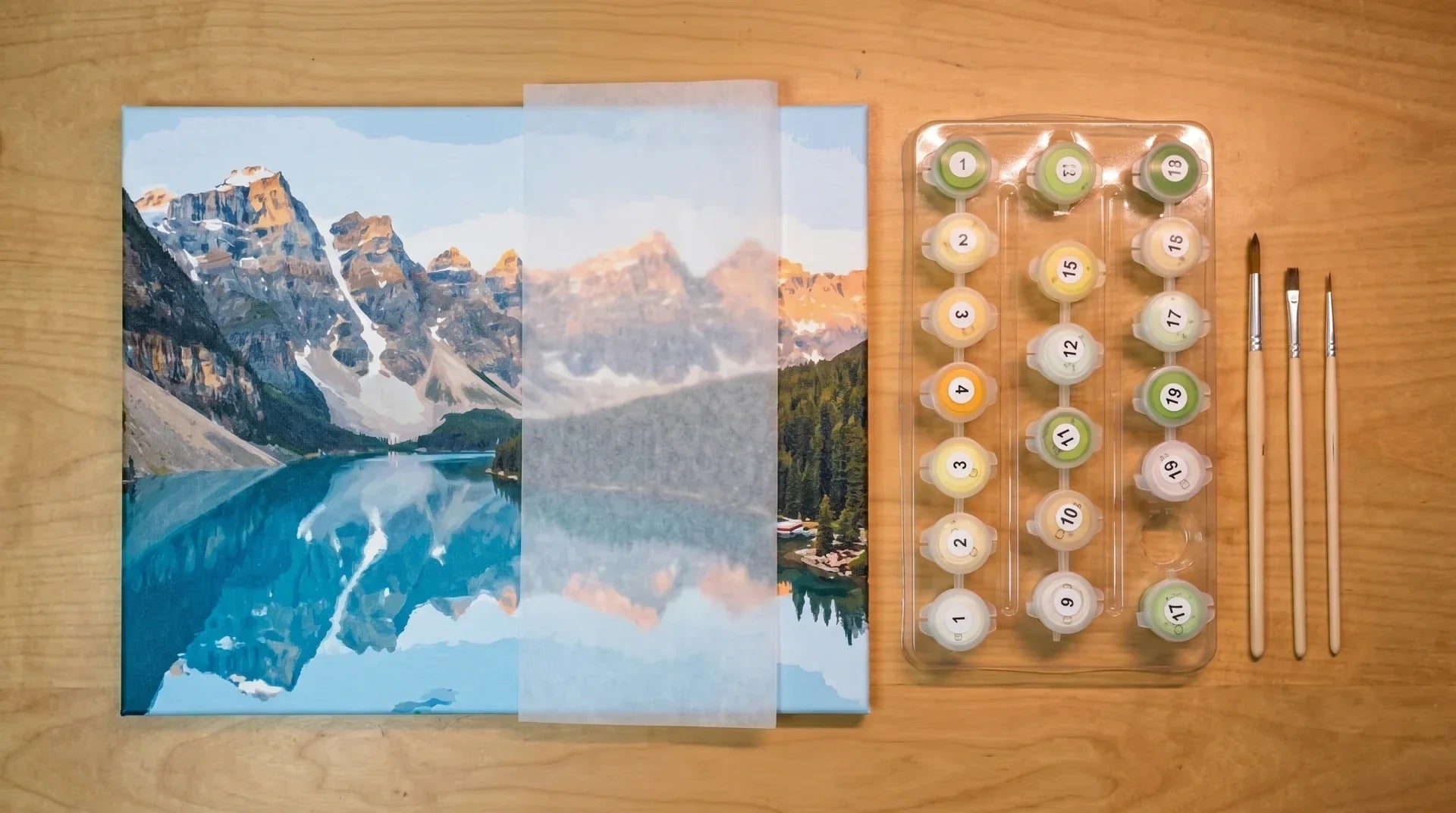
What can you do during those two weeks? Leave the painting flat on a surface, in a low-traffic room, away from direct sunlight. Cover it loosely with a piece of tracing paper or thin tissue if you are worried about dust. Do not stack anything on top of it. Do not touch the surface. After two weeks the paint is mechanically stable enough to varnish, frame, or hang.
Should you seal the painting?
This is the question I get most. The honest answer is that you can leave a paint-by-numbers unsealed and it will be fine for years, especially if it is hung on a wall away from kitchen grease and direct light. Most of our customers do not seal their kits at all. The painting holds up, the colours hold up, and there is no compelling reason to add a step.

The reasons to seal it are specific. If the painting is going to live somewhere it will collect kitchen grease or smoke, a varnish gives you a cleanable surface and your painting back via a damp cloth instead of a dust storm. If you want a uniform finish across the whole surface (acrylic varies in glossiness depending on which pigments are denser), a single coat of gloss or matte varnish evens it out. If you are giving the painting as a gift and want it to feel finished-finished, the varnish adds about thirty percent to the perceived production value.
If you decide to seal it, the choice is between a proper picture varnish (removable, the conservation-grade option), a gel medium (permanent home-grade protective coat), or a spray sealer (the easy option). I cover the trade-offs in more detail in our acrylic gel medium for paint-by-numbers article, but the short version: gel medium is what most home painters end up using because it is forgiving to apply and the finished feel is good. Varnish is what you would use if the painting was going to a museum.
The frame question
Paint-by-numbers canvases ship pre-stretched on a wooden frame, which means they are wall-ready without any additional framing. You can absolutely hang the bare stretched canvas as it is, especially if you painted the side edges in step one above. Many of our customers do this and the result looks intentional, not unfinished.
The argument for adding a frame is presentation. A simple wood frame in a colour that complements the painting (warm wood for warm-toned subjects, dark wood for cool-toned subjects) gives the piece a final visual border. It also protects the side edges from wall-bump damage. I have a longer article on how to frame paint by numbers that walks through the depth question (pre-stretched canvases need deeper frames than flat prints) and the corner-clip versus glued-frame trade-off.
One thing not to do: do not put glass over a finished acrylic paint-by-numbers. Glass traps any residual moisture from the curing process, sometimes for years, and the painting can develop spots or cloudiness under the glass. Acrylic paintings are meant to breathe. The whole industry standard is no glass on acrylic, only on watercolour and prints.
How to hang and where
The hanging decision is mostly common sense, but two specifics that matter. First, avoid direct sunlight on the painting for any sustained period. Acrylic pigments are reasonably lightfast at the artist-grade level, but a south-facing wall in direct afternoon sun will fade colours over a few years. A wall that gets reflected daylight is fine. A wall that gets the actual sun beam through a south window is not.

Second, the kitchen-bathroom rule. Humidity over 70 percent for extended periods softens an acrylic paint film, even after full cure. A kitchen wall ten feet from the stove is fine; a wall right above the kettle, less so. A bathroom is generally a bad idea unless the room has serious ventilation. A living room, bedroom, hallway, dining room are all unproblematic.
Hanging hardware is the easy part. A pre-stretched canvas at sixteen by twenty inches weighs almost nothing and can hang from a single picture hook in drywall. Heavier framed pieces want two hooks for stability rather than load. Use a wall anchor for anything heavier than a few pounds.
Maintenance over time
An acrylic paint-by-numbers that is hung and left alone is essentially maintenance-free for the first few years. The thing that creeps up is dust, which settles on the slightly-tacky acrylic surface and dulls colours over time. The Smithsonian's MCI page on caring for acrylic paintings recommends a soft dry brush or microfiber cloth to lift dust off the surface, no water, no cleaners, no pressure. Do this once a year and the painting stays looking the same as it did the day you hung it.
If you varnished the painting, you can additionally wipe it down with a slightly damp cloth, which deals with kitchen-grease accumulation. Unvarnished paintings should stay dry-cleaning only.
The avoidable finishing mistakes
Pulling these together as a checklist because they are the ones that ruin kits most often.
Rolling the canvas for transport in the first two weeks. The paint film is not flexible enough yet, and the curl produces fine cracking that you cannot un-do.
Varnishing on the same day you finish painting. The varnish bonds with uncured paint, and the surface goes cloudy. Two weeks minimum before varnish.
Putting glass over the painting. Traps moisture, causes spots. Acrylic paintings do not need or want glass.
Spraying perfume, hairspray, or aerosol of any kind near the finished painting in the first month. Aerosol particles land on the still-soft surface and create a permanent textural haze.
Hanging in direct sunlight. Even artist-grade pigments fade over a few years of direct beam.
Skipping the edge work. The painting feels unfinished even when it is technically complete, and the fix is twenty minutes with a small brush.
Frequently asked questions
How long should I wait before varnishing a paint-by-numbers?
Two weeks minimum at room temperature, three to four weeks if your house is cool or humid. The paint feels dry inside an hour but is not chemically stable enough to varnish for much longer. If you varnish too early the surface goes cloudy or grainy and is hard to fix.
Do I need to seal my finished paint-by-numbers?
Not really. Most customers do not seal their kits at all and the paintings hold up fine. Seal it if it will collect kitchen grease, if you want a uniform finish, or if it is a gift you want to feel more polished. Otherwise the bare painting on its stretched canvas is fine to hang.
Can I roll my canvas to ship it?
After the painting has fully cured (about two weeks of waiting). Before that, the paint film is not flexible enough and the curl will produce hairline cracks across the surface. If you must roll it earlier, roll it loosely with the paint side out (less compression) and unroll it as soon as it arrives.
What is the difference between gel medium and varnish for sealing?
Gel medium is a permanent home-grade protective coat that bonds with the paint. Varnish is a removable conservation-grade coat that sits on top of the paint and can be cleaned off and replaced. For a home painting you plan to hang for years, gel medium is fine. For a painting that might one day be conserved or restored, varnish is the standard. Most paint-by-numbers go the gel medium route. The longer comparison is in our gel medium article.
Can I hang a paint-by-numbers without a frame?
Yes, and many people do. The pre-stretched canvas is wall-ready, especially if you painted the side edges in matching colours during the finishing pass. A frame adds presentation and edge protection, but it is not required for the painting to look intentional.
These finishing steps apply to every kit, but they matter most on the larger kits made for adult painters that you will actually frame and hang.