Acrylic Gel Medium for Paint by Numbers: When to Use It
By Simon I., co-founder, Paint Kit Studio. Published 8 May 2026.
Key takeaways
- Acrylic gel medium is the same acrylic binder that's in your paint pots, just without pigment. It mixes into paint to extend volume, slow drying, and add gloss; it can also seal a finished painting as a clear protective coat.
- If you run out of a colour mid-kit, water is the wrong fix; gel medium is the right one. A drop of gel medium with the last bit of paint extends usable volume without thinning the colour into a wash.
- For wet-on-wet blending in skies and water, mixing roughly 1 part gel medium to 2 parts paint roughly doubles the working time before the paint sets up.
- For sealing a finished canvas, wait 72 hours after the last brushstroke before applying a thin gel medium topcoat. Acrylic films cure slowly even after they dry to the touch.
- Gel medium is not the same as varnish. Varnish is removable for future cleaning; gel medium is permanent. For a paint by numbers wall piece in a normal home, gel medium is fine. For a museum-grade conservation choice, varnish is the right call.
Bottom line: If you've finished one or two paint by numbers kits and you're starting to hit the limits of what the included paint pots can do, a small bottle of acrylic gloss gel medium opens up three new techniques for the next kit. This article walks through what it actually is, when to reach for it, and how much to mix in.
The customer email that got me writing this
A few weeks ago a customer named Maya emailed us. She was halfway through her second paint by numbers kit, a coastal scene with a lot of sky, and she was frustrated. The sky needed a soft gradient between two blues, but every time she tried to blend the wet edges together, the paint had already started setting and the brush was leaving streaky drag marks instead of a smooth transition.
"I tried watering it down," she wrote. "But then the colour got pale and I could see the canvas through it."
That email is the reason this article exists. The answer Maya needed was acrylic gel medium, and almost no one comes to a paint by numbers kit knowing what that is. PKS sends out roughly 40 replacement paint pots a year because customers run out mid-kit; a fair share of those replacements would have been unnecessary if the customer had a small bottle of gel medium on the desk.
So this is the long version of what I tell anyone who asks. What gel medium actually is, when to use it on a paint by numbers kit, how much to mix, and the one or two ways it can go wrong.
What is acrylic gel medium?
Acrylic paint is a pigment suspended in an acrylic resin binder, plus water. The Smithsonian's Museum Conservation Institute notes that "Artists' acrylic paint was introduced in the 1950s and has been accepted as a viable alternative to oil paint" (Smithsonian MCI, n.d., retrieved 8 May 2026). Acrylic gel medium is the same binder system without the pigment. Open a bottle and the contents look milky white when wet, but they dry transparent.
That difference is the whole reason gel medium is useful. Mixed into paint, it adds volume and gloss without changing the colour appreciably. On its own, it dries to a clear glossy film that can sit on top of a finished painting as a protective coat.

The other thing worth knowing up front: acrylics dry fast. Smithsonian's Museum Conservation Institute notes that "Acrylics dry in less than thirty minutes" (Smithsonian MCI, n.d., retrieved 8 May 2026), which is great when you want to move on to the next numbered section but bad when you're trying to blend two adjacent colours into each other. Slowing that 30-minute window is one of the three things gel medium is good for.
Why would I add it to a paint by numbers kit?
Three reasons, from most common to least.
Extending paint when you run out. The paint pots in any PKS kit have a finite amount of each colour. The 24-colour standard tier ships with smaller pots than the 36 or 48-colour tiers because each colour covers more of the canvas at the standard tier. If you run out of a key colour with one numbered section to go, mixing roughly half a teaspoon of gel medium into the last drops of paint usually gives you another small section's worth of coverage. The colour stays the same; you just have less pigment per square inch. Most painters won't notice the difference at normal viewing distance. This works because the gel medium uses the same acrylic binder system as the paint, so the mixed result behaves identically to the original paint just slightly more transparent. It does not work with water past about 25% dilution. Water past that point breaks the binder system and the paint goes streaky and pale, which is what happened to Maya.
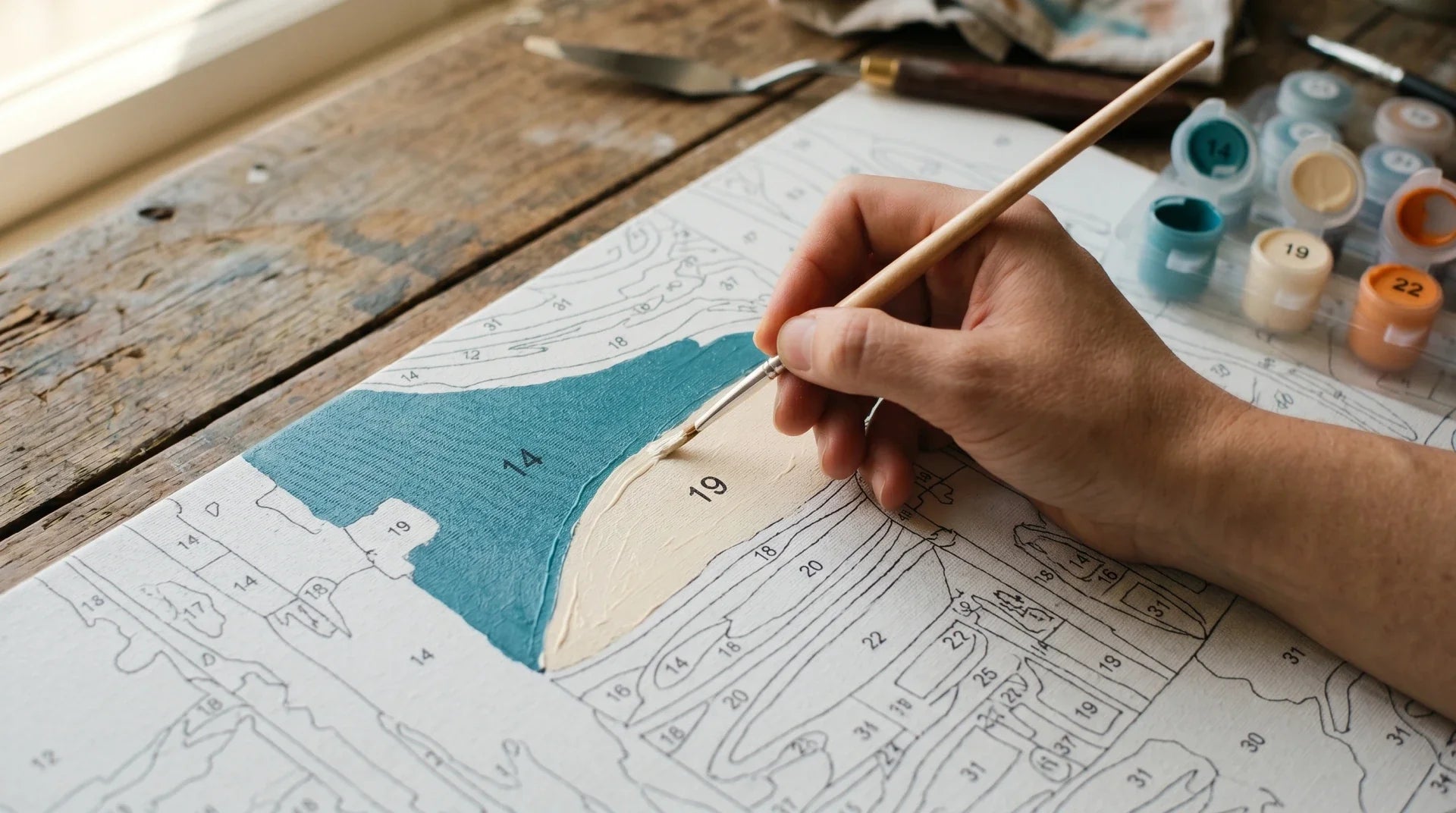
Slowing drying time for blending. Mixing roughly 1 part gel medium to 2 parts paint roughly doubles your working time before the paint sets up. This is the difference between getting a smooth gradient in a sky section and getting drag marks. The technique is to mix the paint and gel medium on a palette card or scrap of glossy magazine paper, paint the section, and use a clean wet brush to soften the wet edge into the next colour. Without gel medium, this technique only works if you can paint very fast. With gel medium, it works at normal painting pace.
Sealing the finished canvas. A thin layer of gel medium brushed evenly over a fully-dried painting adds a clear protective coat over the paint surface. The Smithsonian's painting-care guide notes that "Acrylic films are not as hard as oil films. The surfaces of the soft acrylic films hold onto dust and dirt" (Smithsonian MCI, n.d., retrieved 8 May 2026); a sealing coat of gel medium puts a harder transparent layer between the soft acrylic film and the dust. It also intensifies the colour saturation. The Smithsonian's separate piece on painting varnishes explains why: "Varnishes intensify the appearance of pigments on the painting surface by the refraction of light" (Smithsonian MCI, n.d., retrieved 8 May 2026). Gloss gel medium produces a similar refraction effect on home-display paintings, although it is not a true picture varnish (see the section on sealing technique below for the practical difference).
How much should I mix in?
This depends on what you're trying to achieve. Liquitex's product page for their Professional Gloss Gel Medium notes that you can "mix as much as you like into acrylic color to create the viscosity and transparency you want" (Liquitex, n.d., retrieved 8 May 2026), but in practice there are sensible ranges for paint by numbers work specifically.
| Use case | Mix ratio (gel medium : paint) | What to expect |
|---|---|---|
| Extending paint volume when running out | 1:2 (gel:paint) | Same colour appearance at normal distance, slightly more transparent. Adds one small numbered section worth of coverage. |
| Wet-on-wet blending in skies / water / large gradients | 1:2 (gel:paint) | Roughly double the working time. Smoother gradient transitions. No noticeable colour shift. |
| Glaze layer (transparent colour pass over dry layer) | 3:1 (gel:paint) | Strongly transparent. Used for shadow tinting or warming up a section after it's dry. Optional advanced technique. |
| Final sealing coat over finished canvas | Pure gel medium, no paint | Clear glossy protective film. Apply with a clean flat brush, one even thin coat. |
Test any new ratio on a scrap card before applying it to your actual canvas. Different gel medium brands have slightly different viscosities; Liquitex Professional Gloss Gel Medium specifically can be thinned with "up to 25% water, with distilled water giving best results" (Liquitex, n.d., retrieved 8 May 2026), which is useful when you want a thinner glaze.
Gloss versus matte versus heavy body, what's the difference?
Gel mediums come in three rough categories.
Gloss dries to a shiny transparent finish and intensifies the underlying paint colour. This is the default for paint by numbers work. The PKS gel medium is gloss for this reason; most paint by numbers customers want their finished piece to look slightly more vivid, not less.
Matte dries to a flat finish with no shine and slightly mutes the colour. It's useful if your finished piece is going under glass (where gloss reflections compete with the painting itself) or if you specifically prefer the paper-like look of unvarnished oils. Most home displays don't need this.
Heavy body is gloss gel medium with much higher viscosity, used for impasto work where you want visible brushstroke texture. For paint by numbers work this is overkill, since the kit is designed around flat numbered colour fields rather than expressive brushwork.
For the "should I add it to my desk" question, gloss is the answer. Matte and heavy body are specialist tools for techniques outside the standard paint by numbers workflow.
How do I seal a finished paint by numbers canvas?
Wait at least 72 hours after your last brushstroke before applying any sealing coat. The painting feels dry to the touch within an hour, but the underlying acrylic film continues to cure for several days. Sealing too early can lift the paint or trap solvents under the topcoat.
The application steps are simple.
- Lay the canvas flat on a clean surface in good light. Make sure the painting is fully dry. Run a soft brush over the surface to remove any dust.
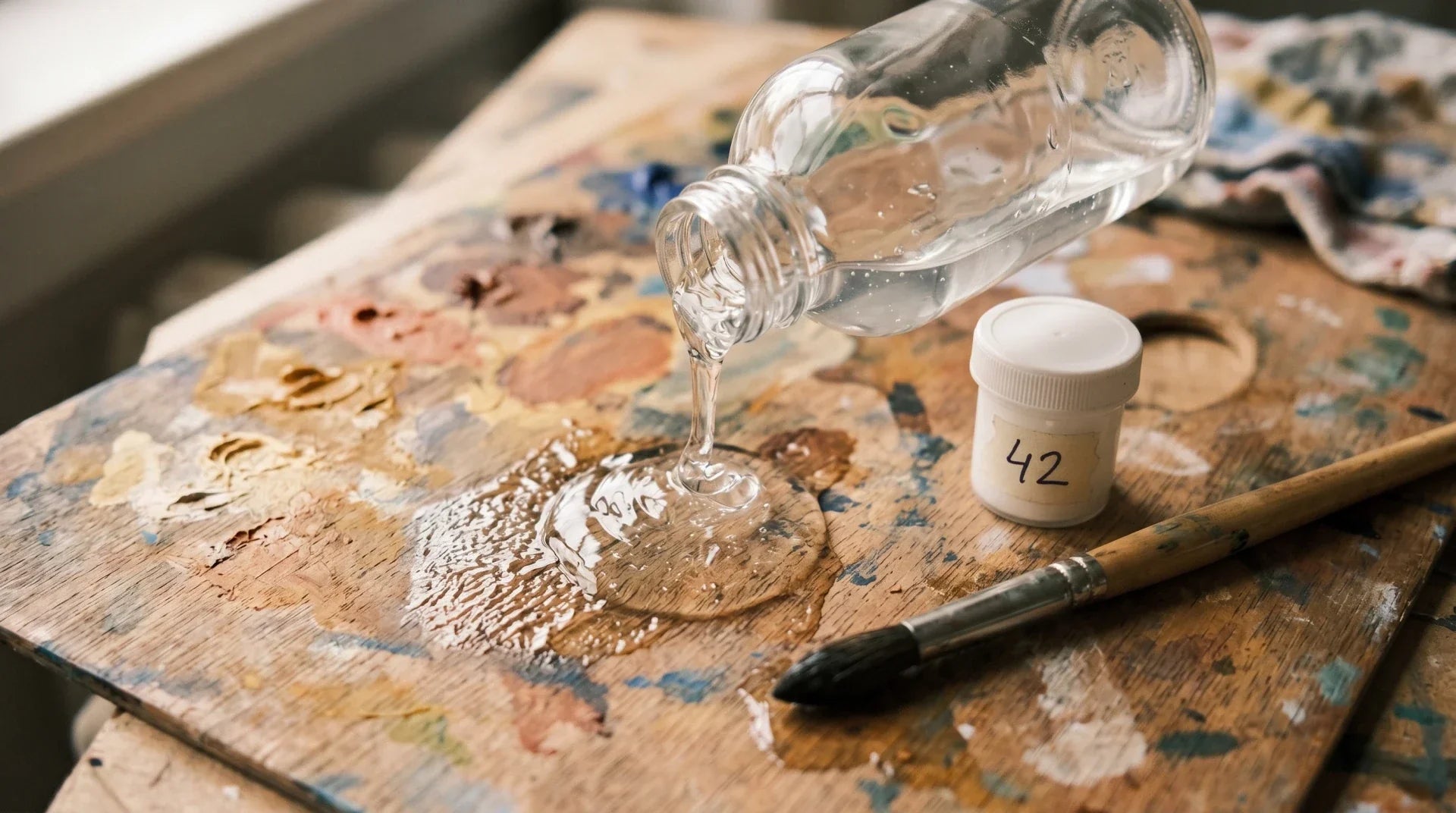
- Pour a small amount of gel medium onto a palette or paper plate. Don't dip your brush directly into the bottle; dust and paint flecks will contaminate the supply.
- Use a clean flat synthetic brush, ideally 1 to 2 inches wide. The flat brush included in your PKS kit will work for a 16 by 20 canvas.
- Brush a thin even coat across the entire painting in one direction. Don't go back over wet sections; let them be. The gel medium looks milky white while wet, which can be alarming the first time. It dries clear.
- Set the canvas flat to dry, away from dust. Drying takes 1 to 2 hours to touch and 24 hours to fully cure.
One coat is normally enough. If you want a more pronounced gloss, you can apply a second coat after the first is fully dry.

One caveat about what gel medium is and is not. The Smithsonian's painting-conservation guidance notes that "The varnish layer plays a dual role: it has [an] effect on the final appearance of the painting and also serves as a protective coating for the paint surface" (Smithsonian MCI, n.d., retrieved 8 May 2026), and that varnishing acrylic paintings is not straightforward because acrylic resin proprietary varnishes share solvent solubility with the paint film itself. Gel medium is not a substitute for a true picture varnish in that sense. It is a permanent, non-removable protective coat that provides a clear topcoat over the painted surface for everyday home display. If you intend a kit specifically as a long-archived heirloom that may need future cleaning or restoration, the right answer is to consult a paintings conservator about an appropriate varnish system rather than apply gel medium. For a paint by numbers piece going on a wall in a normal home, gel medium's permanence is usually fine, and the lower complexity is the practical trade-off most painters want.
When does adding gel medium go wrong?
The most common mistake is sealing too early. Apply a topcoat over paint that's still curing and you can lift colour or trap moisture. Wait the 72 hours.
The second mistake is over-thinning. If you mix gel medium with paint at ratios stronger than 3 parts gel to 1 part paint, the colour goes too transparent for solid coverage. The numbered sections start showing through. For a glaze layer this is fine; for a normal numbered section, you'll need to apply two coats. Stay under 3:1 unless you're glazing on purpose.
The third is brush-pickup. Don't dip your brush directly into the bottle. Pour what you need onto a palette and replace the cap. Gel medium picks up dust and paint flecks easily, and a contaminated bottle becomes useless.
The fourth and least common is using the wrong type. Matte gel medium under a varnish topcoat will dull the painting permanently. If you're not sure which type you have, do a small test patch on a scrap and let it dry before committing to the full canvas.
Frequently asked questions
Does gel medium dry clear?
Yes. Gloss gel medium dries to a transparent film. It looks milky white wet, which can be unnerving on the first application, but the cloudy appearance disappears as it dries. The fully cured film is glass-clear and resists yellowing for years under normal indoor lighting.
Can I use gel medium instead of varnish?
For most paint by numbers wall pieces in a home, yes. Varnish is the right choice for paintings you want to preserve at conservation grade, since varnish can be removed and reapplied for future cleaning, and gel medium cannot. For a paint by numbers canvas hung in a living room or bedroom, the difference doesn't matter in practice; gel medium gives you most of the protection at less complexity.
Will it work with the paints in my Paint Kit Studio kit?
Yes. All paint pots in PKS kits are water-based acrylics, fully compatible with acrylic gel medium. The same answer holds for most other acrylic paint brands you might already own. Acrylic gel medium does not work with oil paints or with watercolour.
How long does one bottle last?
For paint-extending or blending use cases, a 4-ounce bottle covers many kits because you only use a few drops at a time. For final sealing, a 4-ounce bottle covers roughly 8 to 10 16-by-20 canvases at one coat each. Most painters keep a single bottle on hand and replace it once every several months of regular kit work.
Is gel medium safe to ship internationally?
It depends on the carrier. Acrylic gel medium is water-based and not hazardous, so most carriers ship it without restriction. PKS ships internationally to the same destinations as our kits. The gel medium is not a separate hazardous-goods classification.
If you want to keep going from here
If you've never used gel medium and want to start with a small bottle, our Acrylic Gloss Gel Medium ships in a size that suits paint by numbers work specifically; one bottle covers many kits across both blending and sealing use cases.
If you finished your first kit and you're looking at the framing question rather than the sealing question, our walkthrough on how to frame a finished paint by numbers canvas covers float-frame versus traditional frame, sizing, and hanging.
If you're earlier in your paint by numbers journey and want a foundation read, the complete beginner's guide to paint by numbers walks through canvas, paint, and brush selection from scratch.
For shopping the kit catalogue, start at the paint by numbers main hub or browse the paint by numbers for adults collection if you're picking a kit as a hobby project rather than a children's craft.
Last updated 8 May 2026 by Simon I., co-founder, Paint Kit Studio.