Paint by Numbers vs Diamond Painting: When I Tell Customers to Pick Diamond
By Simon I., co-founder, Paint Kit Studio. Published 2026-05-21.
An email landed at 2:14 in the morning, my time, from someone in Western Australia. Her dad's 79th birthday was on Friday. She had three of our paint-by-numbers kits in her cart and one question, written three times in the same message: "will this actually work for him?" Her father has Parkinson's. His hands shake worst in the morning. He had been an architect for forty years and missed using his hands for something visual.
I wrote back at 6 AM and told her not to buy from us this time. I sent three diamond painting brands to check instead. She wrote back at 11 PM with a thank-you and a screenshot of the Diamond Art Club kit she ordered. Her dad's birthday was good.
I get a version of this paint by numbers vs diamond painting question once a week, usually phrased differently. "Should I get paint by numbers or diamond painting for my mum, my recovery, my long flight, my anxiety?" The honest answer is that they solve overlapping but different problems, and the answer most stores give you is wrong on purpose. They sell one of the two and they tell you the one they sell is the better craft. I sell paint-by-numbers kits and I am about to argue against that reflex.
What is the actual difference between paint by numbers and diamond painting?
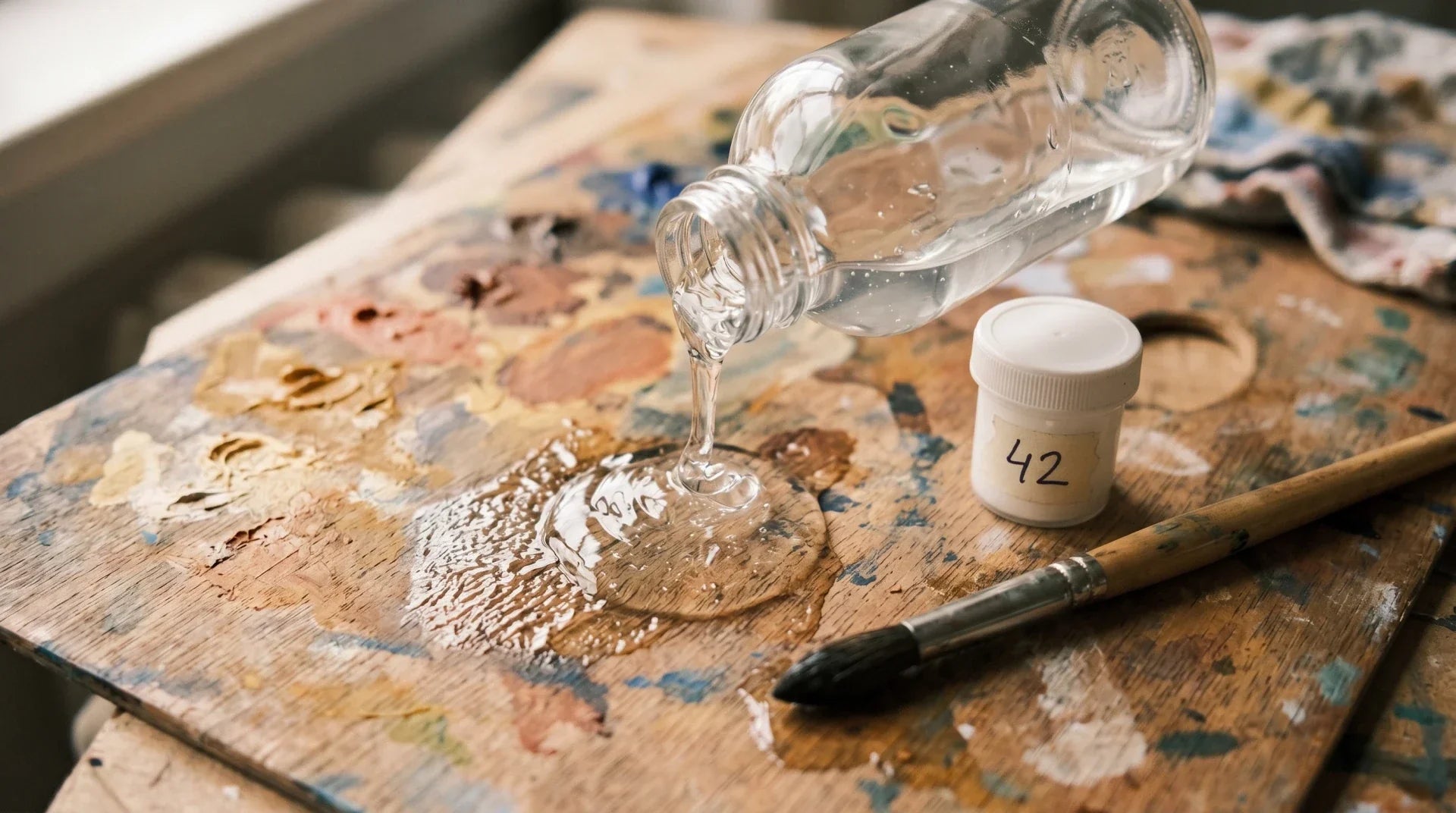
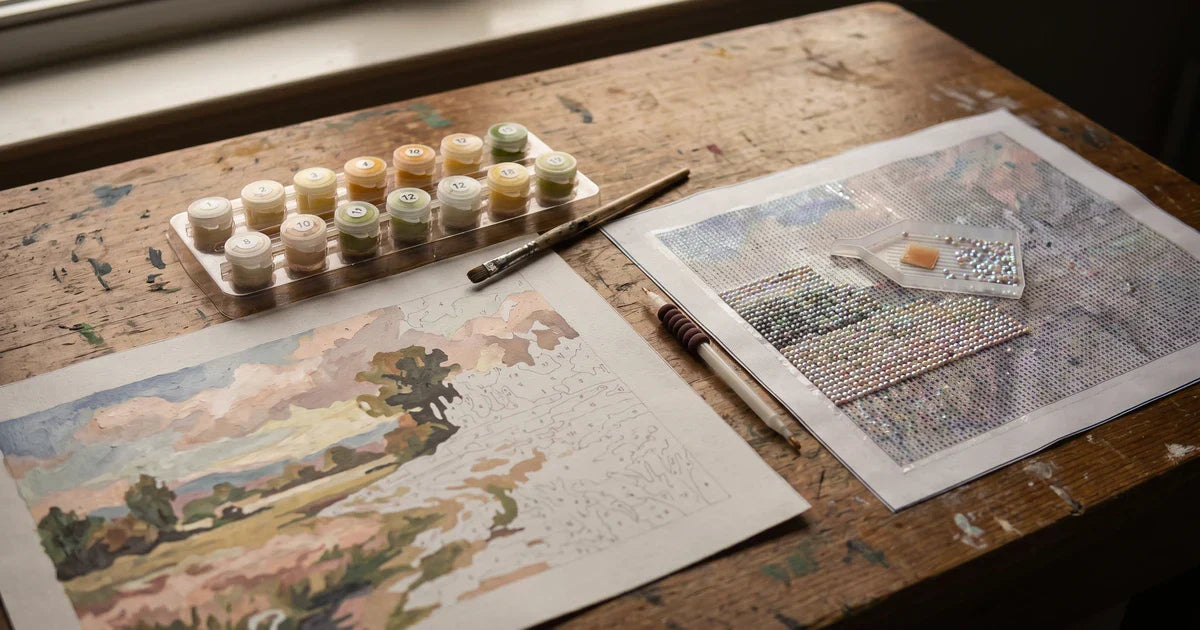
Paint by numbers is a brush craft. You get a pre-printed canvas with faint numbered regions, a set of small acrylic paint pots labelled with matching numbers, and brushes. You match number to region and paint each section. The medium is real acrylic paint, which dries through what Liquitex calls polymer coalescence: "water in the emulsion evaporates, or is absorbed into the painting support. That's when the acrylic polymer particles come into direct contact and fuse with each other" (What is Acrylic Paint, Liquitex, n.d., retrieved 2026-05-19). The finished surface is painterly. Edges can be soft or hard depending on how you handle the brush.

Diamond painting is a mosaic craft pretending to be painting. The kit was developed by Chinese manufacturers in the early 2010s and reached US craft store shelves a few years later (Who Invented Diamond Painting?, Diamond Art Club, n.d., retrieved 2026-05-19). The canvas arrives pre-coated in adhesive under a peelable film. You pick up tiny faceted resin pieces called drills with a wax-tipped applicator pen, and press them onto numbered grid cells one at a time. Round drills sparkle more and place faster. Square drills look cleaner with no gap between them. The finished surface is a glittering pixel mosaic, not a painting in any traditional sense.

This table is the comparison I would show that Australian customer if I were doing it again.
| Dimension | Paint by numbers | Diamond painting |
|---|---|---|
| Medium | Acrylic paint and brushes | Resin drills and adhesive canvas |
| Hand skill required | Brush control, light grip, edge work | Pickup-and-place, no grip strength |
| Hours per 16" x 20" (40cm x 50cm) kit (in our experience) | 20 to 40 hours | 50 to 80 hours |
| Finished look | Painterly, soft or sharp edges | Sparkling pixel mosaic |
| Mistakes | Repaint over with a second coat | Lift and re-place while glue is fresh |
| Travel and pausing | Wet paint, pause at section break | Pause any time, lid the tray |
| Display | Stretch, varnish, or frame | Seal with adhesive sheet, frame under glass |
| Typical retail kit price (our market observation) | $30 to $60 | $25 to $50 |
Should I pick diamond painting if my hands get tired?
This is the first situation where I send people to diamond painting. If the buyer or recipient has a hand condition that makes a small brush stroke unpredictable, the brush is going to fight them on every leaf and eyelash. Tremor, post-surgery weakness, advanced arthritis, late-stage Parkinson's, neuropathy. Diamond painting needs you to pick up a drill and press it down on a grid cell. There is no edge to mess up. There is no second coat to fix. There is no signature on a fine detail that suddenly matters.
A peer-reviewed Korean intervention study followed 28 elderly adults through sixteen sessions that combined physical activity, recreation, and art and craft work like card making, clay pendants, pressed flowers, and mandala mobiles. After eight weeks, "ADL improved remarkably in both men and women" and depression "decreased significantly", especially in women (The effects of a combined physical activity, recreation, and art and craft program on ADL, cognition, and depression in the elderly, J Phys Ther Sci, 2017, retrieved 2026-05-19). The mechanics of placing small objects onto a grid have the same low-stakes, repetitive, success-every-cell shape as those mandala mobiles. The wins compound across a kit. The shaky hand learns it can finish something.
Paint by numbers does not have this property. Every brush stroke is a tiny decision about pressure, edge, and coverage. On a bad day, that is exhausting.
Which one actually wins on speed?
This is the reversal customers do not expect. Diamond painting feels faster while you work, because every drill placed is visible progress. You can see the canvas filling in real time. People film time-lapses of their corners completing. The phone is in everyone's hand again.
The clock disagrees. A full-drill diamond painting at 16" x 20" (40cm x 50cm) has tens of thousands of individual drill cells. By community estimates from major brands, that translates to many more hours of seat time than the same canvas in paint-by-numbers form. A finished diamond painting feels like more work because it is more work. The illusion is that you can see each unit of progress, so the time disappears subjectively. Paint by numbers shows progress in larger blocks, a leaf at a time, a sky at a time, which reads as slower while taking half the hours.
If the buyer's real ask is "I want something to finish before my flight on Sunday", paint by numbers wins. If the real ask is "I want to start something I will not finish for months and that is the point", diamond painting wins.
When does paint by numbers actually beat diamond painting?
I would not write this article if the answer was always one direction. Three situations where I push paint by numbers without hesitation.
One. The finished piece needs to read as a painting from across a room. Diamond painting up close has the texture of a beaded handbag. At three feet it sparkles. At six feet from a sofa, with sidelight, it looks like a craft. A paint-by-numbers kit done with two coats and a final varnish reads as a painting at any distance, because it is one. If the customer is making a wedding gift, a hallway piece, or a portrait of someone they love, paint by numbers is the right answer. Our portraits collection exists for exactly this case.
Two. The buyer wants to feel they made aesthetic decisions. Diamond painting is closer to assembly. The colours are decided, the placement is decided, the grid is decided. You are executing. Paint by numbers gives you small decisions inside each section. How wet to load the brush, whether to soften the edge into the next colour, whether to add a second coat for opacity. A teenager I sold a Van Gogh Café Terrace kit to last month wrote in her Loox review that it was the first time she felt like a "real painter" instead of a "filler-inner". That phrase is doing a lot of work.
Three. The recipient is a long-time painter who is getting bored of their own habits. Paint-by-numbers kits put a competent artist inside a constraint, a fixed palette and fixed shapes, and the result is that they paint differently than they normally would. They come out the other side with notes for their own work.
Are diamond painting drills permanent? Will they fall off?
The adhesive on a fresh diamond painting canvas is strong enough that drills do not fall off during normal handling. The problem is humidity over years. The factory glue is a sticker-like bond, not an industrial one. In humid rooms, edge drills can lift over time without intervention. The standard fix is sealing the finished piece with a clear adhesive sheet sold for this purpose, which is what diamond painting brands like Diamond Art Club describe in their care guides.
Paint by numbers does not have this failure mode. Tate conservation research notes that acrylic emulsion paintings "exhibited high resistance to ultraviolet degradation" and have "outstanding mechanical and aging properties", although they are sensitive to very low temperature and humidity (Conservation Concerns for Acrylic Emulsion Paints, Tate Papers, 2004, retrieved 2026-05-19). A varnished acrylic painting on stretched canvas, kept indoors out of direct sun and not flexed, sits in that same low-risk window. The acrylic film is structurally stable under the conditions Tate describes.
How do I tell which one is right for the person I am gifting?
I ask one question. Does this person want a finished thing on a wall, or do they want a thing to do? If a wall piece is the goal, paint by numbers gets there. In our experience a standard 16" x 20" (40cm x 50cm) kit with a frame finish lands around twenty to forty hours of work. If the goal is the doing, the calm of the repetition, the small reward of each completed cell, diamond painting will give that person more total hours of the activity itself.
Then I ask a second question quietly. What do this person's hands do at the end of a normal day? Tired and sore, with weak grip, send diamond painting. Steady and bored, give paint by numbers. If you do not know, start them on a simpler, lower-detail paint-by-numbers design first, and read our beginners' guide together with them before they open it.
The real difference between paint by numbers and diamond painting no one talks about
Both crafts come from older traditions that nobody markets as "easy art for adults" because both traditions were taken seriously. Diamond painting is the descendant of beadwork mosaic, a craft that built Byzantine churches and Native American regalia and Huichol yarn paintings. Paint by numbers is the descendant of Renaissance workshop apprenticeship, where students filled in their master's underdrawings before they were allowed to do their own. Calling one of these "real art" and the other "a craft" gets the history backwards in both directions.
The thing the category sells you, "easy art for adults who do not paint", is true of both. The thing it does not sell you, that you are participating in a craft tradition that predates the word hobby, is also true of both. Pick by your hands and your week. Stop letting the category sell you the hierarchy.
Frequently asked questions
Is diamond painting easier than paint by numbers?
Mechanically, yes. Diamond painting needs no brush control, no colour mixing, no edge decisions, and no second coat. Time-wise, no. A diamond painting kit at the same canvas size usually takes longer than a paint-by-numbers kit, because there are more units of placement to do.
Can I do both crafts on the same canvas?
Some hybrid kits exist that combine a partial diamond painting area with a paint-by-numbers area. They are a novelty rather than a serious cross-over. The painted side dries flat, the diamond side rises a millimetre or two above the canvas, and the join looks awkward in framed display. Pick one craft per canvas.
Which craft is better for kids?
For kids under about 10, paint by numbers with a small kit and thick brushes is the safer pick in our experience. Diamond drills are tiny, easy to lose, and a swallowing hazard for younger kids. From around 10 upward, either works. Teenagers in our customer base tend to prefer paint by numbers for the same reason adults do, the finished piece reads as a painting they made.
Do I need a special canvas or surface to display either?
In our experience, paint-by-numbers kits ship on canvas that can be stretched on a wooden bar frame or floated on a backing board. Diamond painting kits we have seen tend to ship on a sturdy polyester or vinyl canvas that needs sealing before display, then framing under glass to keep dust off the resin surface. Glass is a real cost. Budget for it.
If I have to pick one to try first, which one?
If you have never done either, start with a smaller paint-by-numbers kit. The skills carry over to almost everything else you might paint later, and the failure mode is gentler. If paint by numbers frustrates you with brush control, diamond painting is a clean second try with the same canvas-on-a-wall goal and almost no fine motor demand. If diamond painting bores you with the lack of decisions, paint by numbers is what you actually wanted.
If it is the painting side that pulls you, our paint by numbers for adults collection is where most grown-up beginners start.
If you land on the painting side, browse our full range of paint by numbers kits to get started.
Last updated 2026-05-21. Read more about how we test our kits, or email me directly at support@paintkitstudio.com with a question about choosing a kit for a specific person.