How to Remove Acrylic Paint From Clothes (Wet, Dried, and the Stains You Can't Save)
By Simon I., co-founder, Paint Kit Studio. Published 2026-05-22.
A customer named Megan emailed our support line on a Sunday night. Her nine-year-old had knocked a pot of our cadmium-red across a school uniform shirt about an hour before she wrote. She had already done the worst possible thing and run it under the hot tap. The stain had set into a stiff pink patch about the size of a coaster. She wanted to know which of our products would fix it. None of them would. The fix was never a product. It was a process, and the part of that process that mattered most had already gone past while she was looking for a bottle to spray.
I run a paint-by-numbers company. Paint on clothes, paint on the carpet, paint on the good tablecloth, we hear about it most weeks. What follows is what I actually write back. And the headline almost nobody puts first: the ten minutes right after a spill decide most of how it ends. The rest of this article splits into two halves depending on whether you still have those ten minutes.
Can you actually get dried acrylic paint out of clothes?
Partly. Sometimes. It hangs on three things, which are how long ago it dried, what the fabric is, and how dark the colour is. Here is why I cannot just say yes.
Acrylic paint is pigment suspended in an acrylic polymer emulsion. While it is wet, water holds the polymer apart and the whole thing rinses. Once the water leaves, that changes. Liquitex describes the moment the water evaporates: "the acrylic polymer particles come into direct contact and fuse with each other", and "the clear polymer particles organize themselves into a stable, hexagonal structure, trapping the pigment in place" (What is Acrylic Paint, Liquitex, n.d., retrieved 2026-05-20). That fused structure is a thin sheet of plastic, and a durable one by design. Tate conservation researchers note that acrylic emulsion paint films have "outstanding mechanical and aging properties" (Conservation Concerns for Acrylic Emulsion Paints, Tate Papers, 2004, retrieved 2026-05-20). On a canvas that durability is the whole point. On a shirt it means the paint is no longer resting on the fabric. It is locked into the weave. Clorox says it without softening it: "while wet, acrylic paint is water soluble, but once dried, it becomes permanently embedded" (How to Get Acrylic Paint Out of Polyester Clothes, Clorox, n.d., retrieved 2026-05-20).
So getting dried acrylic out is not cleaning. It is breaking a plastic film off fabric without taking the fabric with it. Some days that works. Some days it does not. The rest of this article is mostly about telling those days apart before you commit to anything you cannot undo.
What should I do in the first ten minutes?
This is the section that matters. A wet paint stain is not a difficult situation yet. You keep it that way by moving fast and not going hunting for the perfect product first.
The window is short because acrylic skins over quickly. Golden Artist Colors splits drying into two stages, a first one where "very thin films can feel dry within seconds", and a second, far slower one for "the entire thickness of the film to be thoroughly dry" (Drying Technical Notes, Golden Artist Colors, n.d., retrieved 2026-05-20). A smear on a shirt is about as thin a film as paint gets. It can start skinning in minutes. So get to a tap before it does.
Four steps:
- Scrape off the excess with a spoon edge or a butter knife. You want to lift the blob, not press it in deeper.
- Turn the garment inside out. Run cold water through the back of the stain so the paint gets pushed back out the way it came in, instead of further through the cloth.
- Keep the water running until it runs clear. Cold the whole time. Heat is the thing that sets paint, and a surprising number of people reach for warm water on instinct.
- Rub a bit of dish soap or laundry liquid into the spot with your fingers, then rinse it again.
No scrubbing in circles, no hot tap. Both of those just spread the pigment sideways and hurry the skinning along. That is the whole protocol. It is not clever, and it needs nothing you do not already own, which is probably why people skip past it looking for something that feels more like a solution. Flush a wet stain properly inside that first ten minutes and, most of the time, the shirt goes through a normal wash afterwards and you forget it ever happened.

How do I remove acrylic paint that has already dried?
If you are reading this part because the paint is already a hard patch, here is the version without the optimism. The ten-minute window is gone. From here you are using a solvent to break a polymer film, and you might get a full save, you might get a faint shadow left behind, you might get nothing. Going in knowing that, rather than expecting a guaranteed rescue, is what stops you doing something you regret to the garment.
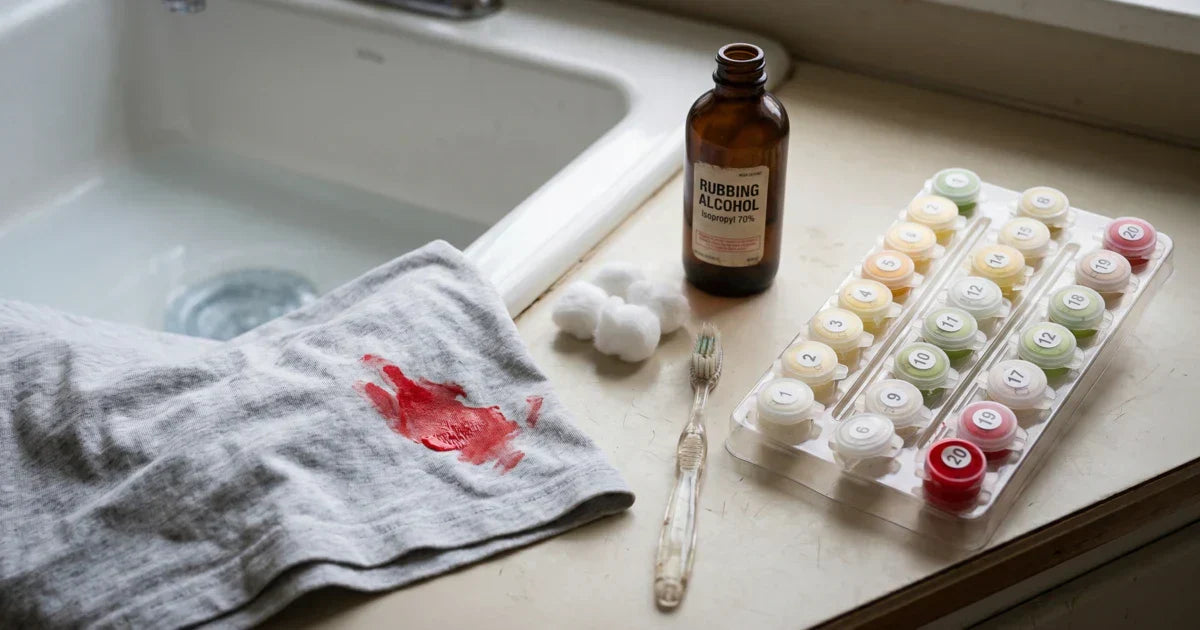
The tool is isopropyl alcohol, the rubbing alcohol from the chemist. It softens a cured acrylic film without the fabric-melting risk that comes with acetone or paint thinner. How I do it:
- Put the garment on an old towel, stain up, and scrape any raised crust off with a blunt edge.
- Dab isopropyl alcohol onto the stain with a cotton ball. Leave it a minute so it can soak into the film rather than just wet the surface.
- Work from the outside of the stain toward the middle. Going edge-inward keeps you from smearing the border into clean fabric.
- Lift the softened paint with an old toothbrush. It comes away in little flecks, and seeing that is how you know the alcohol is doing its job.
- Rinse, wash as normal, and then look at the stain before the garment goes anywhere near a dryer. Dryer heat sets whatever the wash left behind.

If you would rather follow a consumer-brand routine, Clorox runs basically the same logic: scrape, rinse warm water through the back, soak with a colour-safe stain remover for about ten minutes, work it in, then machine wash with whatever bleach the fabric can take. Soften, lift, rinse, check before heat. That sequence is the part that matters, whatever product is in your hand.
Does the fabric type change what I should do?
It does, and this is the bit most spill advice quietly gets backwards. People assume natural fibres like cotton are the forgiving ones. Cotton breathes, it washes well, it feels like the wholesome choice. For paint it is the hard case. Cotton is absorbent and porous, so wet paint wicks down into the fibres and grabs hold. A smooth synthetic gives the paint much less to sink into. The cheap polyester shirt is usually the easier rescue. The nice cotton one is the one that fights you.
| Fabric | How acrylic behaves on it | Approach |
|---|---|---|
| Cotton, linen | Absorbent and porous, paint wicks deep into the fibres and grips | The most patient treatment; alcohol, repeat, and accept a faint shadow may stay |
| Polyester, nylon | Smooth and non-absorbent, wet paint sits closer to the surface | Often lifts well if you catch it wet; alcohol works cleanly on a dried stain |
| Denim | Dense cotton weave, surface paint flakes off but the deep stain digs in | Scrape first, then alcohol; a slight shadow in the weave is likely |
| Wool, silk | Delicate protein fibres that solvents and bleach will damage | Cool water blotting only, then take it to a professional cleaner |
| Spandex, elastane blends | Stretch fibres that strong solvents can degrade over time | Mild soap and water; spot-test on a hidden seam before any alcohol, or skip it |
If you genuinely do not know what a garment is made of, read the care label before you reach for the alcohol. The solvent that saves a cotton t-shirt is the same solvent that can finish off a wool jumper.
What should I never do to a paint stain?
The mistakes do more harm than the spill. Ranked by how often they cross my inbox:
Hot water. Heat sets the polymer, full stop. The hot tap is the exact reason Megan's stain turned permanent inside an hour. Cold water, every time, until the stain is genuinely gone.
The dryer. A tumble dryer is just a hot box. New Mexico State University's extension stain guide puts it in five words: "Heat sets stains" (Removing Clothing Stains, New Mexico State University Extension, n.d., retrieved 2026-05-20). If a treated garment still shows anything, do not dry it. Treat it again wet and let it air-dry instead.
Scrubbing in circles. That grinds pigment sideways into fabric that was still clean, and a small spot becomes a wide grey smudge. Blot and flush. Do not scrub.
Bleach on the wrong fabric. Never bleach wool, silk, leather, or spandex. On protein fibres bleach does not really lighten the stain, it eats the garment underneath it.
Acetone and paint thinner. Yes, they lift acrylic. They also dissolve some synthetic fabrics outright, and their vapour is flammable, so they are a genuine hazard near heat, sparks, or open flame, including the electrics in a washer or dryer. For almost every spill that happens in a normal house, isopropyl alcohol is the solvent to reach for instead.
When is a paint stain genuinely not coming out?
This is the part the other guides skip, because admitting it does not sell a product or a clever trick. Some stains are finished, and you should be able to recognise one.
The combination that beats you is specific. A dark, heavily pigmented colour. Cured, meaning older than a day or two, and harder the longer it has sat. Bonded into a natural fibre. And, worst of all, already run through a hot wash or a dryer once. By that point the pigment is sealed inside a plastic film. That film has bonded down into porous fibre. The only things strong enough to pull it out will pull the fabric out with it.
Knowing this is worth more than any technique, because the way people lose garments is almost never the paint. It is the chasing. They bleach a wool sweater until there is a hole where the stain was. They soak elastane leggings in alcohol until the stretch is dead. They send a shirt through five hot washes, each one setting the stain a little harder, going after a result that stopped being available after wash one. If you have a fully cured dark stain on cotton and a careful first round of alcohol barely shifts it, that is your answer. Stop there. The choice in front of you is a shirt with a mark on it, or a shirt with a mark on it and a hole.
The reframe worth making
If you paint, you are going to stain clothes eventually. Every painter I know has a paint shirt or a paint apron, and not one of them treats it as a failure. It is more like a uniform. So the smart move is not keeping every garment spotless. It is deciding, before you open the paints, which clothes are allowed to catch a spill.
Keep one apron, or one old shirt, as the designated paint clothing, and let the marks on it just be a record of what you have painted. This is advice we hand out a lot, because plenty of our customers are adults painting at the kitchen table after work, not people with a studio and a smock. Save the ten-minute rescue in this article for the spills that land on something you actually wanted to keep clean. Protect what matters, let the paint clothes be paint clothes, and do not chase a stain past the point where the chasing is what costs you the garment.
If you are setting up to paint and want the mess contained from the start, our beginners' guide to paint by numbers has a short bit on workspace setup, and the common mistakes article covers the spill-prone habits worth dropping early. Every paint-by-numbers kit we ship runs on water-based acrylic, which is the whole reason the ten-minute rule works at all. While the paint is wet, the polymer has not fused yet, so water can still carry it back out.
Frequently asked questions
Does rubbing alcohol remove acrylic paint from clothes?
Yes. Isopropyl alcohol is the most reliable household solvent for cured acrylic paint, because it softens the polymer film enough for you to lift it with a brush. Dab it on, give it a minute, work from the outside of the stain inward, then rinse and wash. It does this more cleanly on synthetic fabric than on cotton.
Will dried acrylic paint come out in the wash?
Usually not by itself. A normal wash cycle does not break a cured acrylic film, and the dryer afterwards just sets whatever is left. Dried paint needs softening with a solvent like isopropyl alcohol first, then a wash, then a check before any heat.
Is it too late if the paint has already dried?
Not automatically, but the odds drop. Freshly dried, light in colour, on a synthetic fabric, it often still lifts with alcohol. Cured for days, dark, on cotton, already hot-washed, it usually does not. Try one careful round of alcohol treatment and let the result tell you.
Does acrylic paint wash off skin?
Yes, easily, while it is wet. Warm water and soap take it off skin within the first few minutes. Even after it dries on skin it peels away in a day or two, because skin sheds and flexes. Fabric is harder precisely because fabric holds the film instead of shedding it.
Can a dry cleaner remove acrylic paint?
Sometimes, and a professional is the right call for wool, silk, or anything you really value. Tell them it is acrylic paint and roughly when it was spilled. They have solvents and controls a home does not, although even a dry cleaner cannot promise a fully cured dark stain will lift.
Last updated 2026-05-22. Read more about how we test our kits, or email me at support@paintkitstudio.com if you are painting with kids and want help setting up a low-mess space before the first spill, not after.