Acrylic Painting Ideas: How to Choose One You Will Actually Finish
By Simon I., co-founder, Paint Kit Studio. Published 2026-05-23.
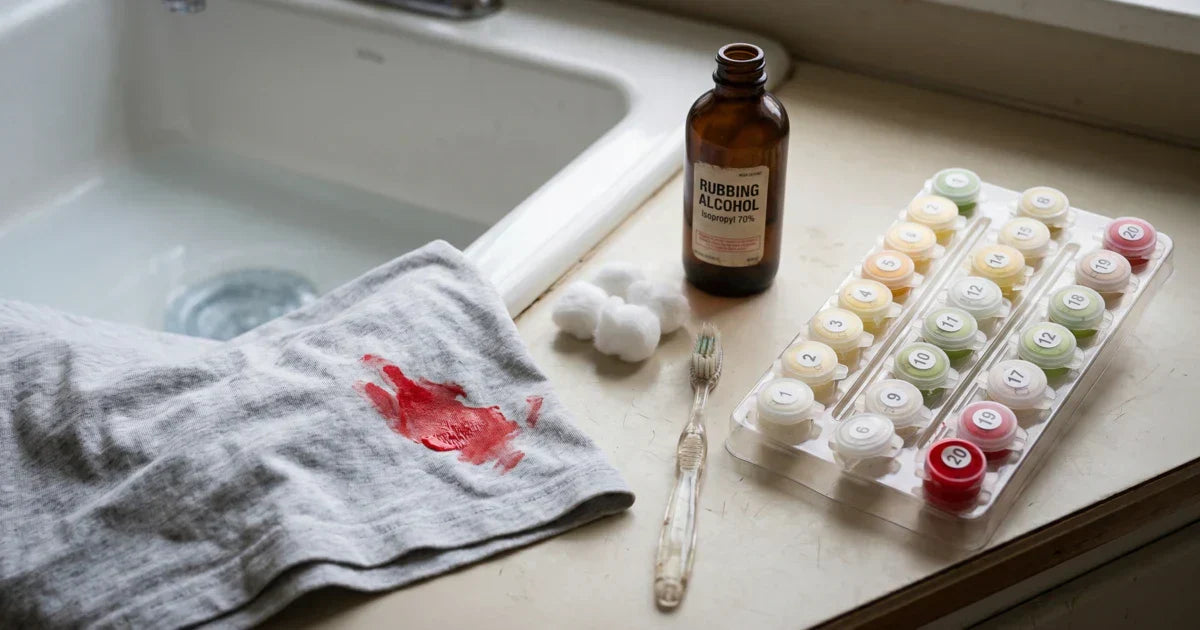
In April a customer named Rachel sent me a photo of an acrylic painting she had given up on, abandoned maybe a third of the way in. It was a bowl of lemons. She had chosen it because some list of easy acrylic painting ideas put a bowl of fruit near the top. The lemons were the whole problem. Every lemon she painted looked slightly off, and because most viewers carry a strong mental image of a lemon, slightly off was glaringly obvious. She could see it herself. So she stopped.
I run a paint-by-numbers company, so I will be honest about my angle here in a second. But first the thing Rachel's email made me want to write down. Most articles about acrylic painting ideas hand you a pile of subjects and wish you luck. They sort them by how interesting they look. Almost none of them sort by the thing that actually decides whether you finish, which is how much a given subject will punish you for being a beginner. That is what this article does.
Why do beginners give up, if it is not for lack of ideas?
Here is the part the ideas lists get backwards. They assume the hard part is not knowing what to paint. In my experience the hard part is almost never that. Pinterest exists. Anyone can find a thousand things to paint in five minutes.
The actual quitting point comes later, usually around hour two, when the painting visibly is not working and the person cannot tell why. They picked a subject that exposes every beginner mistake at full volume, and now they are staring at proof that they "cannot paint". They cannot. Not yet. Nobody can at hour two. But the subject they chose made that fact loud instead of quiet.
So the question is not "what should I paint". It is "what should I paint that will still look alright while I am visibly still learning". Different question. Much more useful one.
What makes an acrylic painting idea forgiving?
Two things, and they stack. The first is the medium. The second is the subject.
Acrylic itself is a forgiving paint, which is half of why it is the standard beginner medium. It is opaque and it dries fast. Liquitex describes opaque colours as ones that "do not allow light to pass through the color layer and offer the best coverage or hiding power" (Art Terms in Acrylic Painting, Liquitex, n.d., retrieved 2026-05-20). In plain terms, a mistake can be covered by the next layer. And because acrylic dries quickly, you do not wait long to do it. Golden Artist Colors notes that with thin films the surface can "feel dry within seconds" (Drying Technical Notes, Golden Artist Colors, n.d., retrieved 2026-05-20). Paint a bad patch, wait, paint over it. The medium is on your side.
The subject is the half nobody talks about. A subject is forgiving when the viewer, including you, has no exact picture of it to compare your version against. Tate defines abstract art as art that "does not attempt to represent an accurate depiction of a visual reality" (Abstract art, Tate, n.d., retrieved 2026-05-20). That is the whole trick. If there is no accurate version to fall short of, you cannot obviously fall short. A wobbly lemon is wrong because lemons are a known shape. A wobbly nebula is just a different nebula.
Which acrylic painting ideas hide mistakes best?
These are the subjects I point new painters toward. Every one of them is genuinely nice to have on a wall, and every one of them quietly absorbs the mistakes a beginner will make.
Abstract colour blocks
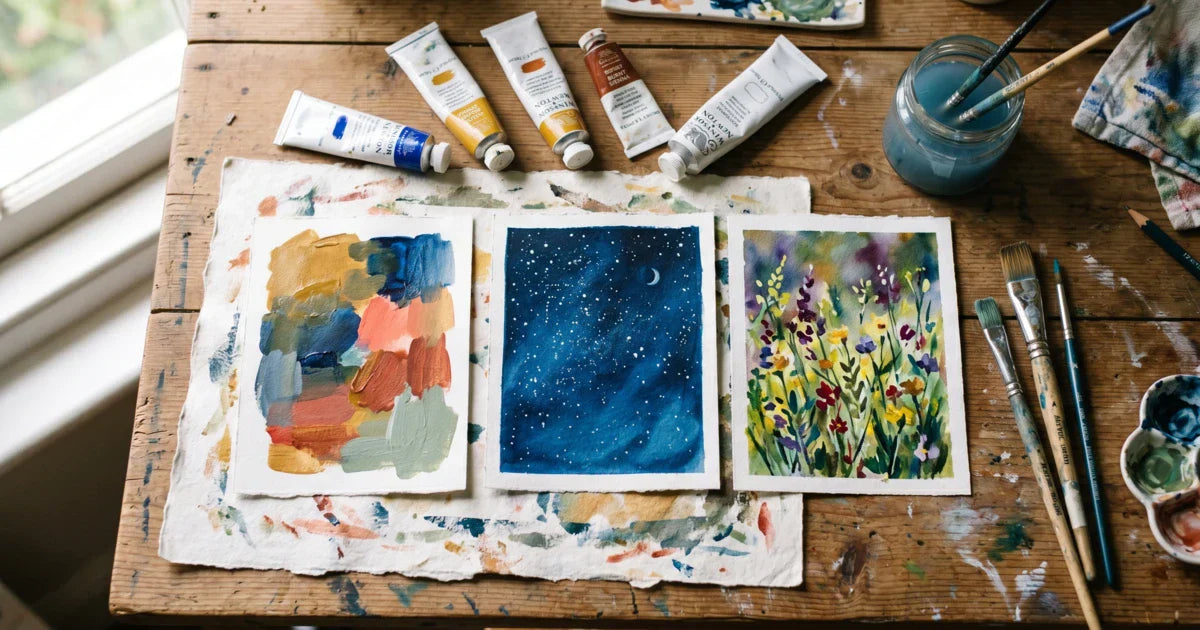
Three or four colours, large simple shapes, no representation of anything. There is no proportion to get wrong because there is no object. Start with three colours you like together and block the canvas into big regions. This is the purest version of the forgiveness principle, and it is also why abstract designs are a calm place to begin.
Night skies and galaxies
A dark base hides an enormous amount. Stars are dots, and a viewer has no fixed expectation of where a star should sit. Begin with a black or deep blue ground, sponge in a soft cloud of lighter colour for a nebula, then flick a toothbrush of white across it for stars. The contrast does the heavy lifting.

Loose florals and wildflower meadows
Flowers vary so much in real life that a misshapen one just reads as another flower. Paint stems and leaves first, then dab petals as blobs of colour. You are not drawing a botanically correct rose. You are suggesting a flower, and suggestion is forgiving. It is the same reason floral subjects are gentle on a nervous beginner.

Misty or foggy landscapes
Fog literally erases detail, so a foggy scene asks you to paint less. Less detail is less to get wrong. Layer pale horizontal bands from light at the horizon to slightly darker, let trees fade into grey, and the softness reads as intentional atmosphere.

Sunsets and colour skies
A sky is a gradient and a mood, not a drawing. There is almost no line work. Blend horizontal bands of warm colour wet into wet, drop in a dark simple silhouette along the bottom, and you have a finished piece that looks far harder than it was.
Moving water and reflections
Water distorts everything anyway, so a wobble in your brushwork reads as movement rather than error. Use broken horizontal strokes, let colours sit next to each other unblended, and the imperfection becomes the point.
Notice the pattern. None of these has a fixed correct shape sitting in the viewer's memory. That is the entire selection criterion.
Which "easy" acrylic painting ideas should a beginner skip?
Now the list to be wary of. None of these are bad subjects. They are bad first subjects, because each one comes with a precise reference image already installed in every viewer's head.
| Idea often called "easy" | Why it punishes a beginner |
|---|---|
| A single fruit or minimal still life | The shape is universally known, so any wobble in the outline is obvious |
| Faces and portraits | Human vision is specialised for faces; a few millimetres off and it looks wrong, even to non-painters |
| Pets | Same face problem, plus you care, so a near miss stings more |
| Buildings and street scenes | Straight lines and perspective are unforgiving; one bad angle tilts the whole painting |
| Hand-lettering and quote art | Letterforms have exact correct shapes, and the eye reads them constantly |
| A photo you personally love | You will compare your canvas to the photo at every step and always feel behind |
The last row is the one I most want people to hear. Painting a photo you adore sounds motivating. It is actually the cruellest first project, because you have set a reference you love directly beside your beginner attempt and you will lose that comparison every time you look up. Paint the photo later, once the skill is there. Not first.
How many acrylic painting ideas do you actually need?
One. Genuinely.
The ideas-list format quietly sells novelty, fifty subjects, a different one every time. The painters I have watched improve fastest do close to the opposite. They pick one forgiving subject, a night sky or a loose floral, and they paint it five or six times. The second sky is better than the first. The fourth is better than the second. By the sixth they have actually learned something repeatable, which is a thing you cannot get from painting six unrelated subjects once each.
Novelty feels like progress. Repetition is progress. A good acrylic painting idea is not a one-off you tick off a list. It is a subject worth coming back to until you have wrung the lesson out of it.
So why is a paint-by-numbers company telling you this?
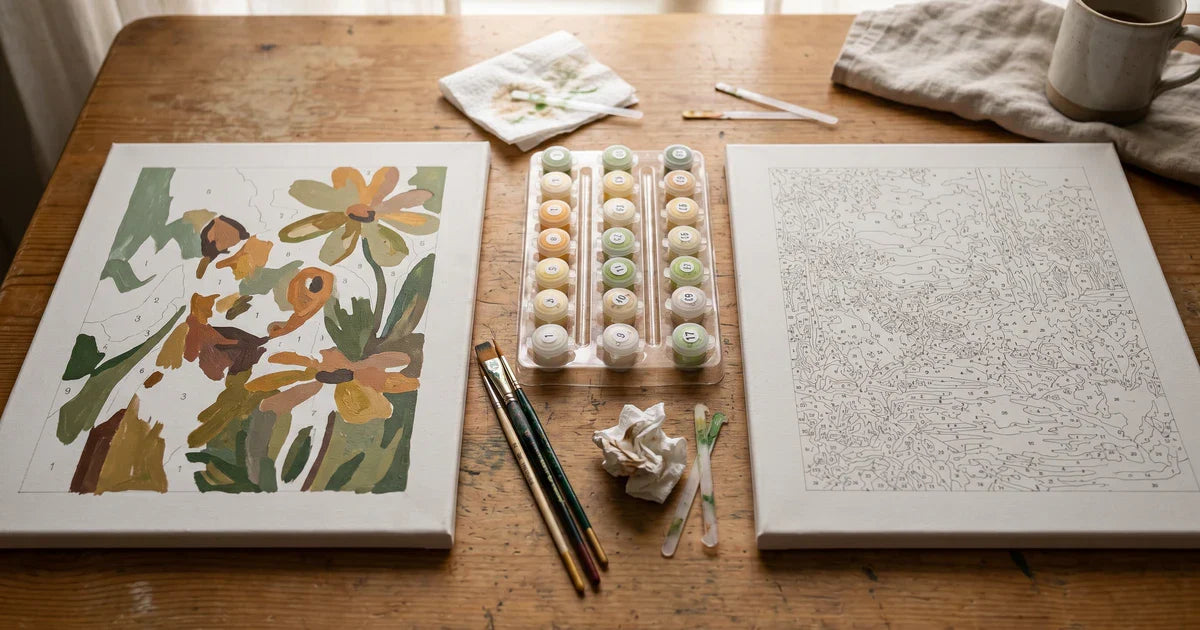
Here is the honest angle I promised. We sell paint-by-numbers kits, and a paint-by-numbers kit exists precisely because choosing and composing a subject is the hard, quitting-prone part of painting. The kit removes that step. The drawing is done, the palette is chosen, the composition works. You supply the brushwork and the calm hour.
So an article telling you how to choose a freehand subject is, a little, an article arguing against my own product. I am fine with that. If you want to paint freehand, you should, and you should choose a subject that does not defeat you in week one. If you would rather skip the choosing entirely and just paint, that is what the kit is for. Both are real painting. Our beginners' guide covers the kit route, and the common mistakes article covers the habits worth dropping early either way. What I do not want is for you to quit over a bowl of lemons and decide painting is not for you. It is. You just picked the wrong lemons.
Frequently asked questions
What is the easiest thing to paint with acrylics for the first time?
An abstract colour block or a night sky. Both have no fixed correct shape, so there is no proportion or perspective to get wrong. You can focus on handling the paint and mixing colour without the subject itself punishing you. A single piece of fruit, despite how often it is recommended, is harder, because its shape is universally known.
Are abstract paintings actually easier for beginners?
Easier to finish without obvious errors, yes. Easier to make genuinely excellent, no. Abstract work has no reference reality, so a beginner attempt does not look visibly wrong the way a beginner portrait does. That makes it a forgiving place to start. Making abstract art that is truly good still takes skill and intent built over time.
What acrylic painting ideas sell or photograph well?
Night skies, sunsets, and abstract colour pieces tend to photograph well because they rely on strong colour and contrast rather than fine detail. They also happen to be forgiving subjects, so this is a rare case where the easy choice and the eye-catching choice are the same choice.
How do I find acrylic painting ideas without copying someone?
Start from your own photos of skies, water, gardens, or shadows, and then simplify hard. Pick one element, blur out the detail, and treat it loosely. The forgiveness comes from the loose treatment, not the source. A photo used as a loose prompt is fine; a photo used as a strict target is the trap described above.
Should I use a reference image at all as a beginner?
Use one for colour and mood, not as a scorecard. Glance at a reference to decide what colours sit where, then paint your own loose version. The moment you start measuring your canvas against the reference inch by inch, you have turned a forgiving subject into an unforgiving one.
If you would rather start from a guided design than a blank canvas, our paint by numbers designed for adults takes the pressure off while you build confidence.
Last updated 2026-05-23. Read more about how we test our kits, or email me at support@paintkitstudio.com and tell me what made you want to paint. I will point you at the route that fits.