Best Paint by Numbers for Adults: How to Choose the Right Kit (Not the Hardest)
By Simon I., co-founder, Paint Kit Studio. Published 2026-05-24.
A customer named David emailed in March. He was 62, recently retired, and he had bought our most detailed kit as a retirement project: 48 colours and very fine numbered sections. The painting itself was not the problem. His eyes were. The numbered regions were too small to read comfortably under his lamp, and squinting through them for an hour was not the calm evening he had pictured. He wanted to know whether he had wasted his money.
He had not, quite. We sorted it out. But David's email is the reason I will not write this article the way these articles are usually written. Most "best paint by numbers for adults" pages are a ranked list of ten kits, one to ten, as if there is a single winner. There is not. The kit that would have been perfect for David's wife was wrong for David. So instead of ranking products, this is how to find the kit that fits the specific adult you are buying for, even if that adult is you.
Is there really a single best paint by numbers kit for adults?
No. And the question itself is half the reason David ended up squinting at section two. "Best" sounds like a property of the kit, something printed on the box. It is not. It is a property of the match between a kit and a person, and a box cannot know the person.
Three things decide that match. One is eyesight, specifically how well the painter still sees fine detail up close. Another is patience, and I mean the real amount a person has on a normal tired evening, not the amount they hope they have. The last is the reason they want to paint at all, which matters more than it sounds and gets its own section further down. Get those right and a modest kit becomes the best kit. Get them wrong and the most expensive canvas in the shop becomes a guilt object on a shelf.
So the rest of this guide is built around those three questions rather than a leaderboard. The leaderboard format sells kits. It does not finish them.
What should an adult actually look for in a kit?
Before the matching, the basics. A kit can have the right design and still be a bad kit if the components are poor. Here is what I would check.
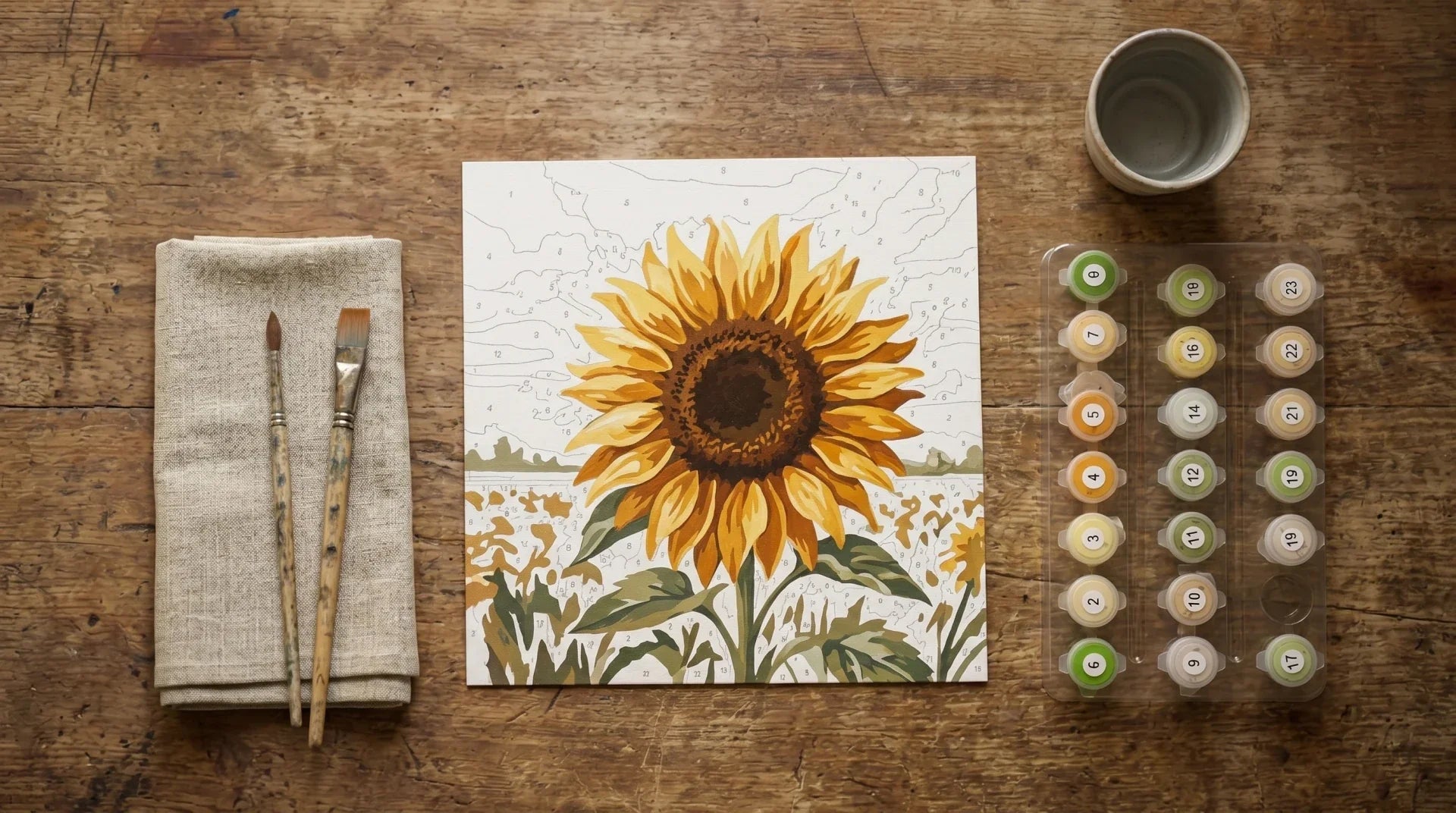
The paint, before anything else. Paint-by-numbers kits use acrylic, and acrylic varies a lot. Liquitex describes good acrylic as "pigment particles dispersed in an acrylic polymer emulsion" (What is Acrylic Paint, Liquitex, n.d., retrieved 2026-05-20). Thin, watery kit paint with weak pigment can take several coats to hide the printed numbers underneath, depending on the pigment and how dark the print is. Better paint often covers in one, maybe two. Nothing else changes a kit from a chore into a pleasure as much as this does.
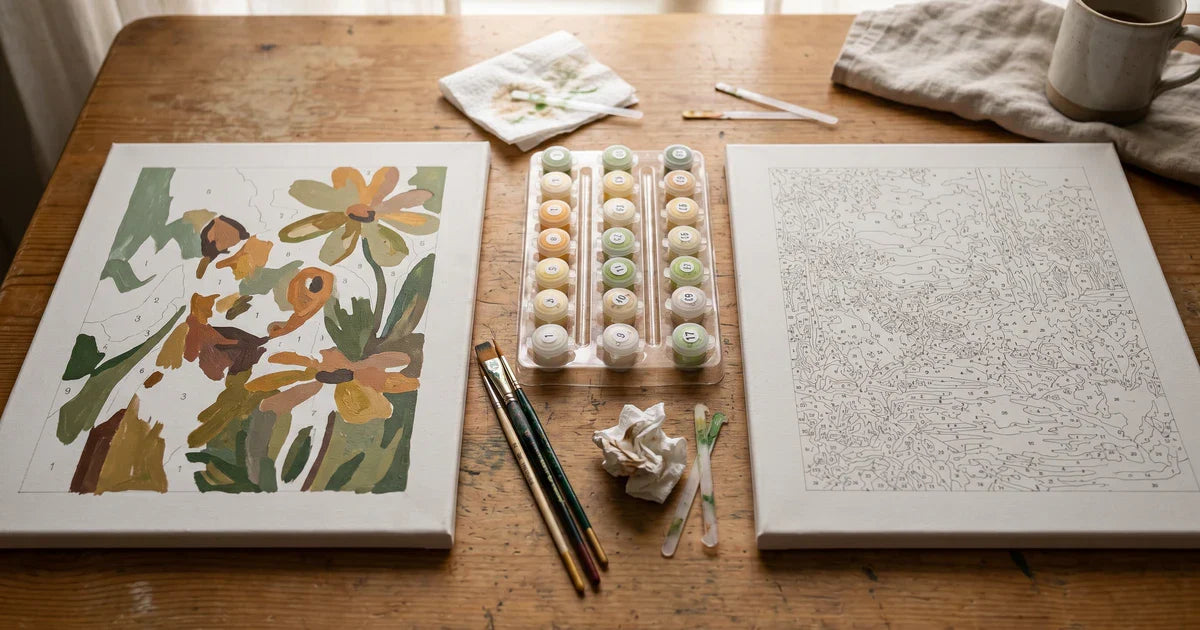
Then the canvas. A pre-stretched canvas on a wooden frame is ready to hang the minute you finish it. A rolled canvas needs stretching or framing later, and that is a job a lot of people simply never get around to. Also look at the printed lines. They should be faint enough to vanish under the paint, not show through it.
Brushes are where kits tend to cut the corner. Most throw in a basic set, and most adults end up buying one decent small brush separately for the fiddly bits. That is fine. Just budget for it and do not be surprised.
And the colour count, which is the spec people read exactly backwards. More colours sounds like more value. What more colours actually means is smaller, more numerous regions to paint. Hold that thought. It is the whole of the next section.
How detailed should an adult's kit be?
Less detailed than the marketing implies, for a lot of adults. This is the reversal that would have saved David an awkward email.
"For adults" has come to mean more detail, more colours, finer sections, as though difficulty were the point. For some adults it is. For many it is the opposite of what they need. The deciding factor is eyesight, and eyesight is not a vanity issue, it is biology. The American Optometric Association notes that with age "the lens inside the eye becomes less flexible", so "many adults may start to have problems seeing clearly at close distances". This normal change, called presbyopia, "will continue to progress over time" (Adult Vision: 41 to 60 Years of Age, American Optometric Association, n.d., retrieved 2026-05-20).
In plain terms: somewhere in the forties, reading small print up close gets harder, and it keeps getting harder. A kit with tiny numbered regions asks the painter to do exactly the thing their eyes are getting worse at, for hours. If you are buying for someone over 50, or for yourself and you already hold the menu at arm's length, choose a kit with larger, fewer regions. The finished painting will look just as good on the wall. The painting of it will not involve a headache.

Why are you painting in the first place?
This is the third question and the one most buying guides skip entirely. The reason behind the purchase should change the purchase.
If the goal is to unwind, the kit should be calm. There is real evidence the calm is the point. A Drexel University study had 39 adults aged 18 to 59 do 45 minutes of art-making, and "75 percent of the participants' cortisol levels lowered", with the effect holding regardless of skill, since "there was no correlation between past art experiences and lower levels" (At Any Skill Level, Making Art Reduces Stress Hormones, Drexel University, 2016, retrieved 2026-05-20). For a stress-relief painter, a simple kit delivers that benefit on evening one. A grindingly complex kit delays it for weeks and adds the low background stress of an unfinished obligation.
If the goal is a genuine challenge, the opposite holds, and a detailed kit is the right call. If the goal is a gift, you are guessing on someone else's behalf, so guess gentle. A kit that turns out a little too easy still gets finished and enjoyed. A kit that turns out too hard becomes a quiet failure the recipient feels slightly guilty about.

| The adult you are buying for | What suits them | What to avoid |
|---|---|---|
| Painting to de-stress after work | A simpler design, fewer colours, larger regions | Anything marketed on its difficulty |
| Over 50, or needs reading glasses | Large regions, bold lines, 24 to 36 colours | Fine-detail kits with tiny sections |
| Wants a real challenge | A detailed design, 48 colours, fine sections | A kit they will outgrow in one sitting |
| Total beginner, unsure | A moderate design, 24 to 36 colours | The most detailed kit as a "statement" |
| A gift, recipient's taste unknown | Gentle subject, moderate detail, safe difficulty | Guessing ambitious on someone else |
When should an adult buy a cheaper or simpler kit?
Often. More often than a shop has any incentive to tell you. I will tell you anyway.
Buy simpler if this is the first kit in years, or ever. The goal of a first kit is not a masterpiece. It is one finished painting, because finishing one is what makes a person reach for a second. A simple design finished beats an ambitious one abandoned, every time, and a lower-detail kit usually costs less too.
Buy cheaper if you are not sure the person will take to it at all. A modest kit is a low-stakes test. If they love it, the next kit can be the ambitious one, and it will mean more because they chose it knowing what they were choosing.
Spend more only in two cases. One, the painter has finished kits before and is genuinely ready for a step up. Two, it is a keepsake, a custom kit from a personal photo, where the subject itself is what carries the value. Outside those two cases, the cheaper kit is usually the smarter buy, and I would rather tell you that and have you come back than sell you a canvas that defeats you.
So what is the best paint by numbers kit for adults?
The honest answer is the one I have been circling the whole article. The best paint by numbers kit for an adult is the one that is still being painted next month.
It is not the most detailed kit, or the one with the most colours, or the one that looked most impressive in the shop. It is the kit whose detail level matches the painter's eyes, whose difficulty matches the patience they actually have on a tired evening, and that delivers the calm or the challenge they wanted in the first place. Match those and almost any well-made kit becomes the best kit. Miss them and the leaderboard's number-one pick still ends up on a shelf at section two.
If you want to browse with those three questions in mind, our paint by numbers for adults collection is sorted so you can browse by subject and difficulty rather than guess. The beginners' guide walks through a first kit start to finish, and the common mistakes article covers what trips adults up early. And if nothing in the main range fits, email me. I would genuinely rather point you at the right kit than the dearest one.
Frequently asked questions
What size paint by numbers kit is best for an adult beginner?
Our kits come in one size, 16" x 20" (40cm x 50cm), which we settled on because it is large enough to feel like a real painting and still small enough to finish. For an adult beginner the lever that matters is not the canvas size, it is the design. Choose one with fewer colours and larger numbered regions, around 24 to 36 colours, and leave the most detailed designs until you know you enjoy it.
How many colours should an adult's kit have?
For most adults, 24 to 36. More colours mean smaller and more numerous regions, which looks impressive on the box and feels harder in the chair. A 48-colour kit suits a painter who has finished kits before and specifically wants more detail. It is not automatically better.
Is paint by numbers too easy or childish for adults?
No. The adult appeal is not difficulty, it is the calm focus of the activity. The Drexel research above found art-making lowered stress hormones regardless of skill level. Plenty of adults paint kits precisely because the structure removes the pressure to be good and leaves only the pleasant part.
Should an older adult choose a different kit?
Usually yes, and the reason is eyesight, not ability. Near vision stiffens with age, so a painter over 50 is generally happier with larger numbered regions, bolder printed lines, and a colour count of 24 to 36. The finished result looks no different on the wall. The hours spent painting are far more comfortable.
Are expensive paint by numbers kits worth it?
Sometimes. A higher price often buys better acrylic paint and a pre-stretched canvas, which genuinely improve the experience. It also sometimes just buys more colours and a more detailed design, which is only worth it if the painter actually wants that. Pay for component quality. Do not pay for detail you will not finish.
Last updated 2026-05-24. Buying a kit for a specific person and not sure it fits? Email me at support@paintkitstudio.com with their age and why they want to paint, and I will point you at the right design.