Paint by Numbers for Kids vs Adults: An Honest Comparison
By Simon I., co-founder, Paint Kit Studio. Published May 27, 2026.
A customer named Colleen left us a review a while back that has stuck with me. She was working through one of our floral kits in her assisted-living facility's community room, where the other residents stop by in the evenings to watch her progress. "I'm slow but I want to do a good job on this beauty," she wrote. I quote her because that one line says more about who an adult paint-by-numbers kit gets bought for than any product description we could write. Slow. Patient. An evening hobby. Something nice on the wall when she finishes.
The question "paint by numbers for kids vs adults" pulls a steady stream of search traffic, and the existing answers all line up the same comparison points: color count, canvas size, maybe a sentence about complexity. They are technically correct, and they still get people in trouble, because the comparison they are doing is not the one that determines whether the gift works.
The framing that matters
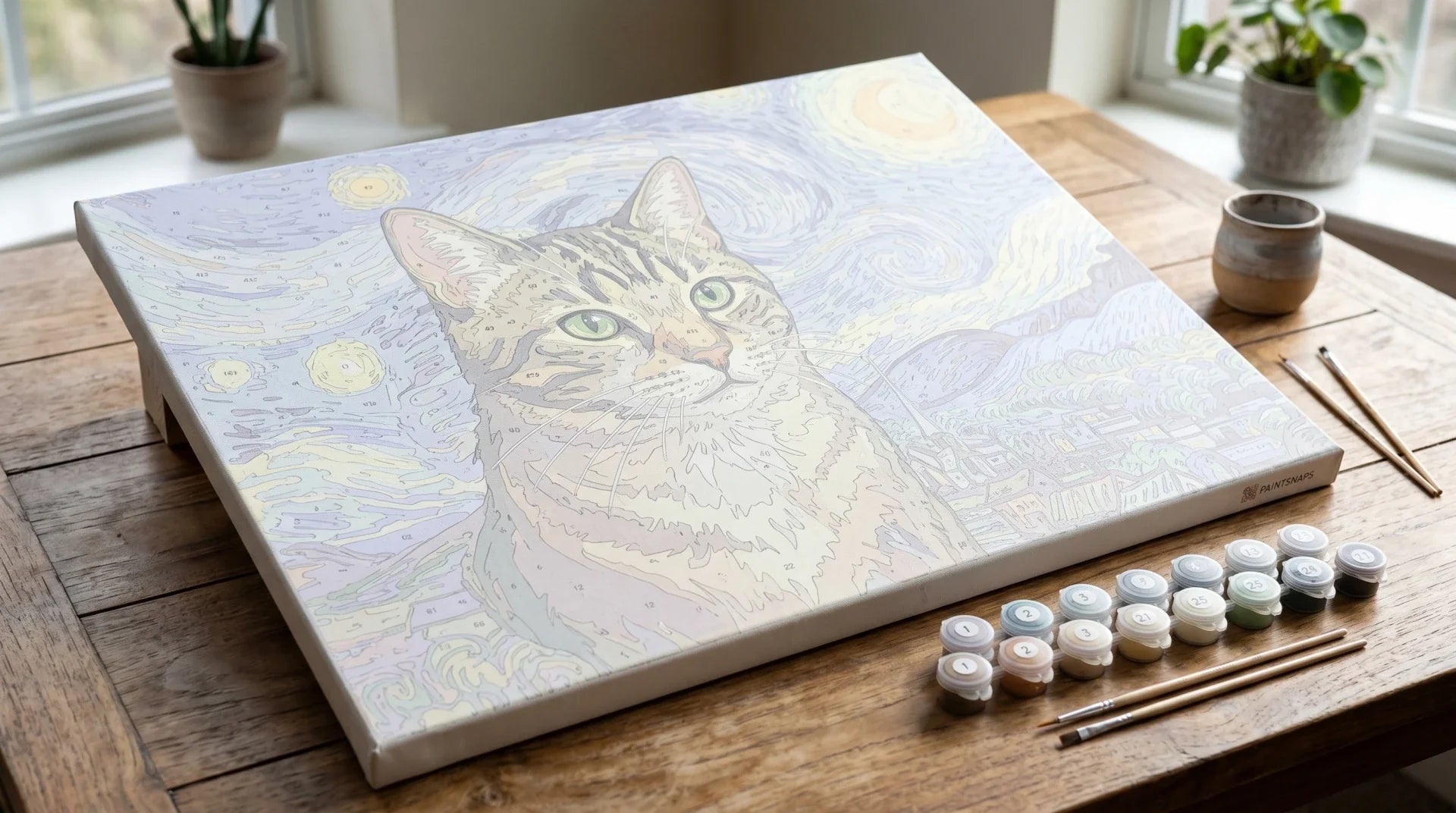
A kid kit and an adult kit are not the same product at two difficulty settings. They are doing two different jobs. A kid kit is a first creative activity, the kind of thing that goes on the fridge after one afternoon and gets a parent saying nice things. An adult kit is closer to an art-making tool, meant to produce a finished thing that hangs on a wall and gets given as a gift with pride. The spec differences (more colors, bigger canvas, real acrylic paint, gallery edges) all follow from that. Purpose drives spec. Difficulty is downstream of purpose.
The reason this matters in practice is that gift orders go sideways when the buyer picks for difficulty rather than purpose. A grandparent buys an adult kit for an eight-year-old because "she loves art." A parent buys a kid kit for a fourteen-year-old because it was on sale. Both gifts arrive and disappoint, and the kit itself is not the problem. The mismatch is between what the kit is designed to do and what the recipient wanted from it.
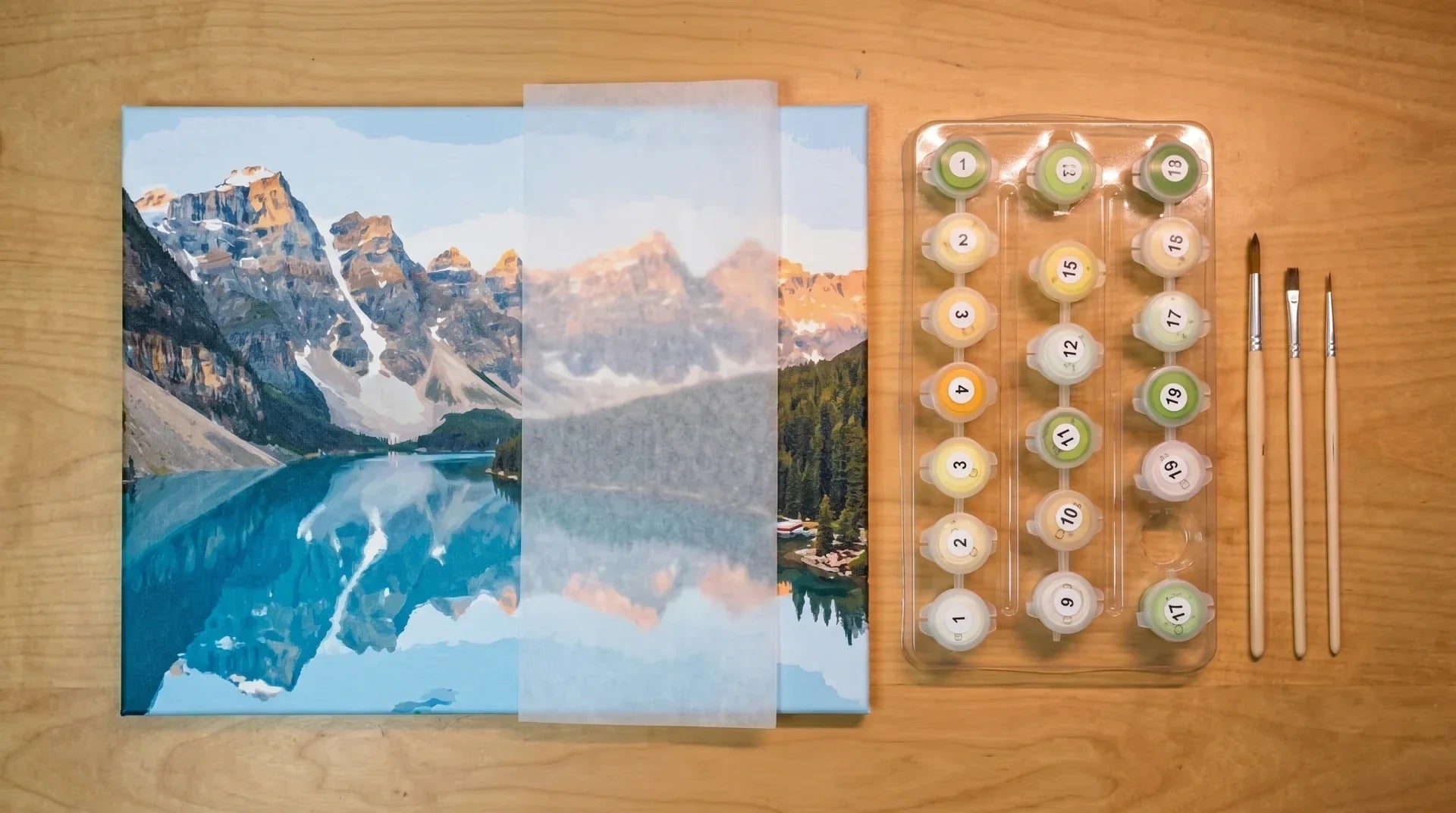
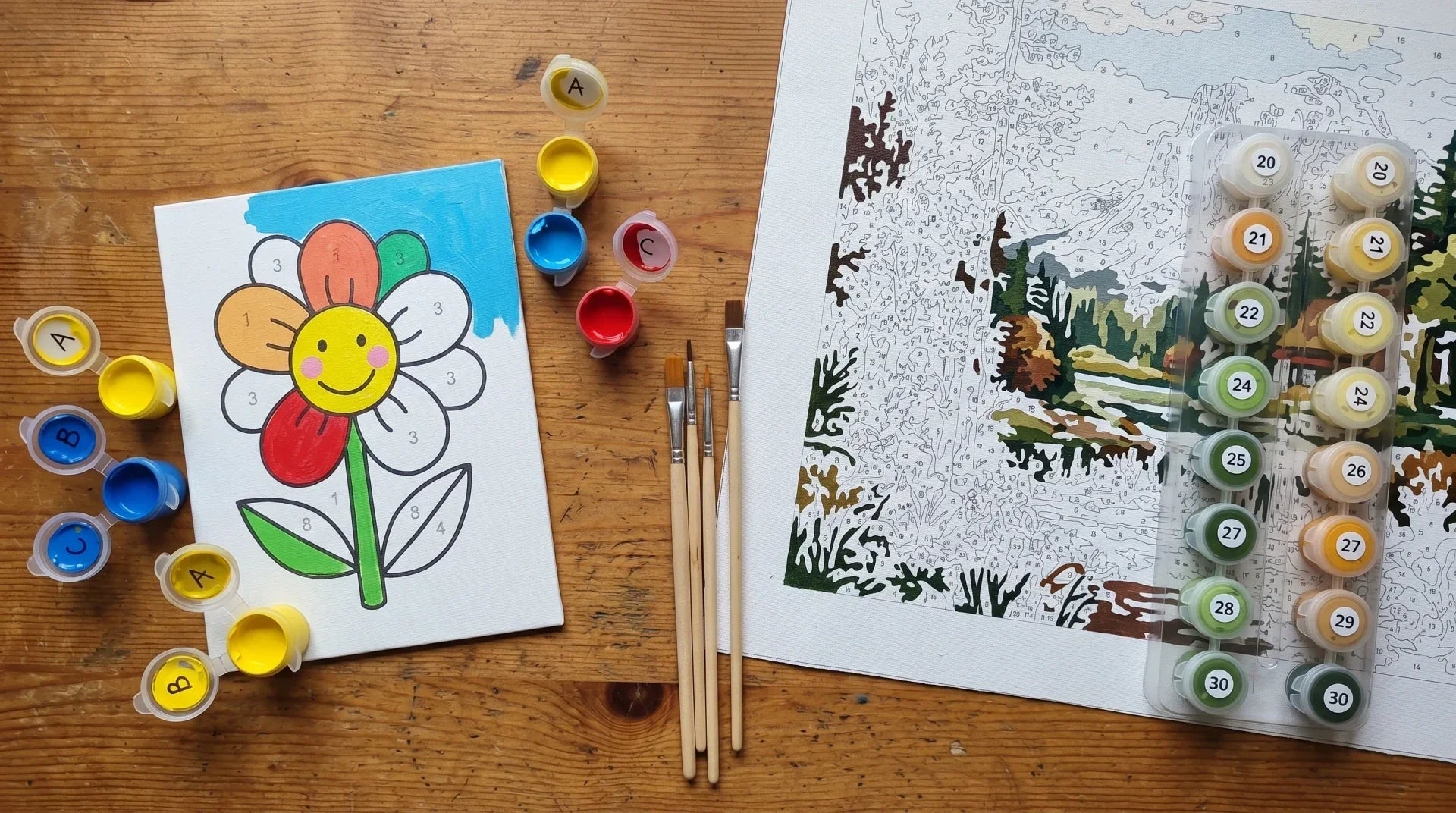
There are a couple of spec differences worth knowing if you are choosing between tiers. Color count goes from around twelve in a basic kid kit up to forty-eight in a serious adult kit, and the upward jump matters more for the attention span it requires than for the painting itself. Tracking forty-eight pots is its own thing. Canvas size goes from around eight-by-ten inches on a paper sheet for a kid kit, up to sixteen-by-twenty on a pre-stretched wooden frame for an adult kit, which is what we ship. The pre-stretched frame is the thing that makes the finished painting look like a finished painting rather than a craft project. And the paint itself: a serious adult kit uses real acrylic, which is its own medium with its own behaviour. The Smithsonian's Museum Conservation Institute notes that artists' acrylic was introduced in the 1950s and has been the standard for serious work since. Cheap kid paint sometimes calls itself acrylic and is really closer to tempera.
So who actually buys which kit?
This is the part I get asked most, usually phrased as "I have a six-year-old, what should I get them?" or "my mum is in her seventies, would she find this too hard?"
The very young end of the range is the easiest call. Under seven, standard paint-by-numbers does not work for most kids. The numbered system is a reading-and-attention-span problem before it is a painting problem, and a four-year-old wants finger paint, sponge prints, the kind of "first paint" kit that has three colors and big blocky shapes. We get asked about our kits for that age band and the honest answer is always to look elsewhere.
Seven to nine is where kid paint-by-numbers actually starts working. Eight to twelve colors, a small canvas, a cartoon-style subject completable in one or two sittings. Ravensburger's CreArt range is the one I see used most for this. If a kid this age abandons it halfway, that is normal. The fridge gets the half-painted canvas and life goes on. The point at this age is the experience, not the finished object.
Ten to twelve is the bridge, and the variable here is patience rather than age. A ten-year-old who has finished two kid kits and is asking why the colors are so limited can usually handle an entry-level adult kit if a parent sits with them through the first session. A restless ten-year-old will be defeated by the longer commitment. I would not buy a forty-eight-color adult kit at this age unless the kid is clearly asking for it.
Thirteen and up is where our entire catalog lives. Adult kits at twenty-four, thirty-six, or forty-eight colors, on a sixteen-by-twenty pre-stretched canvas, with subjects pitched at people who want a finished piece they can hang. Browse our main collection or the adult-focused range for the actual products. The band runs from teenagers (who have asked for it specifically) through the entire adult span, and works fine into the seventies and eighties with a couple of small adjustments: lower color count and high-contrast subjects rather than subtle-gradient portraits.
Colleen, who I quoted at the top, was on a forty-eight-color floral kit in her eighties. She was content to be slow. The pace was the point.
The two mistakes we see most often
Buying an adult kit for a kid who "likes art" is the first one. The phrase "likes art" covers everything from a five-year-old who scribbles with crayons (defeated by an adult paint-by-numbers within ten minutes) to a twelve-year-old who has worked through a few kid kits and is asking what comes next (ready for the entry-level adult version). Patience is the signal to watch for. Adult kits take eight to fifteen hours of focused painting spread over weeks, and most children under twelve do not have that attention span on a single project.
Buying a kid kit for an adult who has never painted is the second mistake, and it feels safer to the buyer but is actually worse. The kid kit is too simple to be satisfying, the paint is too thin, the canvas is too small. The adult opens the box, paints for twenty minutes, and concludes paint-by-numbers is not for them. An entry-level adult kit with twenty-four colors is the right starting point for any adult who has never painted, including ones who think they want something easy.
What does Paint Kit Studio actually do?
The honest answer, since the article is going to compete with our own product pages on the same search. We are an adult brand. Every kit in our catalog ships with twenty-four, thirty-six, or forty-eight pre-mixed acrylic colors, on a sixteen-by-twenty inch (forty by fifty centimetre) pre-stretched canvas. The subjects are pitched at people who want something hung on a wall. We do not make kits for children under ten, and if you are shopping for a four-year-old your kit is a finger-paint set or a Ravensburger CreArt at the lowest tier. We get asked enough that it is worth saying out loud rather than letting the order go through and the kit get returned.

What we do well is the adult-and-senior segment. Yourself in your thirties, parents in their sixties, grandparents in their eighties. The catalog is built around that buyer, with the larger-canvas low-color-count options being the ones I would point an older recipient toward.
And if the gift needs to feel personal, a custom kit built from a photo the recipient actually cares about (their dog, their grandchild, their wedding photo, their grandparents' first house) is the version that gets the best reaction by a wide margin. The numbered system is the same; what changes is that the image already means something.
One footnote on history, since it changes how you read the question
Paint-by-numbers was invented in the early 1950s by Dan Robbins at the Palmer Paint Company. The format was built specifically as a way for adults with no painting training to spend an evening doing something that looked like real painting, and by 1954 the company had sold somewhere around twelve million kits, almost entirely to adults. The kid version is the later derivative. The adult version is the original. Smithsonian Magazine has the full history if you want to read it. The reason it matters here is that if you are buying for an adult who has never painted, you are buying them the product the format was actually designed for, not a watered-down adult version of a children's craft. The order of operations in the comparison is sometimes inverted in people's heads.