Unique Creative Gifts for Art Lovers
By Simon I., co-founder, Paint Kit Studio. Published 2026-05-07.
Diane teaches high-school art in Cleveland. She has a brother named Tom who is a structural engineer, hates his job, and "wants to do something with his hands but isn't artsy." Diane emailed me last March asking what to give him. She'd already cycled through three Christmases of art-themed gifts: a Bob Ross paint set he never opened, a Caran d'Ache pencil tin (still in shrinkwrap), a beginner watercolour kit (used twice). She wanted something different.
The pattern Diane was caught in is the trap most gift-givers hit when shopping for someone with creative leanings. They buy art supplies. The recipient feels like they need to be good at something to use them. The gift sits in a drawer. The gift-giver feels worse than if they'd bought a sweater.
Tom got a custom paint by numbers kit of his late father's old workshop. He finished it over six weekends. It now hangs above his desk. Diane sent me a photo last month.
This is what I wish I could tell every gift-giver in Diane's spot. Pour a coffee.
Key takeaways
- Shopping for someone "creative" goes wrong when you buy supplies. The recipient feels obliged to be good at something they're not. Kit sits unopened.
- What works instead: a structured creative project. The numbered guide takes the artistic decisions off the recipient's plate. They just apply colour for ten to twenty hours and end up with a real piece of wall art.
- For working artists or art appreciators, a custom kit made from a meaningful photo (their pet, a place they love, a memory) hits hardest. Costs $35 to $65, ships in 7 to 10 days.
- Avoid generic art-themed gifts (mugs with Van Gogh prints, candles shaped like brushes). They read as thoughtless to people who actually create.
- Pick a 24-colour beginner kit unless you know the recipient paints. Even experienced artists often prefer "lazy painting" kits as a low-stakes evening activity.
Bottom line: skip the supplies, pick a finished-thing-they-make project, lean toward custom for high-meaning gifts.
Why is shopping for an art lover so hard?
Three reasons stack, and most gift-givers walk into all three.
One. The recipient already owns better supplies than you'd think to buy. Working artists have specific brush brands, specific paint tubes, specific paper stocks. Anything you guess at will be inferior to what's already on their shelf. Even amateur creators tend to have built up materials over years.
Two. Generic art-themed objects feel thoughtless. A mug with a Van Gogh print. A candle in the shape of a paintbrush. A scarf with a Klimt pattern on it. These read as "I know you like art, I bought the cheapest thing in the museum gift shop." Working creators are particularly sensitive to this because they spend their lives noticing aesthetic detail. The shortcut feels worse than a generic gift would.
Three. Buying art supplies puts an obligation on the recipient. A new sketchbook says "I expect you to fill this." A new watercolour set says "I expect you to make something with this." A blank canvas says it loudest. Recipients who already feel under-creative use the gift to silently confirm they're not creative enough. The gift sits.
The thing that breaks all three traps is the same thing. Give them a finished project they make themselves, with the artistic decisions already taken care of. The numbered guide is the answer.
What do creative people actually want in a gift?
After shipping a lot of these and reading a lot of follow-up mail, three patterns are reliable.
An experience, not just a thing. Creative people value the process of making more than they value the object that results. A decorative piece sits on a shelf. A paint by numbers kit gives them ten to twenty hours of hands-on creative time, and a finished painting on the wall as the bonus. The gift is the experience first.
Quality materials. People who make things care about materials. They can spot cheap brushes, thin canvas, and watery paint within thirty seconds. Our kits ship with professional-grade acrylic paint pots, a pre-stretched canvas on a real wooden frame, and three brush sizes. The pigment quality matters more than people guess. The Smithsonian Museum Conservation Institute is plain about why. "The lesser quality paints tend to have cheaper colorants which fade easily under ultraviolet light." (Caring for Acrylic Paintings, Smithsonian MCI, n.d., retrieved 7 May 2026.) Liquitex, one of the major acrylic paint manufacturers, frames the artist-grade case from the manufacturer side. "Artist-grade pigments deliver brilliant, lightfast colors." (FAQ, Liquitex, n.d., retrieved 7 May 2026.) That's why a kit with art-grade pigments matters to someone who appreciates art. The painting they finish will hold its colour over years rather than dulling within a season.
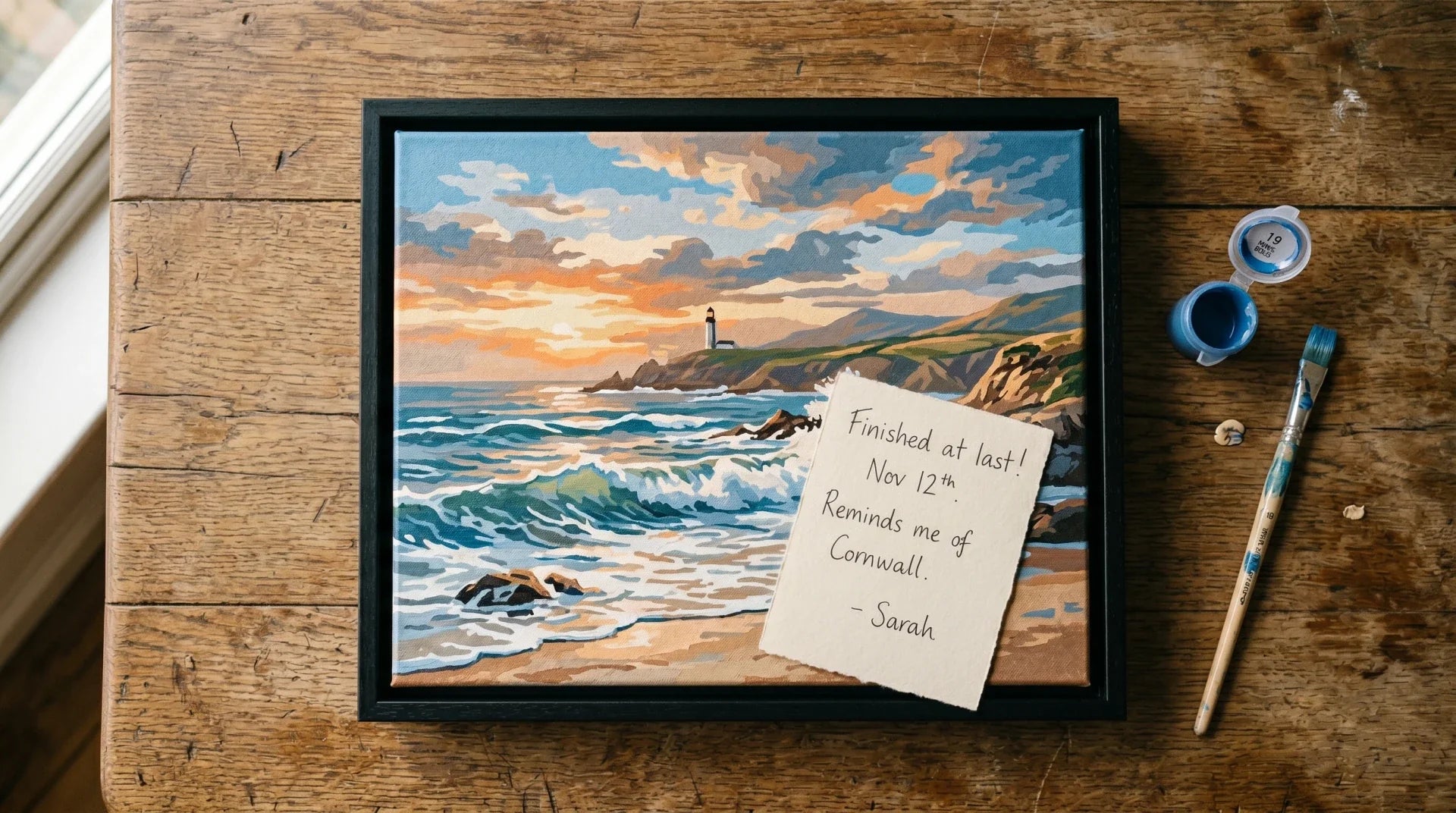
A finished thing they made. The wall art is the part that lingers. Most of our customers send us photos of their kits framed on their walls a year, two years, five years after they painted them. The painting is a daily reminder of evenings they spent doing something instead of looking at a phone.

Why does paint by numbers work even for someone who already paints?
This is the question I get most from gift-givers who know their recipient is an actual working artist. "Won't they think it's beneath them?" Mostly no. Here is why.
For working artists, original work is high-stakes. Every blank canvas is a decision tree of subject, composition, palette, gesture. That cognitive load is the job. When they want to paint as relaxation rather than work, they want a low-stakes alternative that doesn't ask them to make any of those decisions. A paint by numbers kit is exactly that. Subject decided. Composition decided. Palette mixed and labelled. They just apply colour for a few evenings.
A few of our repeat customers are actively-exhibiting painters who use kits as palate cleansers between original pieces. One illustrator I know orders a kit every December and paints it on Christmas afternoon while the rest of her family naps. She says it's the only painting of the year that doesn't end up on a deadline.
The format also has surprising historical respect. The 1950s paint-by-number boom was a gift-shop staple before our parents were born. Smithsonian Magazine puts the scale of it bluntly. "By 1954, the company had sold more than 12 million of the kits, according to a 2001 exhibition on the paint-by-number phenomenon by the Smithsonian National Museum of American History." (Dan Robbins, Who Launched the Paint-by-Number Craze in the 1950s, Has Died, Smithsonian Magazine, 2019, retrieved 7 May 2026.) Twelve million kits, before our parents were born, plus a Smithsonian exhibition about the format itself. It's not a craft-store novelty. It's a piece of American art-cultural history.
What's the right design for an art lover?
Three guidelines that have worked the most often.
Match a known aesthetic preference, not a known interest. Generic interests (their pet, the beach) are fine but the better signal is what's already on their walls. If they have a Hopper print in the dining room, a coastal cityscape kit will land. If they have a Rothko-style abstract on the bedroom wall, an abstract kit will land. If they have a botanical print in the bathroom, flowers will land. Look at their existing taste, not their stated interests.
Lean toward subjects with strong colour relationships. Working artists especially appreciate kits where the source painting itself has interesting colour interaction. Sunsets where warm and cool tones interact. Coastal scenes where the water reflects the sky. Portraits where skin tones shift across light and shadow. These are the kits where the painter notices the design choices being made for them, which is part of the pleasure.
For art appreciators who don't actively paint, lean toward subjects they already love rather than subjects they "should" love. If they have a thing for desert landscapes, the desert kit lands. If they love their golden retriever, a custom kit of the dog lands harder than any generic landscape ever will. The personal hit beats the aesthetic-prestige hit every time, in our gift mail.
The most-gifted categories for art-lover recipients in our data: Seascapes (consistent #1, the colour relationships do the work), Flowers (especially peony and wildflower compositions), Mountains and Lakes (for outdoorsy art lovers), and the custom photo kit (the heaviest hitter for emotional reaction).

Should I get a custom kit or a pre-designed kit?
For art lovers specifically, custom punches above its weight more than for any other recipient category.
The reason. People who appreciate art are also people who notice meaning in art. A pre-designed seascape is beautiful and they will paint it and hang it. A custom kit of the seascape they grew up looking at, traced from a photo they took in 1998, is something they will not stop talking about. Same medium, same hours of painting, completely different emotional load.
Pre-designed pre-printed kits ship in 2 to 3 days. Right call for casual art lovers, colleagues, distant relatives, anyone you don't have a meaningful photo of. Custom kits ship in 7 to 10 days after the photo is uploaded. The rolled version (canvas + paints, you stretch or frame yourself) runs $35 to $45; the pre-stretched canvas version (ready to paint and hang) runs $55 to $65. Right call for spouses, parents, lifelong friends, anyone whose meaningful-photo archive you have access to.
| Recipient profile | Best pick | Why |
|---|---|---|
| Working / exhibiting artist | Pre-designed 24-colour | Lazy painting, low stakes, no design decisions on their plate |
| Hobbyist painter / weekend creator | 36-colour intermediate | More challenge, still no decision overhead |
| Art appreciator (doesn't actively paint) | Custom photo kit | Personal subject + structured guide = strongest emotional hit |
| Art teacher / arts educator | Custom photo kit, or 48-colour advanced | Either personal-subject or technical-challenge angle works |
What's the right difficulty level for an art lover?
The conventional wisdom is "an artist will want a hard kit." It's wrong about half the time.
For working artists who paint as their job, lazy painting at the easiest difficulty is the better gift. They don't need more skill challenge in their off-hours. They need a quiet evening with no decisions. A 24-colour beginner kit is the right call.
For hobbyist painters who paint as relaxation, 36 colours is a sweet spot. More challenge than a beginner kit, but still no design decisions, and the result reads as more impressive on the wall.
For art appreciators who don't paint, 24 colours is right because of the no-experience-needed framing. They will be the most worried about "ruining" the kit, and the easier difficulty kills that worry fastest.
For art teachers or technical-process people who specifically want challenge, 48 colours and a larger canvas (50 x 70 cm or above) makes the kit feel substantive. Some teachers I know paint these as classroom demonstrations for what acrylic colour application looks like.
Which add-ons elevate the gift?
Three small additions consistently land for art-lover recipients.
A floating frame. A $20 to $30 stock matte black floating frame turns the finished kit into a serious wall piece. Art lovers in particular will notice the difference between a bare canvas and a framed one. Our framing guide covers the four options if your recipient wants to pick their own.
A small art-supply upgrade. A single high-quality detail brush, a tabletop easel, a clip-on desk lamp. Anything that signals "I know you'll use this carefully." Art lovers respond well to small material upgrades because they read as the gift-giver paying attention to how the kit will actually be used.
A handwritten card. Buy a small blank card (an art-lover-friendly one if you can; a museum gift shop card usually works), write something honest about why you picked this for them, and tuck it inside the gift-wrapping yourself. We don't print or include gift messages with the kit; the handwritten note from you is what makes the gift feel personal regardless of which kit you pick.
How do I avoid the "thoughtless art-themed gift" trap?
The mental check. Before you buy, ask: would I give this to a non-art-loving friend? If yes, it's fine. If no, you're hiding behind their interest in art instead of paying attention to who they actually are.
The Van Gogh mug fails this test. Almost any product with a famous painting reproduction on it fails this test. The "art lover starter pack" curated boxes fail this test (they're built for the recipient profile, not the recipient).
What passes. A custom kit of a place that means something to them. A pre-designed kit of a subject they've talked about loving. A subscription to an arts magazine they read. An admission to a museum near them. A specific book by an artist they've mentioned. Anything that says "I picked this because of who you are" rather than "I picked this because you said you like art."
What if my recipient doesn't paint but loves art?
Two paths work for art appreciators who don't actively create.
Path one: gift them the painting experience anyway. Many non-painters who receive a kit as a gift end up becoming dedicated painters. The threshold for "I am a person who paints" turns out to be lower than people assume, and a kit at the door is enough to clear it.
Path two: gift the experience plus the meaning. Custom kit of a place they love, a pet, a person, an architectural detail they have a picture of. The "I love art" recipient who specifically doesn't paint is often someone who feels they "can't" paint. The numbered guide kills that block. The personal subject kills any leftover doubt about why they should bother. They paint the kit. The kit becomes the most-displayed object in their home for a year.
Frequently asked questions
What if my recipient is already an experienced painter?
A 24-colour beginner kit as "lazy painting." Lower stakes than their original work, no design decisions, and the format gives them permission to paint without it being work. Several of our repeat customers are exhibiting painters who use kits this way.
How long will the kit take?
Most painters finish a 24-colour kit on a 16 x 20 inch canvas in 8 to 12 hours, spread across one to three weeks at 30 to 60 minutes per evening. 36-colour kits run 12 to 20 hours. 48-colour at larger canvas sizes can run 18 to 30 hours.
Can I include a gift message?
Not from us, but the workaround is easy. We don't currently print or include gift messages with the kit. Buy a small blank card, write your own message, and tuck it inside the box when the kit arrives or fold it into your gift-wrapping. Most painters tell us the handwritten note is what made the gift feel personal.
What's the most-gifted design for art lovers in your data?
Custom photo kits consistently. After custom, our most-gifted categories for art-lover recipients are seascapes, flowers (especially peonies and wildflowers), and mountain landscapes. Abstract designs are a smaller but reliable hit for art appreciators who lean modern.
What if they already have a paint by numbers kit?
Get them a different style. People who finish one PBN kit usually want another, often in a different subject. A first-time finisher who painted seascape will often gravitate to a portrait or a custom kit next. Match it to whatever they did NOT paint.
Ready to find your art lover's gift?
For most art-lover recipients, the strongest move is a custom kit. Turn a meaningful photo into a custom paint by numbers kit. Allow 10 to 14 days lead time, $35 to $65 typical.
For pre-designed picks, our most-gifted art-lover categories: Seascapes, Flowers, Mountains and Lakes, Portraits, and Cities and Villages. The full paint by numbers collection covers the rest.
For more gift-buying context, our main gift guide covers the by-occasion and by-recipient breakdown. For first-time painters, point your recipient at our Complete Beginner's Guide after they open the kit.
For a grown-up recipient, our adult-focused kits skip the kid themes and lean into subjects an adult will actually want on the wall.
Last updated: 2026-05-07.