Dogs Playing Poker: The True Story of America's Most Famous Kitsch Painting
By Simon I., co-founder, Paint Kit Studio. Published 2026-05-18.
Key takeaways
- Dogs Playing Poker is a series of paintings by Cassius Marcellus Coolidge, an American artist almost no one has heard of by name.
- The famous nine poker paintings were commissioned in 1903 by Brown & Bigelow, an advertising firm, to be reproduced as calendars and cigar promotions.
- The series is the textbook example of kitsch in American art. Loved by ordinary households, dismissed by museums, and increasingly studied as Americana a century later.
- Coolidge actually painted sixteen pieces, only nine of which show dogs at cards. The others show dogs at courtrooms, football games, New Year's parties, and ballrooms.
- One original sold for $658,000 at Sotheby's in 2015. The wholesale calendar prints from 1903 still turn up at flea markets for under twenty dollars.
Last June a software engineer named Tomás in Austin uploaded a photo of his golden retriever Beans to our custom kit form at 2 a.m. on a Thursday. The reference was Beans sleeping on a brown leather couch, head on a pillow, one paw stretched out. In the note field Tomás wrote: I want to hang this in our Friday night poker room. Five months later he sent us back a photo of the finished painting framed above a folding card table with four guys around it eating pretzels. The dog above. The dogs below. We all knew which painting he was riffing on.

That painting has been in American living rooms, basement bars, and dorm room walls for over a hundred years. Almost no one knows the painter's name. Fewer know there are sixteen of them. This is the story of Dogs Playing Poker.
So who actually painted Dogs Playing Poker?
Cassius Marcellus Coolidge. Born in 1844 in upstate New York, no formal art training, dead in 1934. The Mental Floss profile of him notes that "Cash" Coolidge "was a hustler with varied professional pursuits" and that "before creating calendar art, he worked as a sign painter, house painter, druggist, art teacher, cartoonist, and even started his own bank and newspaper" (Kristy Puchko, "15 Things You Should Know About Dogs Playing Poker," Mental Floss, updated 2023). He was 59 years old when he got the commission that made him famous.
This is a useful detail. The painter most reproduced in American kitsch was a multi-trade hustler from a small town who never set foot in a Paris atelier. The art-history profession largely ignored him for a century. As My Modern Met puts it, Coolidge "is largely unknown and was once dubbed 'The most famous American artist you've never heard of'" (Emma Taggart, "Dogs Playing Poker," My Modern Met, 28 September 2018). The paintings were never meant to hang in museums. They were meant to hang in barber shops next to the calendar.
How did dogs end up at a poker table?
Through advertising, like a lot of American visual culture. In 1903 the Minnesota-based firm Brown & Bigelow commissioned Coolidge to produce a series of paintings to be reproduced as calendars and cigar promotional materials. The Mental Floss profile notes that the 59-year-old artist "produced works like A Bold Bluff and Poker Sympathy, which were distributed as posters, calendars, prints, and promotional giveaways." The full output was sixteen paintings, of which nine show dogs sitting around poker tables. The others, per My Modern Met, included scenes of dogs in "all sorts of humanistic scenarios" including a courtroom, a football game, and a New Year's Eve party.
Coolidge had been painting anthropomorphic dogs for several years before the commission. The Brown & Bigelow deal scaled it up. Calendar art from that era was the cultural equivalent of streaming subscriptions today: every kitchen in America had at least one promotional calendar on the wall, swapped each January. A funny image of dogs cheating at five card draw was exactly the right cultural product for that channel.
Why is it called kitsch?
Kitsch is the term art critics use for mass-produced sentimental or humorous decorative art aimed at the popular middle class, valued more for its emotional or comedic punch than for any aesthetic ambition. Coolidge's dogs hit every checkbox. Funny premise. Anthropomorphic conceit. Recognisable poker tropes (cheating, bluffing, drinking, smoking). Reproduced in millions of copies. Hung in basements, dorm rooms, dentists' waiting rooms, and dive bars.
For most of the 20th century, museum curators did not take Coolidge seriously. The series was treated as the example of kitsch when teaching art history students what high art was supposedly not. Then, slowly, attitudes shifted. The same paintings that art-history professors had dismissed turned out to be the most-reproduced American artworks of the early 20th century, more universally recognisable than most of what hung in the Met. By the 2010s, museum-adjacent journalism was writing about Coolidge with something close to respect. The dogs had outlasted the disdain.
You can read this as a vindication of popular taste or as a comment on how slow art-historical hierarchies are to update. Both readings work.

Why are there sixteen paintings, not one?
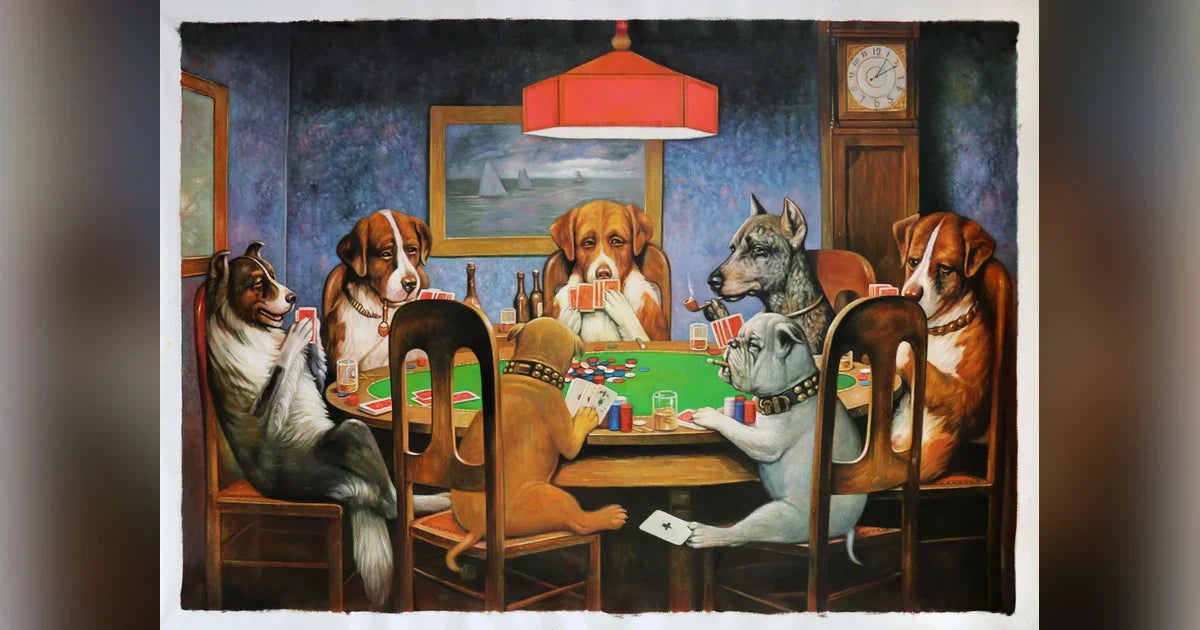
The single most popular image, A Friend in Need, shows a poker game in progress with one bulldog slipping an ace under the table to his neighbour. That painting is the one that ended up on most reproductions and the one most people picture when they hear the title. But the original Brown & Bigelow commission was an entire series.

| Year | Painting | What happens in it |
|---|---|---|
| 1894 | Poker Game | The very first dogs-at-cards painting, predates the Brown & Bigelow commission |
| 1903 | A Friend in Need | One dog cheating, hiding a card under the table. The most famous of the series. |
| 1903 | A Bold Bluff | A St. Bernard runs a bluff with a weak hand |
| 1903 | Poker Sympathy | A dog consoles another who has just lost a hand |
| 1903 | Pinched with Four Aces | Police interrupt a dog poker game |
| 1906 | Waterloo | Sequel to A Bold Bluff. The bluff has been called. |


The other ten paintings in the Coolidge anthropomorphic-dog catalogue cover football, ballroom dancing, baseball, and a courtroom. They are less famous because the poker premise is the one that travelled. A dog in a top hat at a ballroom is fine. A bulldog cheating at five card draw is unforgettable.
Has anyone ever sold one for serious money?
Yes, but the path from $50 calendar art to six-figure auction price took a hundred years.
In the late 1990s a Coolidge original sold at Sotheby's for around $74,000. In 2005 two of the originals, A Bold Bluff and Waterloo, went together at Doyle New York for $590,400, four times what the auction house had predicted. The high-water mark so far was a 2015 Sotheby's New York sale where the 1894 Poker Game, the original dogs-at-cards painting that predated the Brown & Bigelow commission, sold for $658,000.
For context, these are not Picasso-tier prices. A second-tier Monet sketch outpaces them comfortably. But for a series that nobody in the art establishment took seriously for a century, those numbers represent a permanent re-evaluation. Coolidge is now studied. The originals trade. The reproductions, which were always the point, still hang in basements.
Where does paint by numbers come in?
Closer to this story than to most art history we cover here.
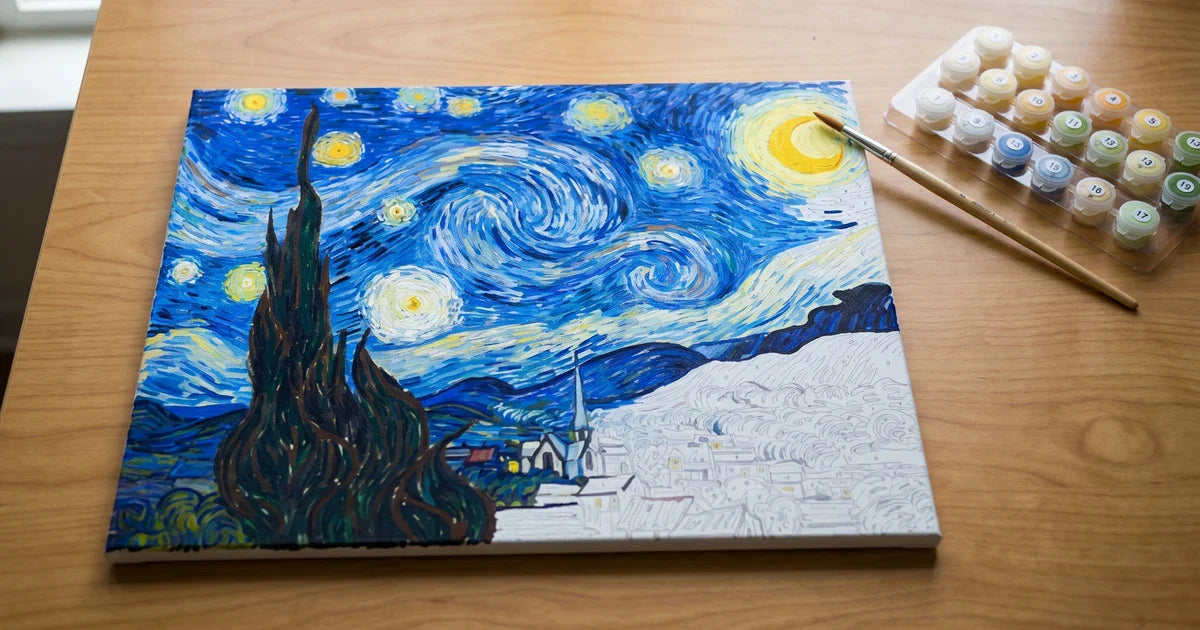
Both Coolidge's calendar paintings and the original Craft Master paint-by-numbers kits launched fifty years apart were designed to put a real-looking painted image on the wall of an ordinary American home that could not afford an original painting. The pricing logic was the same: cheap reproduction at scale. The visual style was the same: recognisable subject, humour or warmth, no irony. The cultural reception was the same too. Both were dismissed for decades as not-real-art and then, slowly, accepted as something a country had genuinely made.
This is why our dogs paint-by-numbers collection goes deep on dog portraits: it is the strongest single subject in our catalogue, just like dogs were the strongest single subject in Coolidge's. The customers who order them are descendants of the audience Brown & Bigelow was selling to in 1903.
If you want to put your own dog at the centre of one (or just at the centre of a sleeping-on-the-couch composition like Beans), our custom kit turns a photo into a numbered canvas you can paint over a couple of evenings. About half the custom orders we ship are dog portraits. The other half cover cats, family members, landscapes, and the occasional poker buddy in a tuxedo.
Frequently asked questions
Where can I see the original Dogs Playing Poker paintings?
You probably cannot, easily. The 1894 Poker Game sold privately at Sotheby's in 2015 and is in a private collection. A Bold Bluff and Waterloo went into private hands in 2005. The other originals are scattered across private collections and Brown & Bigelow's corporate archive. No major American museum currently holds one on permanent display, which is part of the painting's ongoing story.
Is Dogs Playing Poker considered "real art"?
It is now, in the sense that it is studied, auctioned, and re-evaluated. It was not for most of the 20th century. The work sits in the kitsch category alongside Norman Rockwell prints, novelty figurines, and the velvet Elvis. All of those have similarly been re-examined as serious Americana in the past twenty years. Whether kitsch should be called art is the kind of museum-label argument that does not actually affect whether people hang these paintings on their walls.
What size are the original Dogs Playing Poker paintings?
Living-room scale, not gallery scale. The original oils were sized to be reproduced as posters and calendars, not to dominate a museum wall. The reproductions ranged from poster-sized down to small calendar tear-offs. If you have ever seen one in person you may be surprised how modest the originals are compared to the cultural footprint they cast.
What about the cigar-smoking detail?
The series was originally produced for commercial promotional use, including cigar advertising. The visible smoking fits that commercial context. The cigars stayed in popular memory because they make the whole scene feel more masculine and clubby, which kept the cultural appeal alive for a century.
Can I get a Dogs Playing Poker paint by numbers kit?
The 1903 Coolidge paintings are in the public domain in the US, so direct reproductions exist in many forms. We have chosen not to make a direct PBN clone of A Friend in Need; instead our dogs kits include several poker-table-adjacent compositions (dogs at tables, dogs in suits, group dog portraits), and the custom kit lets you upload your own photo of your own dog. Tomás from the opening anecdote went the custom route. So have several hundred customers a month.
For more on the broader history this fits into, the famous paintings pillar covers Mona Lisa through Andy Warhol territory.
It is exactly the kind of conversation-piece subject our paint by numbers for adults collection is built around.
It is one of countless subjects across our full paint by numbers kits range.
Last updated 2026-05-18. Comments are closed; questions welcome at support@paintkitstudio.com.