The Best Custom Paint by Numbers Kit: What Actually Makes One Good
By Simon I., co-founder, Paint Kit Studio. Published June 9, 2026. Last updated June 9, 2026.
Key takeaways
- The custom kit somebody loves almost never comes down to colour count. It comes down to the photo they sent and whether the shop was honest about what it would do with it.
- A 48-colour kit built from a dark, blurry phone snap loses to a 24-colour kit built from a bright, sharp one. I have watched it happen more times than I can count.
- Ask one question before you buy anywhere: do I see a proof before you print? A clear yes or a clear no both beat a vague "our design team reviews everything."
- A real custom kit runs roughly $34.95 to $64.95, the spread coming from colour count and framing. A lot cheaper usually hides a worse print or a checkout that climbs.
- Pick the colour tier for the photo, not your ambition. A simple landscape is happy at 24. A beloved face is where 36 or 48 earns its keep.
Bottom line: the "best" custom kit is whichever one gets fed a good photo, by a shop that tells you the truth about what happens to it, at a price that matches a genuine one-off print. Everything on the spec sheet is downstream of that.
Search "best custom paint by numbers kit" and you get roundup after roundup ranking kits by colour count, canvas size and price, like a custom kit were a toaster. I understand the instinct. Those are the numbers that drop neatly into a table. They are also mostly the wrong ones. We have shipped a lot of custom kits, and the spec sheet has turned out to have very little to do with who writes back delighted and who writes back a little flat.
Take Marcus. He found us last spring and ordered the top tier, framed, 48 colours, the most expensive thing on the page. Uploaded a photo of his family from a dinner out, taken from across the table in dim restaurant light, and waited. When the canvas arrived he was baffled that it looked muddy. He had bought the best kit we make. The trouble was the photo, and the trouble underneath the trouble was every roundup that had quietly promised him more colours would mean a better result. They will not. They cannot. So instead of ranking kits by the toaster numbers, let me walk you through what actually decided whether Marcus, and a few thousand people like him, ended up happy.
What "best" even means for a custom paint by numbers kit
Most people arrive expecting to judge a custom kit the way they judge a catalogue one. That is the first wrong turn. When you buy one of our shelf designs, an artist already drew the picture, painted a test copy, and shoved the regions around until they filled cleanly. Somebody finished and checked it long before you saw it.
A custom kit from a photo is the mirror image of that. It gets built the morning your order lands, out of a file nobody but you has ever seen, and no test copy exists because the thing did not exist until you hit upload. There is no finished design to grade. What you are actually grading, whether you realise it or not, is the machine that turns your file into a canvas, and how honest the shop is about that machine. Marcus graded brush quality and frame finish. The brushes were lovely. It made no difference at all to the canvas.
Why the photo decides almost everything
The software that turns a photo into numbered regions behaves like a photocopier, not an artist. Hand it a crisp, well-lit original and it copies that beauty faithfully. Hand it something dim and soft and cluttered, and it copies the dimness and the softness and the clutter just as faithfully, region by region, onto the canvas. There is no judgment in it. Marcus's restaurant photo got copied exactly, which is the whole problem.

A handful of shops genuinely hand-clean your file before printing. Most of us, honestly, run it through software and ship what comes out, and that is fine, as long as we say so plainly. The version that burned Marcus is the shop that conjures up an image of a studio full of artists lovingly retouching your photo, when behind the curtain it is the same automated pass everyone runs. He sent a mediocre photo trusting it would be rescued, and nobody ever rescued it.
Which means the best thing you can do is grade your own photo before you spend a penny anywhere. Hold it up and look hard. Bright, sharp, one clear subject, plain background, the subject filling the frame. Clear that and almost any competent shop sends back a canvas you will love. Miss it and no kit, no tier, no spec sheet rescues you. We wrote a whole plain-English guide to custom kits just on choosing the photo, because it carries that much of the result.
The one question to ask every shop
Before you buy custom anywhere, ask this: do I get to see a preview before you print? The answer matters far less than how cleanly they give it.
Some shops really do send a digital proof, then an email round, a tweak, then printing. That is genuine work, and you can see it in the price and the wait, often one to three weeks before anything ships. If you are fussy and you have the time, that can be money well spent.
We went the other way, and I would rather tell you straight than dress it up. We send no proof. The canvas prints from the file you uploaded and ships, and that is the whole story. We chose that because the proof round kept killing the gift, with the painting landing the week after the birthday, and because most "design review" replies from shops that offer it come back saying "looks great, ready to print" regardless. So in our version, you are the proof step, by picking the photo well. The shop to be wary of is neither of those. It is the one that advertises loving human review, charges you for it, then runs the same software pass everyone else does. A clean no beats a foggy yes, every time.
What turns up in the box, and what should
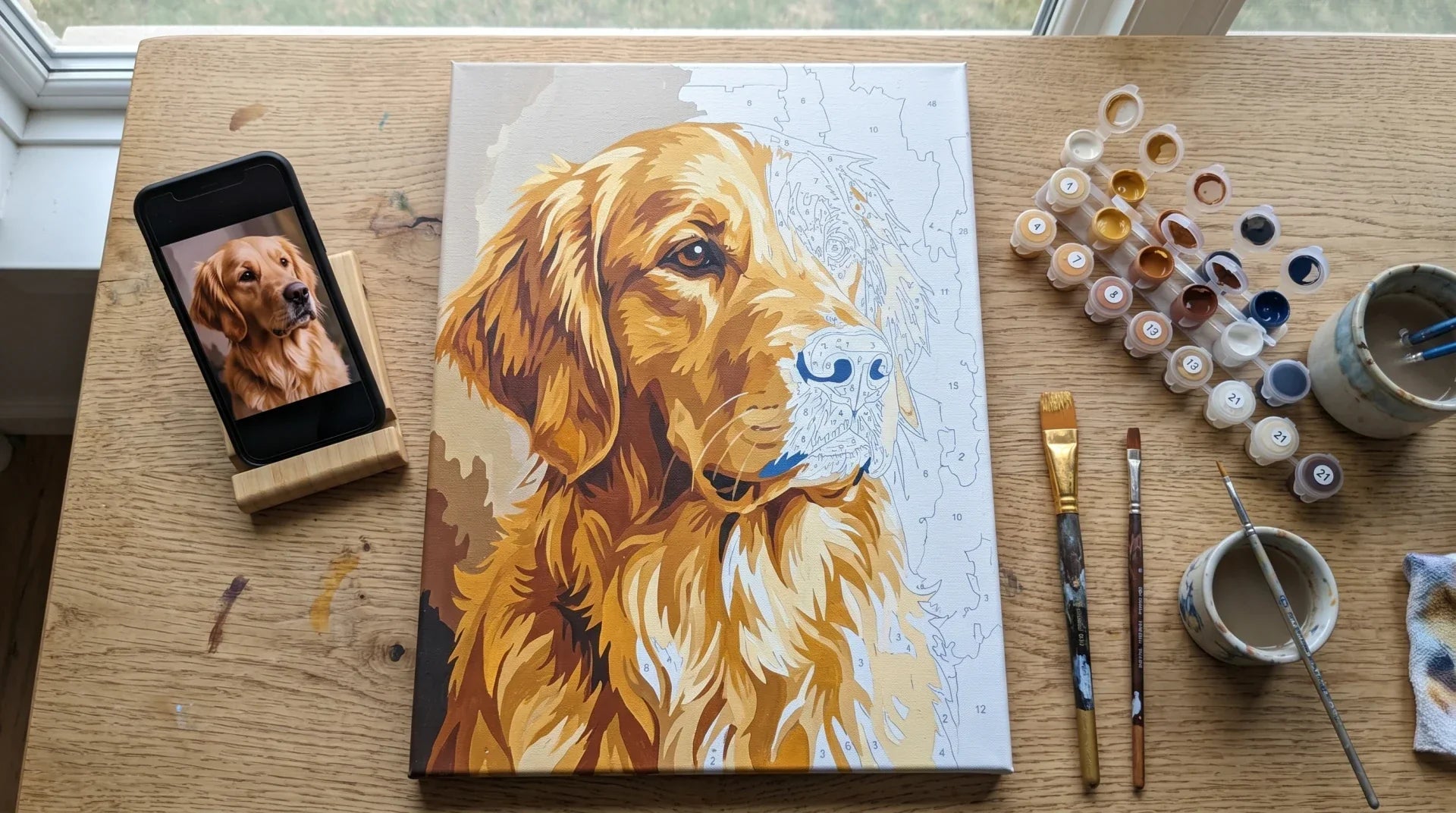
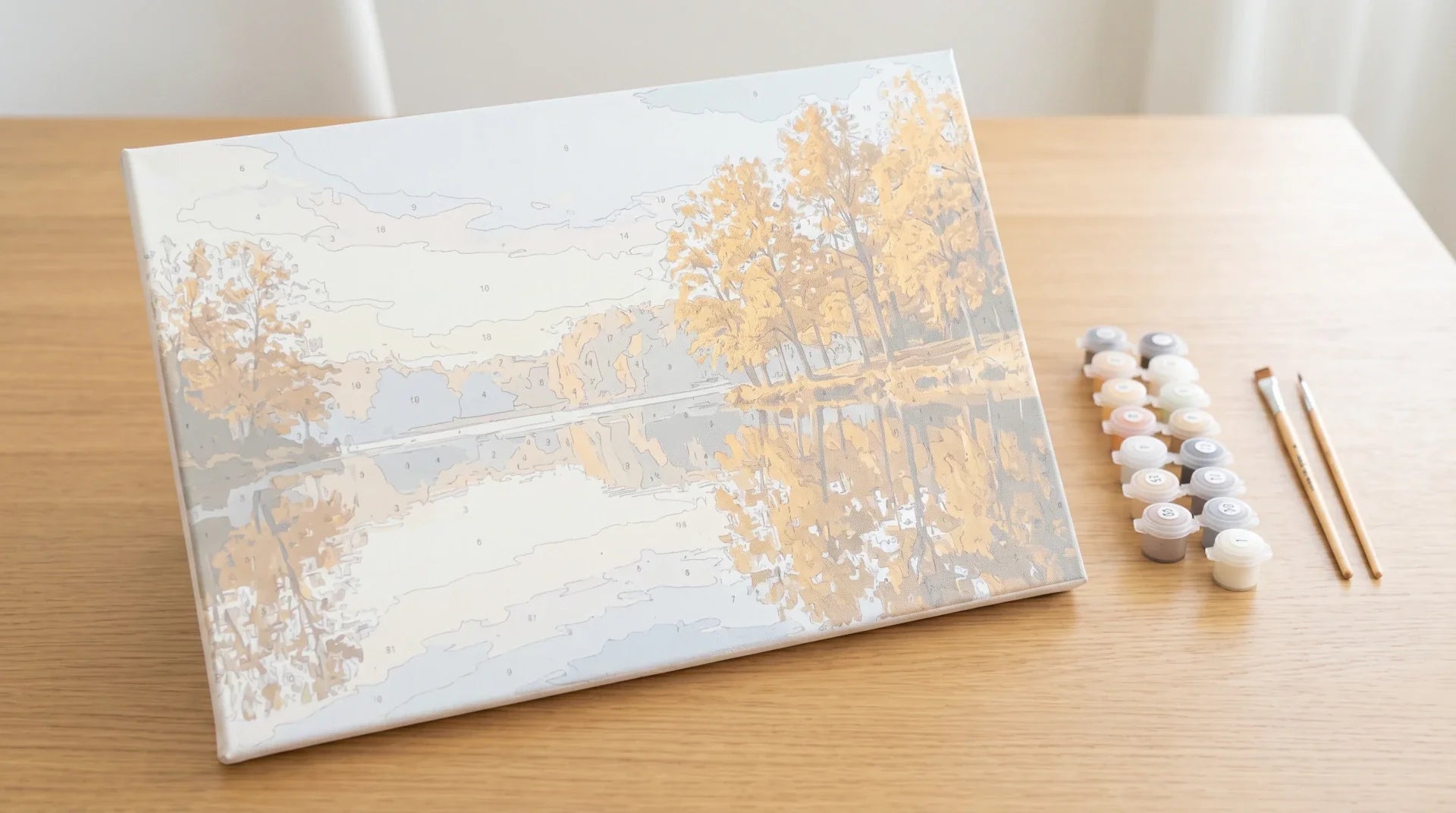
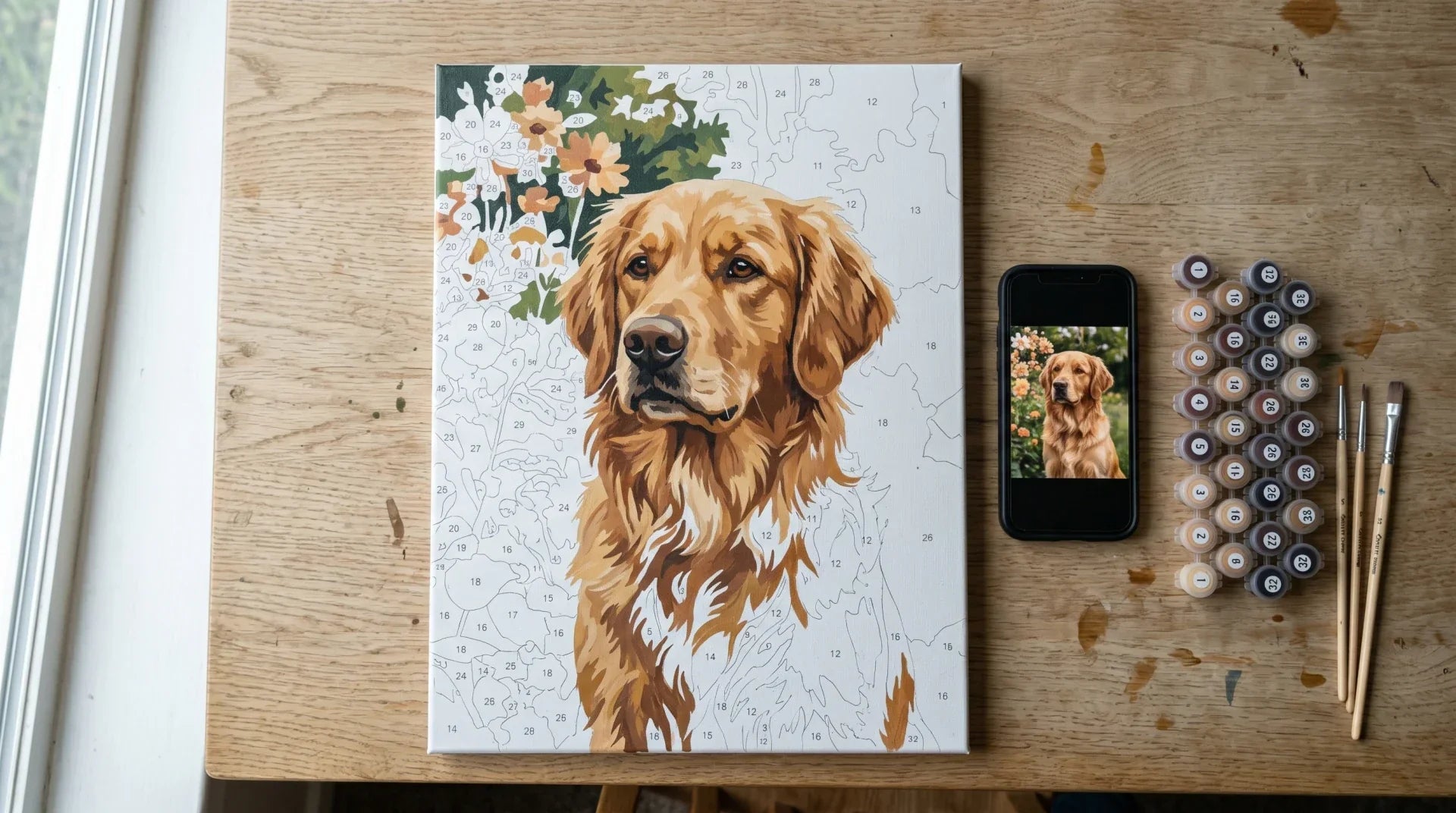
Once the photo and the honesty are settled, the kit itself is much of a muchness wherever you shop. When Marcus reordered, the box that turned up on his doorstep held roughly what yours should. A colour-printed canvas, the image sitting faintly under the numbered outlines instead of a bare white canvas with lines, because that soft colour base genuinely helps you judge your tones. Numbered acrylic pots, the lids a bit fiddly. Three brushes, one fine round, one medium, one flat for the backgrounds. A reference chart he said he barely used and a swatch card he used constantly.
The acrylic part is worth a second. It is water-based, so a finished patch is touch-dry within the hour and your brushes rinse clean under the tap, and acrylic is valued for its durable, flexible paint film, which is rather the point of something meant to outlast the occasion (Tate keeps a tidy plain-English page on the medium). The one spec people forget to check is canvas size. Ours is a single size, 40cm x 50cm, large enough for a face to read and small enough to actually finish. If a shop is selling you a postcard at a custom price, that is worth noticing.
| Worth seeing | Worth a second look |
|---|---|
| A plain, direct answer about the proof step | Vague "expert design review" with no detail |
| A colour-printed canvas base under the outlines | A bare white canvas with lines only |
| Honest photo guidance offered before you buy | "Any photo works!" with no caveats anywhere |
| One canvas priced around $34.95 to $64.95 | Oddly cheap, or a price that balloons at checkout |
What a custom kit should cost, and why
A custom kit costs more to make than a catalogue one for a boring, honest reason: it gets printed to order rather than pulled off a shelf. Ours runs from $34.95 for the no-frame 24-colour up to $64.95 for the framed 48-colour. The steps in between are colour count, which adds roughly five hours of painting each time you go up, and a twenty-dollar jump for framing. That range is about normal for the real thing.
When I see a custom kit going for a lot less, I get a little suspicious on the buyer's behalf, because the saving usually hides somewhere. A cheaper print. A canvas smaller than the photos imply. Or a tempting headline price that quietly grows the moment you add framing, more colours, or anything labelled premium at the checkout. At the other end, a hefty premium is usually paying for that proof-and-review service, which is real labour, so the only question is whether you want it. For a gift, by the way, framed wins nearly every time, because it arrives ready to hang with nothing to sort out between the wrapping paper and the wall.
How many colours you actually need
The regret I see most often is somebody paying for more colours than their photo can use, which is what Marcus did the first time. Colour count is not a quality dial you crank to the top. It is a detail budget, and detail only buys you something where the photo has detail to spend.
A simple, high-contrast subject paints up beautifully at 24 and finishes faster, ten to fifteen hours across a couple of weeks of evenings. One dog against a plain wall, a landscape, a building, all happy there. Faces and fine fur are where the extra colours start to matter, because the tiny shadow shifts from one number to the next are exactly what make a portrait read as that specific cat instead of a generic one. Simple scene, 24 is plenty. A face you badly want to land, step up to 36 or 48. It is calming to paint at any tier, and there is real research showing a short art-making session can lower cortisol levels, even for people without much art experience (Kaimal et al., 2016), so do not let the colour-count decision curdle into its own little worry.
If you have never painted one of these before, I would quietly suggest doing a standard paint by numbers kit first, before you hand a photo that matters over to canvas. You learn the rhythm on a design with nothing riding on it, and the custom one comes out better for it. Our beginner's guide covers what that first one feels like.

So which one is best?
The honest answer is the one no roundup wants to give, because it does not rank cleanly. The best custom kit is whichever one is fed a good photo, made by a shop that tells you the truth about what it does to that photo, at a price that matches a genuine one-off print. That is the case for our own custom paint by numbers kit, and it is a fair bar to hold us to. Send a good photo, expect no proof step, pay a real-print price, and get something worth hanging. Marcus, since you have followed him this far, came back a few months later with a bright, close-up shot of just his dog on the 24-colour tier. It hangs in his hallway now. He emailed a photo of it. Best thing in my inbox that week.
Last updated June 9, 2026 by Simon I., Paint Kit Studio.